APU clinical hours by program and course
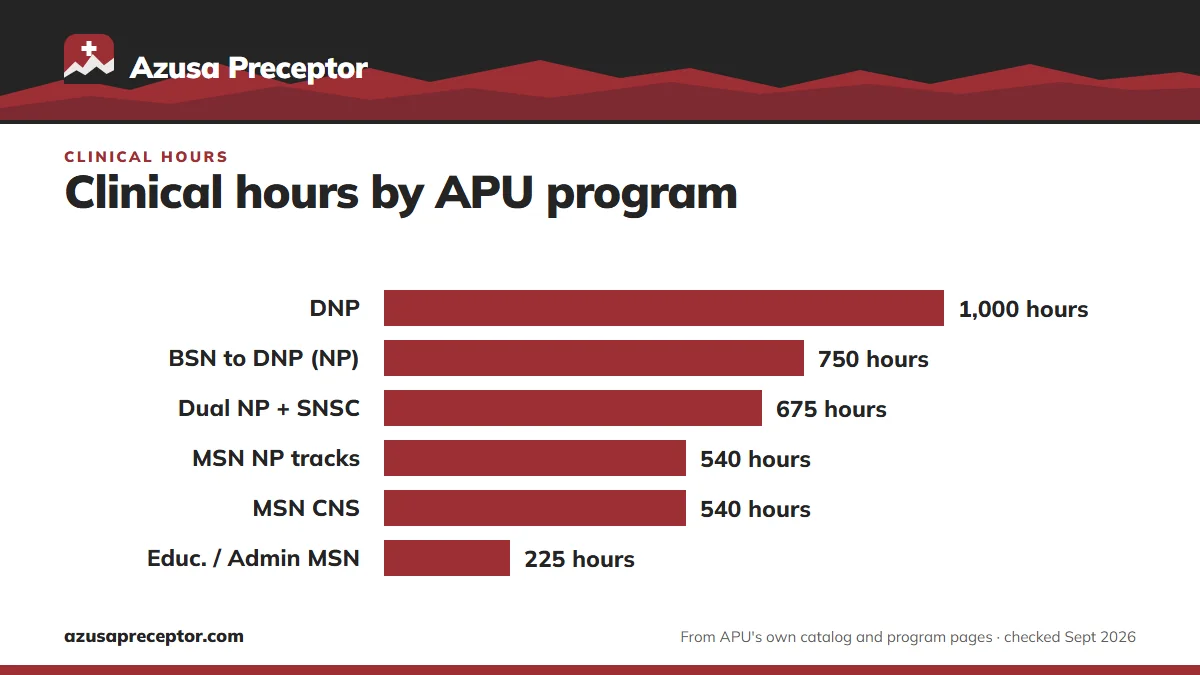
At Azusa Pacific University (APU), the MSN nurse practitioner and CNS tracks each come to 540 clinical hours, the BSN to DNP asks for 750 NP direct-care hours inside a 1,000-hour doctorate, and the online education and leadership MSNs need 225. Pick your track in the planner below, then use the tables for each course and for the spots where APU's sources disagree.
Plan your hours with a preceptor
Tell us your track, course and the hours you still need.
Pick your APU program
Your clinical courses and hours, who can precept you, where, and when to start looking. From APU's own catalog, handbooks and program pages.
- Who precepts
- An MD, DO, NP, or a PA with an on-site physician, in family practice; a pediatric provider for your 135 pediatric hours
- Where
- Family practice and primary care close to home in Southern California; pediatric clinics or family practices that see at least six pediatric patients a day
- Start looking
- Clinicals follow advanced pathophysiology, pharmacology and health assessment at B- or better; tell APU about a new preceptor 6 to 8 weeks before the term
- Who precepts
- An MD, DO, NP, or a PA with an on-site physician, in adult and older-adult primary care
- Where
- Internal medicine, family practice and geriatric settings close to home in Southern California
- Start looking
- Take 2 to 6 clinical units of GNRS 600 a term with faculty approval, 90 to 270 hours each term
- Who precepts
- A pediatric provider in primary care; GNRS 532 splits between a pediatric specialty and primary pediatric practice
- Where
- Pediatric clinics and pediatric specialty practices in your part of Southern California
- Start looking
- GNRS 542 carries the summative OSCE for PNP students
- Who precepts
- A psychiatrist or a PMHNP for each population course
- Where
- Outpatient psychiatry, community mental health and other psychiatric settings close to home
- Start looking
- One population course at a time; each has its own Graduate Preceptor Request form on the PMHNP form
- Who precepts
- A clinical nurse specialist in your population focus (adult-gerontology or pediatric)
- Where
- Hospital and health-system settings; pediatric students take GNRS 530 and GNRS 531 in place of GNRS 520 and GNRS 521
- Start looking
- APU's request form lists 180 hours for each CNS clinical course
- Who precepts
- NP-track preceptors for GNRS 600 (FNP or AGPCNP), then residency mentors for the DNP project
- Where
- Primary care close to home for the 750 direct-care hours; your project organization for the residency
- Start looking
- APRN-track students stay in GNRS 600 continuously at 90 to 270 hours a term; 8 months of RN experience before year two
- Who precepts
- A residency site and mentor that support your DNP project
- Where
- An organization where your scholarly project can run; coursework is online
- Start looking
- Up to 500 hours may transfer in from your master's program; GNRS 732 repeats until the hours are met
- Who precepts
- A nurse educator preceptor for the GNRS 663 capstone
- Where
- An academic or staff-development setting in the state where you hold your license
- Start looking
- APU's Nursing Education site form makes finding the preceptor and setting your responsibility
- Who precepts
- A health care leader who signs a learning contract with you
- Where
- Your employer or up to three other organizations named on Practicum Survey A
- Start looking
- Survey A is due April 15 for fall and September 15 for spring on APU's published calendar
On this page
NP and CNS tracksDNP, MSN and BSN hoursCourse by courseThe 45-hour ruleConflicting figuresHours that countWhy students choose usQuestionsHours for APU's NP, CNS and school nurse tracks
APU's NP and CNS specialties each land on 540 clinical hours, but APU prints that total only for the FNP and AGPCNP. For the other tracks it comes from course units at 45 hours per clinical unit, so the table marks it 'works out to'. Post-master's certificates use the matching MSN's clinical courses.
| Track | Clinical courses | Clinical hours | Figure |
|---|---|---|---|
| MSN FNP | GNRS 600, 12 units | 540, of which 135 are pediatric | Printed |
| MSN AGPCNP | GNRS 600, 12 units | 540 | Printed |
| MSN PNP-PC | GNRS 590A, GNRS 532, GNRS 590B, GNRS 542 | 540, or 630 with the optional GNRS 543 | Works out to |
| MSN PMHNP | GNRS 535 to GNRS 538 | 540 | Works out to |
| MSN CNS, adult-gerontology or pediatric | GNRS 520 or GNRS 530, GNRS 521 or GNRS 531, GNRS 543 | 540 | Works out to |
| MSN FNP with School Nurse Services Credential | GNRS 600, GNRS 550A | 675 | 540 printed plus 135 |
| MSN PNP-PC with School Nurse Services Credential | PNP-PC courses plus GNRS 550A | 675 | Works out to |
| MSN with SNSC, or the SNSC alone | GNRS 550A, GNRS 590C | 270 | Works out to |
| Post-master's NP or CNS certificate | The matching MSN's clinical courses | 540 (PNP-PC 630 with GNRS 543) | As the MSN |
| Oncology NP Fellowship | GNRS 630A, GNRS 630B, GNRS 630C | 540 | Printed |
School nurse tracks add a California-approved audiometry course, listed as GNRS 559 Audiometry for School Nurses, with eight on-site practicum hours outside the totals above.
Doctoral, education, leadership and bachelor's hours
Away from the NP and CNS tracks, totals depend on the kind of practicum. The DNP counts residency hours instead of units, each online MSN has two practicum courses, and bachelor's and ELM prelicensure clinicals are assigned by the School of Nursing.
| Program | Courses | Hours | Figure |
|---|---|---|---|
| BSN to DNP, APRN track | GNRS 600 (17 units), then GNRS 732 | 750 NP direct-care hours within 1,000 | 750 printed; 17 units works out to 765 |
| BSN to DNP, Health Systems Leadership | GNRS 732 | 1,000 | Printed |
| DNP, post-master's | GNRS 732, repeated until complete | 1,000, up to 500 transferred in | Printed |
| MSN Nursing Education | GNRS 518 (90), GNRS 663 (135) | 225 | 135 printed; 90 works out to |
| MSN Healthcare Administration and Leadership | GNRS 562P (90), GNRS 567 (135) | 225 | Works out to |
| ELM-MSN, prelicensure phase | GNRS 554 through the GNRS 573 residency | About 945 to 990 | Works out to; school-assigned |
| RN to BSN | RNRS 482P | 90 | Works out to |
| Traditional BSN | UNRS 107P through UNRS 414P | 945 to 1,035, plus a 45-hour lab | Works out to; school-assigned |
After the NCLEX, ELM students enter the matching MSN specialty, so their advanced practice hours follow the first table. The ELM-MSN page explains the switch from assigned clinicals to finding your own site.
Hours course by course
Preceptors ask about one course at a time, and multi-course tracks split their hours unevenly. Figures marked 'request form' come from APU's 2026 Graduate Preceptor Request forms.
| Course | Track | Hours | Source |
|---|---|---|---|
GNRS 600 Nurse Practitioner Clinical Experience | FNP, AGPCNP, BSN to DNP | 90 to 270 a term at 2 to 6 units | Catalog |
GNRS 590A Primary Health Care of the Young Family | PNP-PC | 135 | Request form |
GNRS 532 Advanced Nursing Practice in Pediatrics | PNP-PC | 135: at least 60 in a pediatric specialty, 75 in primary pediatric practice | Request form |
GNRS 590B Clinical Practicum in Pediatrics | PNP-PC | 180 | Works out to |
GNRS 542 Advanced Concepts and Competencies in Pediatric Primary Health Care | PNP-PC | 90 | Request form |
GNRS 535, GNRS 536, GNRS 537, GNRS 538 | PMHNP | 135 each | PMHNP request form |
GNRS 520/GNRS 530, GNRS 521/GNRS 531, GNRS 543 | CNS | 180 each | Request form |
GNRS 550A and GNRS 590C | School nurse tracks | 135 each | Works out to |
Each course group has a page on preceptors and settings: PNP-PC courses, PMHNP courses, CNS courses, school nurse credential courses, the nurse educator practicum, the HAL practicum and DNP residency hours.
The 45-hour rule behind these numbers
APU prints clock hours for only a handful of courses, and each printed pair divides evenly into 45 hours per clinical unit: twelve units of GNRS 600 are 540 hours, and the three units of GNRS 663 are 135. Every other figure here is clinical units multiplied by 45, hence the label 'works out to'.
Count only the clinical side of a split such as 6 (3/3), which holds 135 hours, not 270. Doctoral hours are the exception to the math, since GNRS 732 carries no units and simply repeats until the residency total is met. Our page on 45 hours per clinical unit turns a unit load into weekly hours.
Where APU's own figures disagree
APU's catalog, program pages, 2026 request forms and older guidelines do not always agree. Each conflict appears below as APU publishes it; your syllabus, clinical faculty and APU's Graduate Placement Team settle the figure for your catalog year.
- 540, 750 or 765 in
GNRS 600. The course description prints a range of 540-765. MSN and certificate students need 540 over 12 units; BSN-to-DNP students need 750 direct-care hours, while their 17-unit cap works out to 765. FNP students on either path owe 135 pediatric hours (FNP pediatric hours), and DNP-path AGPCNP students owe 135 in geriatrics. GNRS 589Adolescent Health Care. APU's Azusa and Inland Empire request form puts it at 90 hours, yet the 2026-27 catalog shows the course as 2 (2/0), a classroom course with no clinical units.- Older course numbers. The same form still lists
GNRS 581(135 hours),GNRS 591(90), andGNRS 592BandGNRS 593(90 each). The catalog keeps them, andGNRS 592Bstill says clinical hours are completed there, though current FNP and AGPCNP hours are logged underGNRS 600. - Leadership practicum hours. APU's 2025-26 healthcare administration guidelines give
GNRS 54390 practicum hours and pair the three practicum units ofGNRS 567with 90 hours, where the 45-hour rule gives 135. Those guidelines cite the 2020-21 catalog. - The doctoral overlap. APU's catalog lets earlier graduate clinical hours count toward
GNRS 732, yet it never explains how a BSN-to-DNP student's NP hours and residency hours combine to reach 1,000.
Which logged hours count toward your total
The totals above count only hours that meet APU's rules, and a shift at the wrong site or in the wrong week can come off your record. Three rules do most of the work:
- Hours begin after the site is cleared in writing and are logged weekly; entries from an unapproved site are removed, as our Medatrax page explains.
- Pacing stays steady, and any hours from a stretch when faculty paused the rotation are struck; see clinical rotation rules.
- A failed course keeps none of its hours; grades and probation covers repeats.
Short on hours near the end of a term? Behind on clinical hours walks through the options.
Why APU students choose us to plan their hours
The reason APU students pick us: we begin with the hours your track owes and work backward to a preceptor who can carry them. Tell us your course and what is left, and we search close to where you live in Southern California for clinic days that fit: 135 hours with the right population for a PMHNP course, 180 in the right setting for a CNS course, or a steady pace through GNRS 600.
Every request we prepare carries the details APU's Graduate Placement Team checks: the preceptor's license and credential, the practice's legal name and who signs for it, and an office contact. We ask the site up front whether an APU affiliation agreement already exists. APU clears each site in writing; our job is making sure the file it reviews is complete and within the rules. When a preceptor has to leave mid-term, we go find the next one for the hours still owed. See how it works.
Questions APU students ask
How many clinical hours does APU's FNP program require?
The MSN FNP and the FNP post-master's certificate require 540 supervised direct patient care hours in GNRS 600, and 135 of them must be pediatric. On the BSN-to-DNP FNP track, the NP minimum rises to 750 direct-care hours, again with 135 in pediatrics, inside the 1,000 hours the doctorate requires.
Why does the planner show no hour figure for some courses?
A blank means APU does not publish an hour figure for that course. GNRS 612 Advanced Health Assessment carries a lab unit rather than preceptor hours, and several practicum courses are listed in units only. Hours this page shows as 'works out to' are clinical units times 45; your syllabus confirms them.
Can clinical hours from another program transfer to APU?
The DNP spells it out: graduates of an accredited APRN program, and non-APRN master's graduates, may transfer up to 500 hours toward the 1,000, with a letter from their program. Current California NPs, nurse-midwives and certified CNSs entering a post-master's certificate may challenge or waive courses; ask the department about hours.
How many clinical hours is APU's PMHNP program?
The four PMHNP clinical courses, GNRS 535 through GNRS 538, carry 135 hours each, 540 in all. The catalog lists them in units, so the total works out from 45 hours per clinical unit, and APU's PMHNP request form shows the same 135 per course.
Related pages
Last checked 2026-09-25
We check these pages against APU's own catalog and program pages. Your syllabus, your clinical faculty and APU's student placement coordinators have the final word.
APU says the clinical site and preceptor are yours to find. We make that the easy part.
Tell us your APU program, where you live in Southern California and when your next clinical term starts. We find preceptors who fit the course and prepare what APU and the site need before anything is approved.
- Preceptors matched to the course: primary care for
GNRS 600, pediatrics for the PNP courses, psychiatric care for PMHNP - Credentials, license and site details ready for APU's review and the affiliation agreement
- Close to home, from the San Gabriel Valley and the Inland Empire to San Diego
Start your placement plan
Program, city and term is all we need to begin.