APU RN to BSN: one practicum and a head start on graduate school
Azusa Pacific University (APU) runs its RN to BSN as a 40-unit, cohort-based online program that takes about 15 months. It has one required clinical course, RNRS 482P, a 2-unit community practicum paired with population and community health courses near the end of the sequence. For most RNs, the bigger clinical planning comes afterward, in the graduate programs this degree opens.
Plan your practicum and what comes next
Tell us your city, your cohort start and whether graduate study is on your list.
On this page
How it runsThe RNRS 482P practicumBridge, IEP and electivesComplianceAfter the BSNPlan for working RNsWhy RNs choose usQuestionsHow the program runs
The RN to BSN is asynchronous online and cohort-based, about 60 weeks from start to finish. Admission is rolling, and a cohort begins in fall, spring or summer once enough students enroll. APU's catalog calls the program online only, while its compare page also lists High Desert, the Inland Empire, Monrovia and San Diego, so ask admissions whether any in-person option runs for your cohort.
You need an RN license in good standing before you start clinical coursework. APU does not say which nursing programs follow its professional calendar, which mirrors the graduate dates, but RN to BSN cohorts are among the likely users; our calendar and terms page lays out the sessions.
Grading follows APU's undergraduate nursing rules. You need 73% to pass, you may repeat a failed course once, and the lecture and clinical halves of a clinical course pass or fail together.
The RNRS 482P practicum
RNRS 482P Clinical Practicum is 2 units, which works out to 90 hours at APU's 45 hours per clinical unit. It is the clinical component of two 4-unit courses: RNRS 479 Population Health and Public Health Nursing and RNRS 480 Community Health and Care Transitions.
The work is population-level rather than bedside. You assess a community population and build a health-promotion intervention with community partners. Settings that can fit this kind of assignment are places where a population gathers or receives services, such as a public health program, a school district, a senior center, a faith community, a shelter or a community clinic. Your course faculty decide what qualifies.
APU's public pages do not say who arranges the community partner for RNRS 482P. Your syllabus and course faculty will tell you whether you propose a partner or APU assigns one, and what the partner must approve before you begin.
Optional clinicals and other routes in
Two electives add clinical time for newer RNs. RNRS 298 (3 units) includes 36 hours of precepted clinical experience, and RNRS 299 Transition to Professional Practice includes a clinical and simulation component.
The Bridge to BSN lets associate degree nursing students take BSN courses in APU summer sessions; Bridge students must hold the RN license before upper-division clinical courses. APU lists Bridge as online in its program finder, and at Azusa, High Desert, the Inland Empire and San Diego on its compare page. Summer 2026 had a Bridge eight-week session from June 15 to August 7.
The Integrative Enrollment Pathway (IEP) starts in your first semester at a partner community college's ADN program. You take one online APU course a semester and two in summer, and the public and community health course with its practicum, the pathway's single clinical requirement, falls in the summer of year two. Fall starters finish the BSN that summer; spring starters finish in their second fall.
Compliance before the practicum
Even a community practicum needs clearance. Every APU nursing student, undergraduate or graduate, needs a background check before placement at a clinical site, and the student pays for it; our background check page covers the detail. Undergraduate lab fees include liability insurance for School of Nursing practicums.
The School of Nursing student hub lists the compliance items for each program, and every post-licensure program on it lists a current California RN license. Community partners sometimes add onboarding of their own, so ask about it as soon as a partner is confirmed.
Treat the practicum term like a deadline project. Upload documents early, keep your license and CPR card current through the end of the course, and hold on to your onboarding records; they will save time when you apply to graduate programs that ask for the same items.
What comes after the BSN
For many RNs the BSN is a step toward advanced practice, and APU's graduate programs put far more of the clinical planning on the student. The MSN nurse practitioner tracks carry 540 clinical hours, expect a year or more of nursing experience and require Southern California residence. If family practice is your goal, start with the MSN FNP.
The BSN to DNP goes from BSN straight to the doctorate, with 750 NP direct-care hours on its APRN track and an eight-month RN experience requirement that new RNs can complete before year two. If you would rather teach, the online MSN in Nursing Education is open to nurses outside Southern California.
In those programs APU expects students to find a clinical site and preceptor with the help of its staff. That is where planning early pays off most, and where a relationship built during your community practicum can turn into a useful contact.
A simple practicum plan for working RNs
APU publishes no week-by-week plan for the RN to BSN practicum, so here is a suggested order that keeps it from colliding with your work schedule:
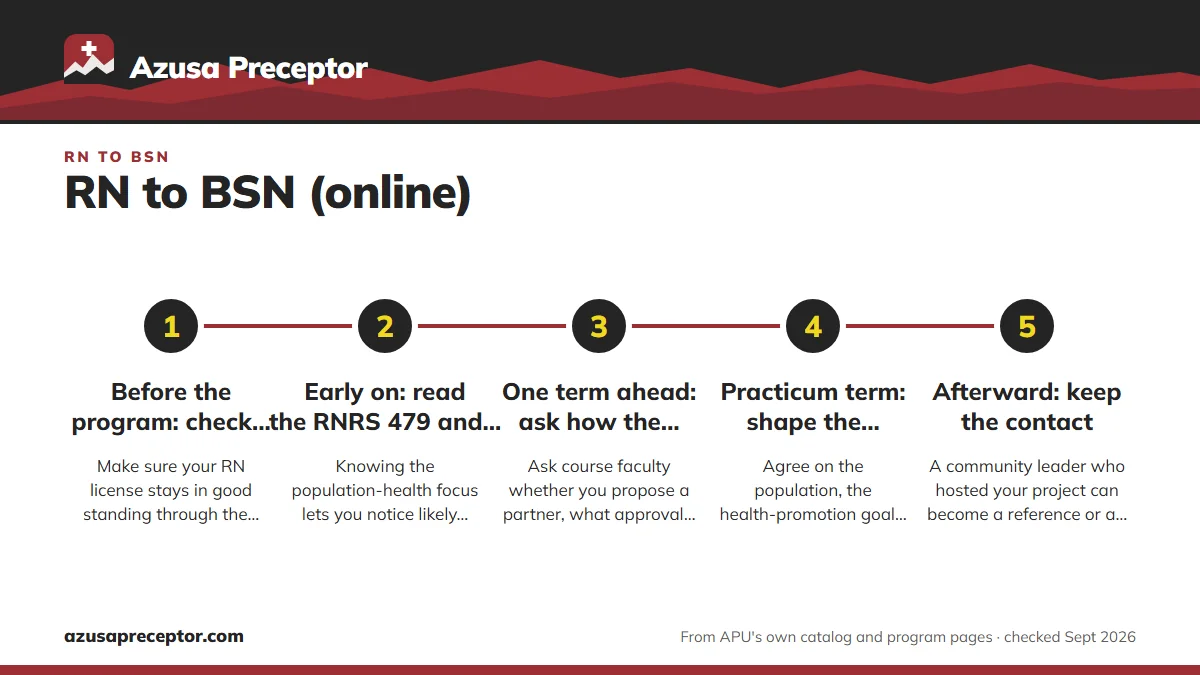
- Before the program: check your license datesMake sure your RN license stays in good standing through the practicum term, and note when it renews.
- Early on: read the
RNRS 479andRNRS 480descriptionsKnowing the population-health focus lets you notice likely community partners near you long before the practicum term. - One term ahead: ask how the partner is setAsk course faculty whether you propose a partner, what approval it needs and which documents APU wants on file.
- Practicum term: shape the intervention with the partnerAgree on the population, the health-promotion goal and a realistic schedule, and record hours the way your course requires.
- Afterward: keep the contactA community leader who hosted your project can become a reference or a useful connection when you reach graduate clinicals.
Why RNs choose us
If your RNRS 482P course asks you to propose a community partner, we identify organizations near you whose populations fit the assignment, reach the right program lead and gather what APU needs to approve the partnership: the organization's legal name, a signer and a day-to-day contact.
Our deepest work begins when you move into graduate study. We specialize in APU's graduate clinical process, from the Graduate Preceptor Request form to the affiliation agreement, and we match NP students with preceptors across Southern California. If you plan to continue at APU, talk with us a term or two before your first graduate clinical course, and we will map the search around your start date. If you are weighing APU's MSN against the BSN to DNP, we also lay out what each track will ask of you clinically, so you choose with the hours and preceptor needs in view. Reach us through the contact page.
Questions APU students ask
Does APU's RN to BSN have clinical hours?
Yes, one clinical course. RNRS 482P is a 2-unit community practicum, about 90 hours by APU's 45-hours-per-unit rule, paired with RNRS 479 and RNRS 480. The optional RNRS 298 elective adds 36 precepted hours for RNs who want more clinical time, and RNRS 299 adds a clinical and simulation component.
Can I do the RN to BSN practicum at the hospital where I work?
The practicum is community and population focused, so a bedside unit is unlikely to fit the assignment. A community program your employer runs might, if course faculty approve it. APU's graduate rules for employer sites require a written division of labor and no regular duties or pay during clinical time; ask your faculty whether the same applies here.
Do I need a California RN license for the online RN to BSN?
APU asks for an RN license in good standing before clinical courses begin, and its student hub lists a current California RN license for post-licensure programs. Because the program is online, where you live matters too: APU does not currently accept distance applicants living in 14 states or Washington, DC, and it revises that list often.
When does the practicum fall in the RN to BSN sequence?
Near the end. RNRS 482P runs alongside RNRS 479 and RNRS 480. In the Integrative Enrollment Pathway, the public and community health course and its practicum fall in the summer of the second year, which gives you most of the program to plan for the community partner and your documents.
Is the RN to BSN the same as APU's LVN to BSN?
No. The RN to BSN is for licensed RNs and has one practicum. LVNs use the in-person LVN to BSN, a prelicensure program with eight school-assigned practicum courses plus a health assessment lab; our page on BSN clinicals explains how those clinicals work.
Related pages
Last checked 2026-09-25
We check these pages against APU's own catalog and program pages. Your syllabus, your clinical faculty and APU's student placement coordinators have the final word.
APU says the clinical site and preceptor are yours to find. We make that the easy part.
Tell us your APU program, where you live in Southern California and when your next clinical term starts. We find preceptors who fit the course and prepare what APU and the site need before anything is approved.
- Preceptors matched to the course: primary care for
GNRS 600, pediatrics for the PNP courses, psychiatric care for PMHNP - Credentials, license and site details ready for APU's review and the affiliation agreement
- Close to home, from the San Gabriel Valley and the Inland Empire to San Diego
Start your placement plan
Program, city and term is all we need to begin.