APU's CNS clinical courses: three 180-hour rotations
Azusa Pacific University (APU) builds its Clinical Nurse Specialist (CNS) clinicals from three 6-unit courses, each with 4 clinical units: the theory and practice course, the clinical specialization course and GNRS 543. The adult-gerontology and pediatric tracks run parallel course numbers, and the three courses together work out to 540 hours, most of them on hospital units and in care transitions.
Get your placement plan
Tell us your APU program and where you live. A placement advisor replies with the preceptor and site options that fit your APU course.
On this page
Courses by trackGNRS 520 or 530GNRS 521 or 531GNRS 543Campus listsHospital onboardingOur CNS searchQuestionsThree courses, two tracks
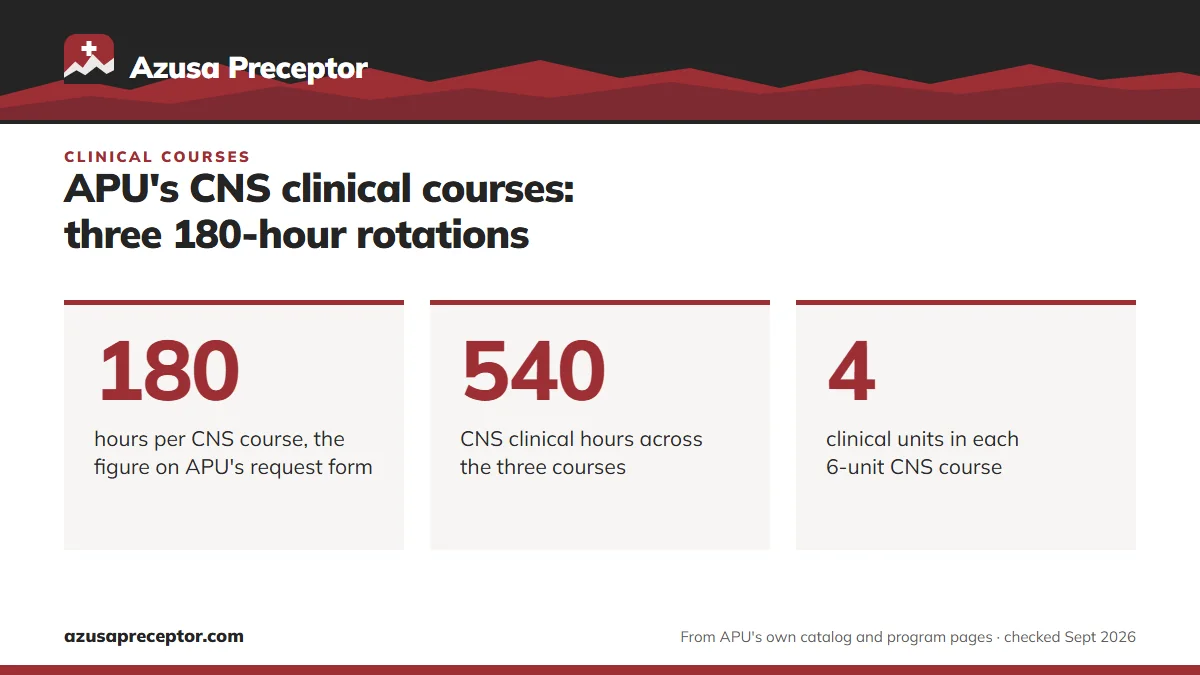
The CNS program has an adult-gerontology track and a pediatric track. Each takes three clinical courses, and each course splits its 6 units into 2 in the classroom and 4 in clinical practice. At APU's 45 hours per clinical unit, 4 units work out to 180 hours, and the Azusa and Inland Empire request form lists 180 for GNRS 520, GNRS 521 and the CNS version of GNRS 543.
| Step | Adult-gerontology | Pediatric | Units (class/clinical) | Hours | Clinical focus |
|---|---|---|---|---|---|
| 1. Theory and Practice of the CNS | GNRS 520 | GNRS 530 | 6 (2/4) | 180 | Critical care or medical-surgical rotations |
| 2. Clinical Specialization | GNRS 521 | GNRS 531 | 6 (2/4) | 180 | Acute illness management |
| 3. Transitions Across the Care Continuum | GNRS 543 | GNRS 543 | 6 (2/4) | 180 | Care as patients move between settings |
Outside the three clinicals, each track takes the 2-unit GNRS 548 course in health promotion, with GNRS 580 Gerontology on the adult-gerontology side and GNRS 589 or GNRS 510 on the pediatric side. The academic core includes GNRS 613 Graduate Statistics, one reason the MSN runs 48 to 50 units. The MSN CNS program page covers admission and the degree itself.
GNRS 520 or GNRS 530: theory and practice on the unit
The first course introduces the CNS role and places you on critical care or medical-surgical units for rotations. Divide 180 by the 16 weeks of a full session and you get about 11.25 hours a week. Under APU's recent guidelines you cannot bunch hours at the start or save them for the end, so that weekly pace has to hold all term.
APU's request form says a CNS precepts GNRS 520. The nurse leader option that appears in the later courses does not extend to this one, so your first rotation needs a practicing clinical nurse specialist. The form names the adult-gerontology numbers; pediatric students should confirm with clinical faculty how the same rule reads for GNRS 530.
Give the placement team the CNS's name, unit and credential as early as you can. APU's recent guidelines want a newly found preceptor named roughly a month and a half to two months before the term, which leaves room for vetting and the liability paperwork, and the hospital's own approval runs alongside that.
GNRS 521 or GNRS 531: clinical specialization
The second course narrows to a clinical specialty and the management of acute illness. It keeps the same 6 units, 2 classroom and 4 clinical, and the same 180 hours. Here the preceptor pool widens: APU's form lets a nurse leader stand in for a CNS in GNRS 521, provided that leader works in leadership, unit-based care or nursing education.
That opens more doors inside a hospital. A unit director or a clinical educator in acute care may qualify, which gives you more names to approach when no CNS covers your specialty. Match the preceptor's area to the specialty you declared, because the hours have to serve the course objectives as well as the credential rule.
If the best specialty site is your own hospital, APU allows it, and three conditions attach: the employer puts your student role and your job on paper as separate things, no paycheck covers clinical time, and the 2026 forms bar the unit you normally staff. The preceptor requirements page lists the rest.
GNRS 543: transitions across the care continuum
The third course follows patients as they move between levels of care. For CNS students, both the catalog's CNS requirement table and the request form give GNRS 543 6 units, 4 of them clinical, or 180 hours at APU's rate. A CNS or a qualifying nurse leader may precept it, under the same condition that applies to GNRS 521.
APU's documents disagree on this course number, so read your own syllabus. The PNP-PC requirement table treats GNRS 543 as an optional 4-unit elective split 2 and 2, or 90 hours, and APU's 2025-26 healthcare administration guidelines also describe 4 units with 90 practicum hours. If your plan shows the shorter version, raise it with your advisor before you agree hours with a preceptor.
Those same healthcare administration guidelines describe the ideal GNRS 543 preceptor for their students as a leader of interdisciplinary care-management teams. That points toward the kind of setting the course has in mind: teams that coordinate care across a hospital stay and beyond it. Confirm the fit with clinical faculty before you submit the form.
Where CNS clinicals run: APU's campus conflict
APU's pages disagree on where the CNS runs, and that shapes where you search. According to the 2023-24 guidelines, Azusa is the only home for CNS specialty courses, a view the Adult-Gerontology CNS certificate page shares. The MSN CNS page names Azusa and San Diego, while the Pediatric CNS certificate page adds the Inland Empire and San Diego to Azusa.
Those guidelines are also blunt about travel: matching the course level and patients matters more to APU than proximity, and they call a one-way trip of an hour or two common. For a CNS student that means choosing the right unit first and the shortest drive second. Our regional campuses guide sets out which programs APU lists at each location.
The post-master's certificates use the same three courses. The Adult-Gerontology CNS certificate is 37 units with GNRS 520, GNRS 521 and GNRS 543, and the Pediatric CNS certificate is 37 units with GNRS 530, GNRS 531 and GNRS 543. Both work out to 540 hours.
Hospital onboarding on top of APU's requirements
Hospitals usually add their own onboarding to APU's. Some hospitals charge for each student they onboard, MyClinicalExchange being one route APU names, and APU's hub assigns that invoice to the School of Nursing, not the student. Some sites ask for extra screening such as Live Scan, and drug screens are ordered only when a site requires one. Our Southern California placement systems guide explains how hospitals take students.
Facility health rules apply as well. APU leaves COVID-19 vaccination to each hospital, so the facility's rule is the one you meet, and hours lost to it may be hard to recover in the same term. Post-licensure students skip routine N95 fit testing, though the School of Nursing sets one up, masks included, when a hospital asks for it.
Start the hospital's steps as soon as the placement is confirmed, since they run on the facility's calendar rather than APU's.
How we set up CNS placements
CNS placements are hospital placements first, so we start with the unit and the person. For GNRS 520 or GNRS 530 we look for a practicing CNS in critical care or medical-surgical nursing; for the specialization course and GNRS 543 we widen the search to qualified nurse leaders in leadership, unit care or education roles, matched to your declared specialty.
For each preceptor we prepare what APU's request form needs, including the facility's legal name and legal signer, and we note what the hospital's own onboarding will ask of you so nothing surprises you after approval. APU's placement team signs off on every site in writing, and the request that reaches them from us is complete. See how it works or tell us your track and start term in the form below.
Questions APU students ask
Who can precept an APU CNS student?
APU's request form assigns GNRS 520 to a clinical nurse specialist. For GNRS 521 and GNRS 543, a nurse leader may take the CNS's place if their work is in leadership, unit care or nursing education. APU sets no public floor for years of experience and no student ratio, so confirm anything beyond the credential with clinical faculty.
How many clinical hours are in APU's CNS program?
The three CNS clinical courses each hold 4 clinical units; at 45 hours a unit that is 180 hours apiece and 540 in total. APU prints units rather than hours in the catalog, but its Azusa and Inland Empire request form lists 180 for each CNS course. Your syllabus confirms the figure for your term.
Is GNRS 543 a 90-hour or a 180-hour course?
It depends on which APU document you read. The CNS requirement table and the request form give CNS students 6 units and 180 hours. The PNP-PC table and the 2025-26 healthcare administration guidelines describe a 4-unit version with 90 hours. CNS students should follow their own program plan and confirm with an advisor.
Can I do my CNS clinicals at the hospital where I work?
Yes, with conditions. Your employer puts a division of labor in writing, you work no regular shift duties and draw no pay during clinical time, and under the 2026 forms you train on a unit other than your own. APU also expects you to disclose any close tie to a preceptor; concealing one counts as an ethics breach that can cost you the course.
Is APU's CNS program approved by the California BRN?
The catalog says all APU graduate nursing programs are BRN-approved, but the BRN's own list includes APU's CNS offerings and says CNS programs are not formally approved, only reviewed. After graduating you can apply to California for CNS certification, and for the national exam APU's catalog points to ANCC.
Related pages
Last checked 2026-09-25
We check these pages against APU's own catalog and program pages. Your syllabus, your clinical faculty and APU's student placement coordinators have the final word.
- APU Academic Catalog 2026-27: MSN Adult-Gerontology or Pediatric CNS
- APU School of Nursing: Confirmed Clinical Placements form, Azusa and Inland Empire
- APU: MSN Clinical Nurse Specialist
- APU School of Nursing: MSN Advanced Practice Program Guidelines 2023-24 (dated)
- California BRN: approved advanced practice programs
APU says the clinical site and preceptor are yours to find. We make that the easy part.
Tell us your APU program, where you live in Southern California and when your next clinical term starts. We find preceptors who fit the course and prepare what APU and the site need before anything is approved.
- Preceptors matched to the course: primary care for
GNRS 600, pediatrics for the PNP courses, psychiatric care for PMHNP - Credentials, license and site details ready for APU's review and the affiliation agreement
- Close to home, from the San Gabriel Valley and the Inland Empire to San Diego
Start your placement plan
Program, city and term is all we need to begin.