APU Oncology NP Fellowship: 540 hours in cancer care
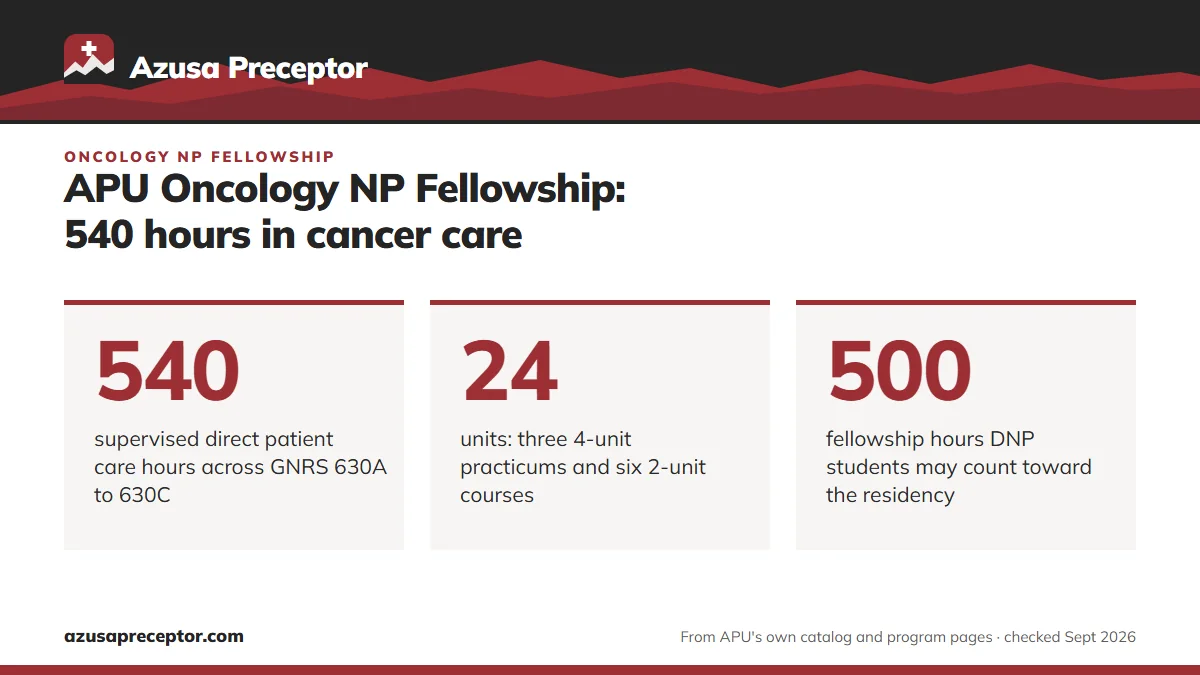
Azusa Pacific University (APU) runs a predoctoral Oncology Nurse Practitioner Fellowship for NPs who already hold a license: 24 units, three clinical practicums and 540 supervised hours in hematology and oncology services at a comprehensive cancer center. It stands alone as a post-master's certificate or runs alongside APU's DNP, where up to 500 of those hours can count toward the residency.
Plan the fellowship around your practice
Tell us your NP role, your city and whether you are also in the DNP.
On this page
What it isEntry requirementsClinical coursesLocation and sitesFellowship and the DNPWhy NPs choose usQuestionsWhat the fellowship is
The fellowship is a post-master's program built on Oncology Nursing Society competencies. APU calls it predoctoral: you can take it on its own, as one of APU's post-master's certificates, or co-enrolled with the post-master's DNP. The clinical core is the same three practicums either way.
It is a small field. APU's program page counts the fellowship as 1 of 16 such programs in the country, while a February 2026 APU article calls it one of just 10. The two APU sources disagree on the count, and both place it among a small number of oncology NP fellowships nationwide.
Finishing the fellowship meets Pathway 1 eligibility for the AOCNP exam from ONCC. APU's catalog notes that pediatric NPs are not eligible to sit for AOCNP as adult oncology NPs, so a PNP should weigh that before applying.
Who can enter and what must be in place
The fellowship assumes you already practice as an NP. APU's catalog and program page list these entry items:
- A master's in nursing that included advanced pathophysiology, advanced pharmacology and advanced health assessment
- A current California NP license and a furnishing number
- For applicants from other states: California NP certification before the practicums begin
- Preferred rather than required: oncology experience and national NP certification
The California credential matters most for timing. An NP certified in another state can be admitted, but clinical hours cannot start until California certification is in hand, so file with the BRN early. Our pages on BRN NP certification and the furnishing number walk through both applications. If your furnishing number is still pending, finish it before you apply: APU lists it as an entry requirement, not a step you complete later in the program.
The clinical courses and hours
APU sets the fellowship at 540 supervised hours of direct patient care. It prints no hours per practicum, but three 4-unit practicums at APU's 45 hours per clinical unit work out to 180 hours each, which matches the stated total.
| Course | Units | Hours | Notes |
|---|---|---|---|
GNRS 630A ONP Clinical Practicum I | 4 | 180, computed | First clinical course, taken with GNRS 631 and GNRS 632 |
GNRS 630B ONP Clinical Practicum II | 4 | 180, computed | Second practicum |
GNRS 630C ONP Clinical Practicum III | 4 | 180, computed | Third practicum, completing the 540 |
GNRS 631 to GNRS 636 | 2 each | None | Six didactic courses |
The hours spread across several hematology and oncology services at the cancer center rather than a single clinic, which is what gives the fellowship its breadth. APU lists Medatrax among the required resources for the oncology courses, so plan on logging hours every week; our Medatrax guide covers the logging rules.
Where the fellowship runs and how sites are set
APU's fellowship page lists the program as online, while APU's program finder lists Azusa and Monrovia. The coursework is online either way; the clinical hours happen at the cancer center.
APU names no cancer center on its public pages. It says it holds several affiliation agreements with practice partners that run cancer centers, which points to the program arranging these placements, though no public page says so outright. Ask at admission how your practicum site is set and when you will hear about it.
That sets the fellowship apart from most APU graduate tracks, where students propose their own preceptor. Plan around the program's partner sites first, and keep your own oncology contacts warm in case you are asked to suggest a setting.
One date to check: the fellowship's deadline on apu.edu still refers to spring 2026, so confirm the current cycle directly with admissions.
Using the fellowship inside the DNP
DNP students may count up to 500 of the 540 fellowship hours toward the 1,000-hour residency in GNRS 732. The DNP also accepts up to 500 hours transferred from an earlier APRN program, so if you bring both, ask APU in writing how the two allowances combine. Our DNP residency hours page explains how the residency counts.
Co-enrollment stacks two calendars: the fellowship practicums, and the DNP core courses with a scholarly project that runs through the residency. Put both on one term-by-term plan with your advisor before GNRS 630A, and decide early which residency hours will come from the cancer center and which need a separate site.
Residency hours beyond the fellowship fall in two kinds, per APU's catalog: clinical hours in an advanced practice specialty, and leadership hours that build organizational leadership and carry the project. Each residency setting needs its own approval before the first hour.
Why oncology NPs choose us
Fellows are experienced NPs, so what they need from us is focused. We help you plan the practicums around your current job and, for co-enrollees, the DNP calendar. We get your compliance record in order before GNRS 630A, and we line up the residency sites the fellowship does not cover.
For DNP co-enrollees, we find residency preceptors and leadership settings that fit your project, for example an oncology service line, an infusion or survivorship program, or a cancer center's quality team. For each one we collect the preceptor's credentials, the organization's legal name and signing officer, and the contact APU needs for an affiliation agreement.
If you are asked to propose an oncology setting, or a residency preceptor leaves partway, we move fast on a replacement that fits the course. APU's faculty approve every site; our job is a complete, rule-ready file on their desk. Share your timeline through our contact page.
Questions APU students ask
Can a pediatric NP apply to APU's Oncology NP Fellowship?
APU's catalog says pediatric NPs are not eligible to sit for the AOCNP exam as adult oncology NPs. The entry list does not exclude PNPs by name, but the certification the fellowship builds toward would not apply in the same way. If your only NP certification is pediatric, talk with the program before you apply.
Do I need oncology experience to get into the fellowship?
No, APU lists it as preferred, along with national NP certification. What is required is a nursing master's that covered advanced pathophysiology, pharmacology and health assessment, a current California NP license and a furnishing number. Applicants from other states need California NP certification before clinicals begin.
How many hours a week do the oncology practicums take?
APU publishes no weekly schedule. The practicums total 540 hours across three courses, about 180 each by APU's unit math. Across a 16-week term, 180 hours averages roughly 11 and a quarter hours weekly; a shorter session raises that. Your practicum faculty and the cancer center set the actual pattern.
Can I take the Oncology NP Fellowship without enrolling in the DNP?
Yes. APU offers the fellowship as a stand-alone post-master's certificate. Co-enrolling in the DNP is an option, and it lets up to 500 fellowship hours count toward the DNP's 1,000-hour residency, but you can complete the fellowship on its own and add the doctorate later or not at all.
What does the fellowship lead to after graduation?
Completing it meets Pathway 1 eligibility for ONCC's AOCNP exam, the advanced oncology NP credential. You keep your existing California NP license and furnishing number, and if you co-enrolled, the fellowship hours also move you toward the DNP residency total.
Will I train at one cancer center or move between several?
APU's catalog describes the 540 hours as spread across several hematology and oncology services at a comprehensive cancer center, so expect to rotate between services rather than between institutions. APU does not name the center on its public pages; ask the program which center and which services your practicums will use.
Related pages
Last checked 2026-09-25
We check these pages against APU's own catalog and program pages. Your syllabus, your clinical faculty and APU's student placement coordinators have the final word.
APU says the clinical site and preceptor are yours to find. We make that the easy part.
Tell us your APU program, where you live in Southern California and when your next clinical term starts. We find preceptors who fit the course and prepare what APU and the site need before anything is approved.
- Preceptors matched to the course: primary care for
GNRS 600, pediatrics for the PNP courses, psychiatric care for PMHNP - Credentials, license and site details ready for APU's review and the affiliation agreement
- Close to home, from the San Gabriel Valley and the Inland Empire to San Diego
Start your placement plan
Program, city and term is all we need to begin.