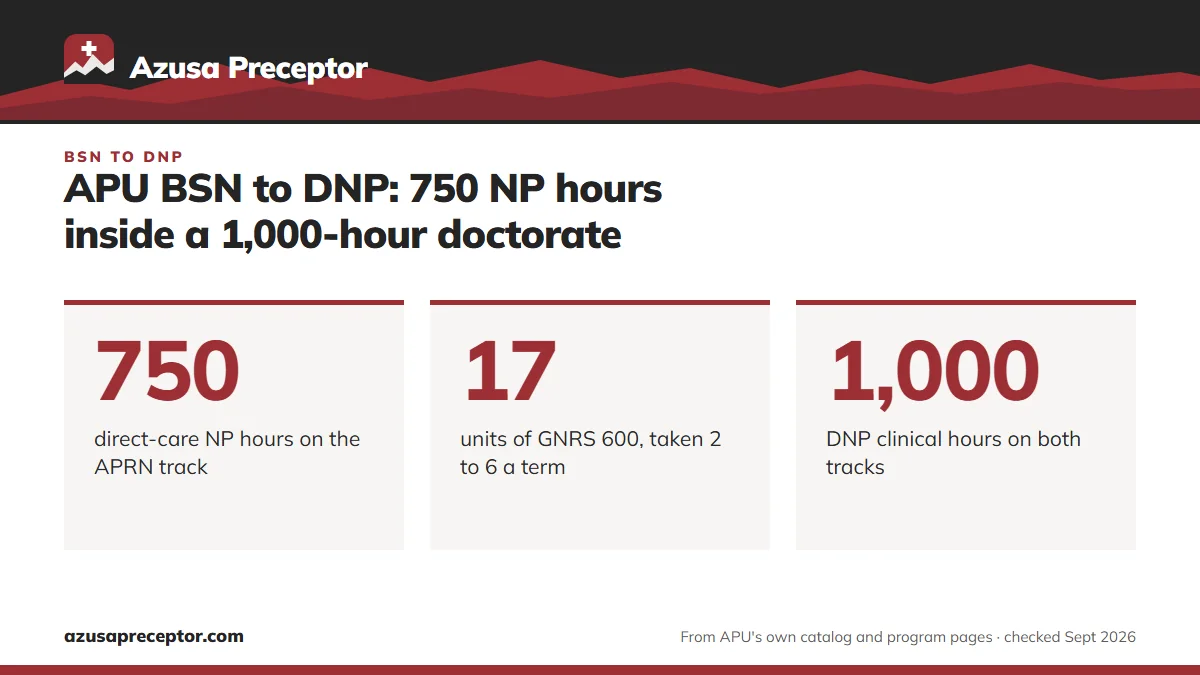
APU BSN to DNP: 750 NP hours inside a 1,000-hour doctorate
Azusa Pacific University (APU) takes BSN-prepared RNs straight to the Doctor of Nursing Practice on two tracks: an APRN track for Family NP or Adult-Gerontology Primary Care NP, and a Health Systems Leadership track. The APRN track carries at least 750 direct-care NP hours in GNRS 600 inside a 1,000-hour DNP total, and APU states plainly that finding the clinical site and preceptor is the student's job, with help from its staff.
Map your BSN to DNP clinical terms
Tell us your track, your nearest APU center and your first GNRS 600 term.
On this page
The two tracksWho finds the site750 within 1,000When clinicals startPreceptor profileLeadership trackWhy students choose usQuestionsTwo tracks, one degree at the end
The APRN track prepares you as a Family NP or an Adult-Gerontology Primary Care NP and runs 70 to 71 units, 40 to 41 of them role-specific. The Health Systems Leadership track runs 67 units with no NP clinical course. Both confer the MSN and the DNP together when you finish; no master's degree is awarded partway through.
Classes mix in-person and online sessions, live and self-paced, across Azusa, the Inland Empire, Monrovia, San Diego and online. APU's catalog describes its DNP as available online, yet NP-track students must live near a Southern California regional center for in-person courses and clinical rotations. Study can be full or part time, and each cohort starts once enough students are admitted.
Admission asks for a current California RN license plus undergraduate research and statistics. Preceptor experience is part of APU's holistic review, a hint at how central the preceptor relationship is to this pathway.
What APU says about finding your site
The BSN to DNP FAQ is the one APU page that answers the question head-on: "Students are responsible for finding a clinical site and preceptor with the assistance of APU staff, faculty, and student placement coordinators." The same answer adds that every clinical site must have an affiliation agreement in place.
In practice, you identify a preceptor and a clinic, and APU's team vets them, secures the agreement and clears the site in writing before your first hour. APU's recent guidelines want a new preceptor's details in hand 6 to 8 weeks ahead of the term, and a clinic with no agreement can take longer; our affiliation agreement guide explains why. The search itself is covered in finding your own clinical site.
On a pathway that logs NP hours almost every term, the search is not a one-time event. Expect two, three or more preceptors across the APRN years, each with its own request form and approval.
The NP hours: 750 within 1,000
APRN-track students take GNRS 600 for 17 units in total, 2 to 6 units a term. At APU's 45 hours per clinical unit that works out to 765 hours, while the course description prints 750 direct-care hours as the requirement, with 135 in pediatrics for FNP students or in geriatrics for AGPCNP students. The unit math and the MSN comparison are on our GNRS 600 guide, and the FNP's 135 has its own pediatric hours page.
APU's recent guidelines add that APRN students admitted after Fall 2023 stay enrolled in GNRS 600 continuously and complete 90 to 270 hours a semester until they pass 750. Put simply, nearly every term of the clinical phase needs an active preceptor.
The rest of the 1,000 runs through GNRS 732, the DNP Clinical Residency: 0 units, repeatable, with a clinical fee that APU's page says includes malpractice insurance. The catalog lets hours from earlier graduate clinical courses count toward GNRS 732, but APU does not spell out how NP hours and residency hours add up for each student, so get your count written into your program plan early. Our DNP residency page has the residency detail.
When the clinical phase starts
The first NP clinical course is GNRS 600, and it follows GNRS 612 Advanced Health Assessment with its lab. On this pathway GNRS 610 is not a prerequisite for GNRS 611, which shortens the chain. GNRS 732 may begin at admission, so residency work can start before your first patient hour as an NP student.
The experience gate differs from the MSN. APU's catalog asks MSN APRN applicants for a year of nursing experience, while the BSN to DNP page asks APRN-track students for eight months of RN experience and lets new RNs finish those months before year two. Our page on the RN license and residence rules sets the two side by side.
Evaluation follows the NP path as well: preceptor and faculty evaluations each term, OSCEs in most clinical courses and, per APU's recent guidelines, a clinical performance exam in GNRS 618 for BSN to DNP APRN students.
The preceptor profile for the APRN track
APU's 2026 request forms and recent guidelines set these rules for GNRS 600 preceptors:
- An MD or DO, an NP, or a PA working with an on-site supervising physician, based in outpatient primary care
- One or more semesters under an NP before you finish
- FNP students: pediatric volume, from a children's clinic or a family practice seeing six or more pediatric patients daily
- AGPCNP students: a practice with enough older adults to build the 135 geriatric hours
- No relatives or close friends precepting you, and no clinical hours on your own unit
Because preceptor experience counts in admission review, you may already know an NP or physician who could precept. Check that person against these rules, and against the practice's patient mix, before you build a term around them.
The leadership track and the Nurse Faculty Loan option
Health Systems Leadership students complete all 1,000 hours through the GNRS 732 residency, with no NP clinical course. Their settings are leadership environments rather than patient clinics, and like every APU clinical site they need approval and an affiliation agreement before hours count.
If you choose the Nurse Faculty Loan Program option, you take four of GNRS 660 to GNRS 664, including GNRS 663, the nurse educator practicum with 135 stated hours under a nurse educator preceptor. That adds a teaching placement to the plan; see our nursing education practicum page.
APRN graduates are eligible for BRN NP certification and the national FNP or AGPCNP exams. Neither the DNP nor the BSN to DNP appears in APU's professional licensure disclosures, so if you might practice outside California later, ask APU how the degree lines up with that state's rules.
Why BSN to DNP students choose us
A pathway with continuous GNRS 600 enrollment rewards planning. We map your NP terms, estimate the hours each preceptor can realistically host at 2 to 6 units a term, and line up the next preceptor before the current one finishes, so one quiet term does not stall your progress toward 750.
For every preceptor we gather what APU's request form and agreement need: credential and license, the clinic's legal name and legal signer, the office manager contact and the site's own onboarding steps. We flag early whether the clinic already holds an APU agreement. For FNP students we look for pediatric volume; for AGPCNP students, a strong geriatric caseload.
For residency hours we find leadership and specialty sites that suit your DNP project. If a preceptor drops, we begin the replacement search immediately. APU's team signs off on every site, and we make the file complete before it reaches them. Start on our contact page.
Questions APU students ask
Can a new graduate RN start APU's BSN to DNP?
Yes, on APU's terms. The APRN track asks for eight months of RN experience, and new RNs may finish those months during the program, before year two. You still need a current California RN license at admission, and NP clinicals wait until you have completed GNRS 612, so the experience usually comes before your first patient hour as an NP student.
Do I earn an MSN partway through the BSN to DNP?
No. APU confers the MSN and the DNP together at the end of the pathway. If you leave partway, you have not yet earned a master's degree, which matters if you are planning a job change or national certification around the NP hours. Talk with your advisor before changing your enrollment.
Can I move away from Southern California during the program?
NP-track students are expected to live close to one of APU's Southern California regional centers for in-person courses and rotations. APU's recent guidelines also advise against moving mid-program and say campus transfers are generally not allowed. The residence rule is written for the NP tracks; leadership-track students should confirm their own rules with an advisor first.
Why does APU print 750 hours in one place and 765 in another?
Both figures are real. The 17 units of GNRS 600 work out to 765 hours at 45 hours per unit, while the course description sets 750 direct-care hours as the requirement. The catalog's 540 to 765 range covers MSN and DNP students together. Your syllabus and program plan fix the exact target for you.
Does the GNRS 732 clinical fee cover malpractice insurance?
APU's BSN to DNP page says the GNRS 732 clinical fee includes malpractice insurance. APU handles malpractice coverage differently elsewhere, and its FNP certificate page asks students to document their own coverage, so confirm with the program which rule applies during your NP terms in GNRS 600.
Related pages
Last checked 2026-09-25
We check these pages against APU's own catalog and program pages. Your syllabus, your clinical faculty and APU's student placement coordinators have the final word.
APU says the clinical site and preceptor are yours to find. We make that the easy part.
Tell us your APU program, where you live in Southern California and when your next clinical term starts. We find preceptors who fit the course and prepare what APU and the site need before anything is approved.
- Preceptors matched to the course: primary care for
GNRS 600, pediatrics for the PNP courses, psychiatric care for PMHNP - Credentials, license and site details ready for APU's review and the affiliation agreement
- Close to home, from the San Gabriel Valley and the Inland Empire to San Diego
Start your placement plan
Program, city and term is all we need to begin.