APU post-master's NP and CNS certificates: the clinical plan
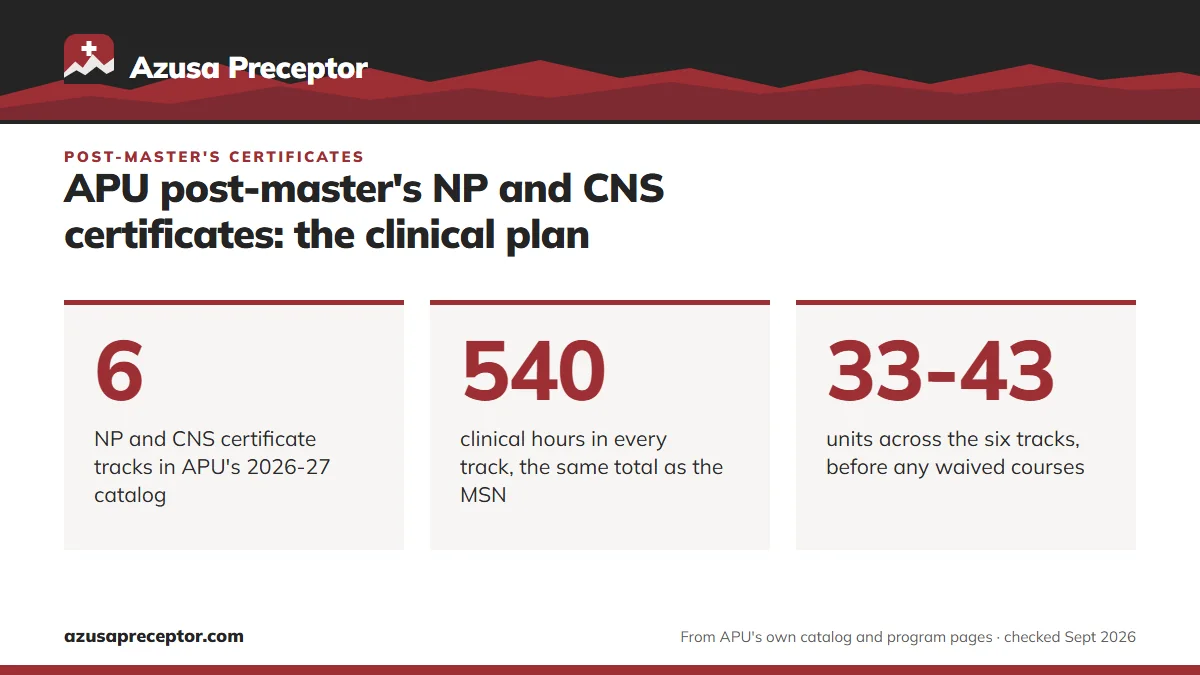
Azusa Pacific University (APU) offers six post-master's certificates for nurses who already hold a nursing master's: Family NP, Adult-Gerontology Primary Care NP, Pediatric NP-Primary Care, Psychiatric Mental Health NP, and the Adult-Gerontology and Pediatric Clinical Nurse Specialist. Each one uses the clinical courses of the matching MSN track, so the clinical load stays at 540 hours even when your classroom plan is short. We find the preceptors those hours need, close to home in Southern California.
Plan your certificate clinicals
Tell us your track, your city and the term your first clinical course starts.
On this page
Who they fitTracks at a glanceWhen clinicals startPreceptor profileWho finds the siteNumbers that conflictWhy students choose usQuestionsWhat the certificates are and who they fit
The certificates are nondegree programs. You arrive with a nursing master's, and APU adds the advanced practice core and the specialty courses you need for national certification and for the California Board of Registered Nursing (BRN). APU issues the certificate only after the national certification and BRN requirements have been met.
To be admitted you need a graduate-level research course plus undergraduate health assessment; when that assessment course is more than five years old, you either take UNRS 220 or petition it. Nurses already practicing in California as NPs, nurse-midwives or certified CNSs may challenge or waive courses, which is why unit totals differ from one student to the next.
Treat your first advising meeting as a gap analysis. Which master's courses carry over, which advanced practice courses you still owe, and which term your first clinical course can open: that last date drives the whole preceptor search, so pin it down before anything else.
The six tracks at a glance
Every track reaches 540 hours by its own route. The table follows APU's 2026-27 catalog. Where a figure says computed, it is the course's clinical units multiplied by APU's 45-hour unit, since the catalog prints clock hours for only a few courses.
| Track | Units | Clinical courses | Clinical hours | Campuses listed |
|---|---|---|---|---|
| FNP | 36 | GNRS 600 (12 units) | 540, stated | Azusa, Inland Empire, San Diego |
| AGPCNP | 35 | GNRS 600 (12 units), with GNRS 580 | 540 | Azusa |
| PNP-PC | 33-37 | GNRS 590A, GNRS 532, GNRS 590B, GNRS 542; optional GNRS 543 | 540 computed; 630 with GNRS 543 | Azusa, Inland Empire, San Diego (program finder: Azusa only) |
| PMHNP | 43 | GNRS 535, GNRS 536, GNRS 537, GNRS 538 | 540 computed | Azusa, Inland Empire |
| Adult-Gerontology CNS | 37 | GNRS 520, GNRS 521, GNRS 543 | 540 computed | Azusa |
| Pediatric CNS | 37 | GNRS 530, GNRS 531, GNRS 543 | 540 computed | Azusa, Inland Empire, San Diego (program finder: Azusa only) |
APU's pages disagree on where some tracks run. The PNP-PC and Pediatric CNS certificate pages name three campuses while APU's program finder names Azusa alone, and APU's recent guidelines placed CNS specialty courses at Azusa only. Ask admissions to confirm your campus before you build a commute around it. The Oncology NP Fellowship sits in the same catalog grouping but works differently, so it has its own page.
When clinicals start and how the hours spread
Your first clinical course follows the advanced practice core. Under APU's recent MSN guidelines, each of the three gate courses (advanced pathophysiology, advanced pharmacology and advanced health assessment) needs a B- or better first, and students who lack a completed program plan are left out of the placement count. If you are waiving one of those courses, settle the waiver before the term you want clinicals to begin.
FNP and AGPCNP certificate students take GNRS 600 in pieces, between 2 and 6 units per term if faculty approve, or roughly 90 to 270 hours per term by the unit math. GNRS 600 also sets aside 135 pediatric hours for FNP students; ask your advisor how that applies to your plan. The unit rules are on our GNRS 600 page.
The other tracks move course by course. PMHNP runs four population courses of 135 hours each, beginning with GNRS 535 (PMHNP course guide). PNP-PC opens with GNRS 590A and closes with the GNRS 542 capstone (PNP sequence). CNS students begin with GNRS 520 or GNRS 530, listed at 180 hours each on APU's request form (CNS courses).
The FNP certificate advertises evening lectures, part-time study and summer courses. Summer is a full graduate term at APU, so a clinical block can open in May as easily as in August.
The preceptor each track needs
APU's 2026 request forms set the preceptor profile course by course. In short:
- FNP and AGPCNP (
GNRS 600): a physician (MD or DO), an NP, or a PA whose supervising physician works on site, all in outpatient primary care. Each NP student needs one or more semesters precepted by an NP. - PMHNP: a psychiatrist or a PMHNP. An LMFT or psychologist is accepted only in
GNRS 535, and at least one semester must be with a PMHNP. - PNP-PC: pediatric clinics, or family practices seeing at least six pediatric patients a day.
GNRS 532splits its hours: 60 or more in a pediatric specialty and 75 or more in primary pediatric practice. - CNS: a CNS, or for
GNRS 521andGNRS 543a nurse leader, working in leadership, unit care or nursing education.
Relatives and close friends cannot precept you under the same forms, and clinical time at your own workplace has to happen away from your home unit. APU publishes no minimum years of preceptor experience, no student-to-preceptor ratio and no site-visit rule. The complete list lives on our preceptor requirements page.
Who finds the site for a certificate student
APU runs a shared model for NP and CNS certificate students. It employs placement staff who weigh the distance to each site, and it also counts on you to locate a nearby site and preceptor and report them to the team. APU's recent guidelines say placements are not promised, and a student left without one must drop the course within the first third of the semester.
Once a preceptor says yes, you file one Graduate Preceptor Request form per preceptor, and the Graduate Placement Team reviews it and checks the site's affiliation agreement. You report to the site only after the team clears it in writing.
Certificate students tend to be working NPs, CNSs and nurse leaders, so most start with a professional network. That network is an asset, with two cautions: a colleague on your own unit or a close friend will not pass APU's rules, and a clinic with no agreement adds lead time you have to plan for.
Course numbers and deadlines that trip people up
Several apu.edu certificate pages still refer to GNRS 512 for advanced health assessment, a number the 2026-27 catalog has replaced with GNRS 612. Others list GNRS 594 for pharmacology, which is now GNRS 611. When you compare an old transcript, an older plan or a forum post with your own plan, translate the numbers first.
Application deadlines vary as well. Most certificate pages give April 1 and June 15 for fall and July 15 and September 30 for spring. The FNP certificate page, though, lists both June 30 and June 15 as its fall final date, and the AGPCNP and Adult-Gerontology CNS pages print one set of dates at the top and another lower down. Ask admissions which date applies to your term.
CCNE first accredited APU's post-graduate APRN certificate in February 2018, with accreditation now extending through December 31, 2028. In APU's licensure disclosures, the NP certificates read Yes for California and Not Determined elsewhere.
Why certificate students choose us
We build the search around your track rather than a generic NP list. A PMHNP student needs a psychiatrist or PMHNP who can carry four population courses; a Pediatric CNS student needs a CNS in acute pediatric care; an FNP student needs a family practice with real pediatric volume. We match the preceptor to the course you are entering and the term it opens.
Before anything is filed, we assemble what APU's request form asks for: the preceptor's license and credential, the practice's legal name and the person authorized to sign for it, and the office manager's contact. We confirm up front whether an APU agreement is already on file for that clinic, which puts any new-agreement lead time on your calendar in week one, not week ten.
If a preceptor steps away between courses, we start the replacement search right away. APU's Graduate Placement Team gives written clearance for every site, and we see to it that the file they receive is complete, fits the rules and arrives early. Begin with the form below or on our contact page.
Questions APU students ask
Can I use clinical hours from my first NP program toward an APU certificate?
APU lets nurses who already hold California NP, nurse-midwife or CNS certification challenge or waive courses, but its catalog does not say that earlier clinical hours count toward a new specialty's clinical courses. Plan on the full 540 hours for the new population unless your written program plan says otherwise. APU's DNP is different: it accepts up to 500 transferred hours.
Do certificate students have to live in Southern California?
APU's catalog states the Southern California residence rule for MSN APRN applicants, and its recent guidelines discourage moving while enrolled. The certificates share the MSN's campuses and clinical courses, so plan on clinicals in Southern California and confirm the residence rule for your track with admissions before you apply.
How long does an APU post-master's NP certificate take?
APU publishes no sample plan for the certificates. Length depends on waived courses and on your clinical load. With approval, FNP and AGPCNP students can schedule GNRS 600 at 2 to 6 units per term, so the 12 clinical units can stretch across anywhere from two to six terms, and summer counts as a full term.
Is the Oncology NP Fellowship one of these certificates?
It sits in the same catalog grouping, but it is built differently: 24 units for NPs who already hold a California NP license and furnishing number, with three practicums in a comprehensive cancer center's hematology and oncology services. Its admission rules and clinical setting are its own, so plan it separately.
Can I complete certificate clinicals where I already work?
Only with conditions. APU's recent guidelines permit clinical time at your employer if the employer signs a written division of labor, and during those hours you cannot perform your usual job or draw pay. The 2026 request forms also keep the clinical off the unit you normally staff.
Related pages
Last checked 2026-09-25
We check these pages against APU's own catalog and program pages. Your syllabus, your clinical faculty and APU's student placement coordinators have the final word.
APU says the clinical site and preceptor are yours to find. We make that the easy part.
Tell us your APU program, where you live in Southern California and when your next clinical term starts. We find preceptors who fit the course and prepare what APU and the site need before anything is approved.
- Preceptors matched to the course: primary care for
GNRS 600, pediatrics for the PNP courses, psychiatric care for PMHNP - Credentials, license and site details ready for APU's review and the affiliation agreement
- Close to home, from the San Gabriel Valley and the Inland Empire to San Diego
Start your placement plan
Program, city and term is all we need to begin.