APU's MSN PMHNP: four population courses, 135 hours each
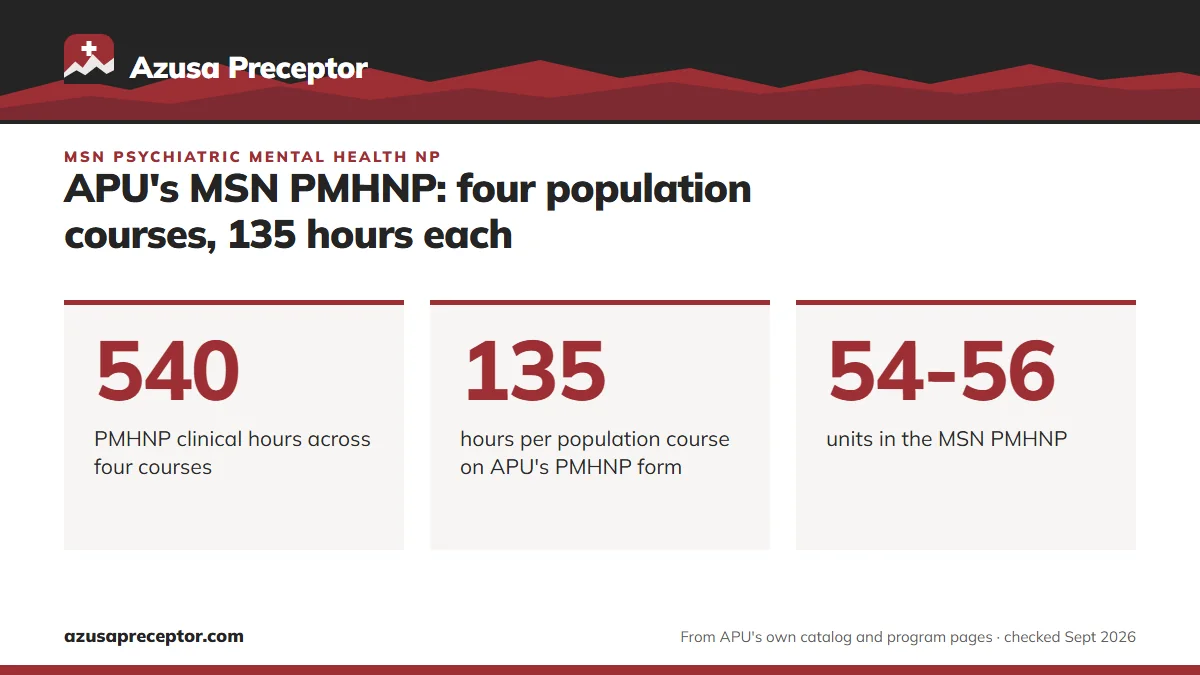
Azusa Pacific University (APU) organizes its Psychiatric Mental Health Nurse Practitioner (PMHNP) clinicals as four population courses, GNRS 535 through GNRS 538, each listed at 135 hours on APU's PMHNP request form. Together they come to 540 hours with psychiatrists and PMHNPs, from children to older adults. Each block has its own population, so each term needs a preceptor whose caseload matches it.
Plan your PMHNP clinicals
Your campus and next population course is enough to begin.
On this page
Program overviewPath to GNRS 535Courses and hoursPreceptor profileResidence and experienceCertificationWhy students choose usQuestionsThe PMHNP program from the clinical side
APU's PMHNP prepares you for psychiatric and mental health care across the lifespan, with a focus on people living with severe or chronic mental illness, and it trains you in individual, family and group psychotherapy. At 54 to 56 units it is the largest of APU's four single-specialty NP tracks, partly because its advanced practice core adds GNRS 510 Family Theory.
Campus listings conflict for this track. The MSN NP page puts every NP specialty on all three campuses, San Diego included, yet two other APU sources, the recent guidelines and the PMHNP certificate page, name only Azusa and the Inland Empire for psychiatric NP study. If you live in San Diego County, confirm with admissions where PMHNP courses meet before you plan sites around that campus. The campus guide tracks the discrepancy.
The PMHNP also has paperwork of its own. APU's onboarding hub posts a separate PMHNP preceptor request form, apart from the general NP form used at Azusa and the Inland Empire, and it is the form that sets the preceptor rules described below.
Didactic courses first, then GNRS 535
Precepted work begins in GNRS 535, the lifespan course on psychiatric interventions and health promotion. The road there runs through the GNRS 612 health assessment lab and then a pair of classroom-only courses of 2 units each: GNRS 533 on psychiatric theories and GNRS 534 on integrated psychiatric and health assessment. Psychopharmacology, GNRS 539, is allowed in the same term as GNRS 535.
APU's 2023-24 guidelines hold clinical courses back until you have earned at least a B- in each advanced core course (pathophysiology, pharmacology, health assessment), and they only place students whose program plan is finished. The current handbook sits behind the APU login; check it, or ask your advisor, for the rule in force this year.
GNRS 535 is also the one course in which APU's PMHNP form widens the preceptor pool, as the next sections explain. That makes your first clinical term the most flexible one for preceptors, which is worth using: a first term that starts on time keeps the other three population courses on schedule.
Four population courses and their hours
| Course | Population | Units (class/clinical) | Hours |
|---|---|---|---|
GNRS 535 Psychiatric Interventions and Health Promotion across the Life Span | Lifespan | 6 (3/3) | 135 |
GNRS 536 Psychiatric Mental Health Care with Adults and Older Adults | Adults and older adults | 6 (3/3) | 135 |
GNRS 537 Psychiatric Mental Health Care with Children and Adolescents | Children and adolescents | 6 (3/3) | 135 |
GNRS 538 Psychiatric Mental Health Care with Selected Populations | A selected population | 5 (2/3) | 135 |
Each course's 135 hours is the figure on APU's PMHNP request form, and it agrees with the catalog's three clinical units at 45 hours apiece. With no program total printed, 540 is simply the four added together. GNRS 538 carries one fewer class unit than the others but the same clinical load. The PMHNP clinical courses page goes course by course.
Give the child and adolescent block the longest lead time. GNRS 537 is the one course where a practice that sees only adults cannot fit, so its preceptor search deserves to start first, even if the course comes third on your plan.
Who can precept a PMHNP student
APU's PMHNP form names two kinds of preceptor: psychiatrists (MD) and PMHNPs. The one exception belongs to GNRS 535, where a psychologist or a licensed marriage and family therapist (LMFT) is also acceptable. Across the program, one semester or more has to be spent with a PMHNP.
Put together, one workable four-term plan starts GNRS 535 with a therapist, psychologist or psychiatrist, then moves to psychiatrists and at least one PMHNP for the later three courses. Specialty clinics need faculty review before they count toward hours.
APU's public pages do not list PMHNP clinical settings, so your clinical faculty confirm whether a site's patient mix fits each course. APU sets no published floor on preceptor experience and no stated student ratio.
The integrity rules match every APU track: no relatives or close friends as preceptors, no hours on your own unit at work, and a written division of labor from your employer if you train where you work. The preceptor requirements page has the full list.
Residence, experience and the campus question
PMHNP applicants meet the same two gates as other APU NP applicants: residence in Southern California and at least one year of nursing experience. Psychiatric nursing experience is not among the published requirements. What matters for clinicals is where you live in relation to your campus and your sites, since APU's placement staff weigh distance and the guidelines discourage moving mid-program.
The campus conflict makes this sharper for PMHNP than for the other NP tracks. If your classes meet in Azusa or the Inland Empire and you live farther south, expect the review of each site to start with fit: APU's 2023-24 guidelines say a site's match to your level and population comes before distance.
You also need an active California RN license on record, and you keep a clinical job while you study. The license and residence page explains both rules.
PMHNP certification and the 500-hour board minimum
The PMHNP ends in two steps, state and national: California's Board of Registered Nursing (BRN) certifies you as a nurse practitioner, and a national board examines you as a psychiatric specialist. The BRN's list of approved NP programs names APU's Psych/Mental Health NP track. ANCC's PMHNP-BC requires at least 500 faculty-supervised clinical hours in the program, and NPCB also lists a PMHNP exam.
Your 540 hours clear ANCC's 500, but only hours that count in APU's courses count at all. Under APU's recent guidelines, time logged at an unapproved site is stripped from Medatrax, and a failed course's hours are lost rather than carried forward. The Medatrax page explains weekly logging.
GNRS 611 Advanced Pharmacology, part of your core, is the course APU says meets the BRN's furnishing-number coursework requirement, and California program graduates apply for NP certification under the BRN's Method One.
Why PMHNP students choose us
PMHNP placements turn on two things: the preceptor's credential and the preceptor's caseload. We build your plan around both, course by course.
- We look for psychiatrists and PMHNPs near home whose patients match each population course, starting the child and adolescent search first.
- We flag when your first term can use the
GNRS 535exception for an LMFT or psychologist. - We make sure at least one term is with a PMHNP, so the semester rule is met before your last course.
- We prepare the details for APU's separate PMHNP request form, one form for each preceptor.
APU's placement team clears each PMHNP site in writing before you set foot there. We get the request to them complete and matched to the course, so the review can move. Use the form below to start.
Questions APU students ask
Can a therapist be my PMHNP preceptor at APU?
For one course only. GNRS 535, the lifespan interventions course, accepts an LMFT or a psychologist; the three later population courses need a psychiatrist (MD) or a PMHNP under APU's PMHNP form. If you use the therapist option, put it in your first clinical term and line up psychiatric prescribers for the rest.
What is the total PMHNP clinical requirement?
Four courses at 135 hours each, so 540. That per-course figure is printed on APU's PMHNP request form, and it squares with the catalog's three clinical units per course. Because APU never prints one program-wide total, treat each syllabus as the final word for its course.
Does APU offer the PMHNP in San Diego?
APU's sources disagree. San Diego appears on the MSN NP page's campus list for all specialties, but not on the PMHNP certificate page or in the recent guidelines, which stop at Azusa and the San Bernardino campus. Ask admissions which campus your cohort uses before you look for sites near it.
Can a PMHNP certificate student use the same clinical courses?
Yes. The 43-unit PMHNP post-master's certificate carries the same psychiatric sequence, GNRS 533 to GNRS 539, on top of the advanced practice core and GNRS 510, so the 540 hours are identical. It runs at Azusa and the Inland Empire. The certificates page covers how prior coursework is reviewed.
What if my PMHNP preceptor leaves mid-term?
Tell your clinical faculty at once. APU's recent guidelines say a clinical incomplete may be offered when a site falls through and no replacement is found, and late-drop fees can be waived, with next-term priority placement, when a preceptor withdrew for reasons outside your control. The preceptor dropped out page covers the next steps.
Related pages
Last checked 2026-09-25
We check these pages against APU's own catalog and program pages. Your syllabus, your clinical faculty and APU's student placement coordinators have the final word.
APU says the clinical site and preceptor are yours to find. We make that the easy part.
Tell us your APU program, where you live in Southern California and when your next clinical term starts. We find preceptors who fit the course and prepare what APU and the site need before anything is approved.
- Preceptors matched to the course: primary care for
GNRS 600, pediatrics for the PNP courses, psychiatric care for PMHNP - Credentials, license and site details ready for APU's review and the affiliation agreement
- Close to home, from the San Gabriel Valley and the Inland Empire to San Diego
Start your placement plan
Program, city and term is all we need to begin.