GNRS 612 and the three-course gate before APU clinicals
At Azusa Pacific University (APU), GNRS 612 Advanced Health Assessment and Diagnostic Reasoning is the last stop before most graduate clinical courses. APU's recent guidelines set a B- floor in three courses, advanced pathophysiology, pharmacology and health assessment, and no clinical course starts until all three clear it. That makes the term you sit in GNRS 612 the term to line up your first preceptor.
Get your placement plan
Tell us your APU program and where you live. A placement advisor replies with the preceptor and site options that fit your APU course.
GNRS 612: 3 classroom and 1 lab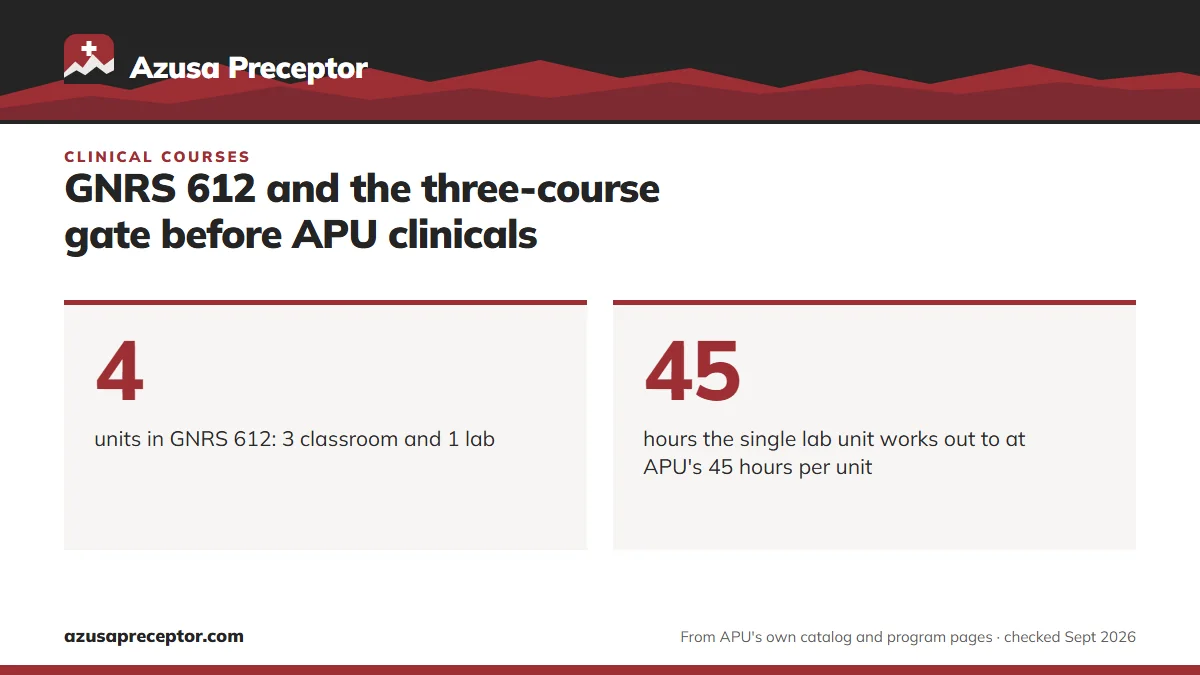
On this page
Where GNRS 612 sitsThe three-course gateAssessment course by trackCompliance at the labOld course numbersPlan your first preceptorQuestionsWhat GNRS 612 is and where it sits in your plan
GNRS 612 Advanced Health Assessment and Diagnostic Reasoning carries 4 units in the 2026-27 APU catalog: 3 classroom units and 1 lab unit. Every unit and hour pair APU prints works out to 45 hours per clinical or lab unit, so the lab portion works out to roughly 45 hours. APU prints no separate hour figure for this lab, so your syllabus sets the real schedule.
The course belongs to the 12-unit advanced practice core that FNP students complete: GNRS 610, GNRS 611, GNRS 612 and GNRS 513. The catalog sets them in sequence: GNRS 610 first, GNRS 611 Advanced Pharmacology next, and GNRS 612 with its lab last. Only after that chain does the first precepted course open, which for FNP and AGPCNP students is GNRS 600 taken together with GNRS 601.
BSN to DNP students follow a slightly shorter chain. The catalog lets them start GNRS 611 without first taking GNRS 610, yet GNRS 612 still comes before GNRS 600. The page on APU's 45 hours per clinical unit shows how APU turns units into hours on your schedule.
The gate: pathophysiology, pharmacology, assessment
APU's 2023-24 MSN Advanced Practice Program Guidelines, the latest edition posted where the public can read it, say advanced pathophysiology, pharmacology and health assessment must each be passed with a B- or better before a student begins any clinical course. Newer editions need an APU login, so check the handbook and your advisor for the version tied to your catalog year.
The same guidelines tie the gate to planning. Students without a program plan are not counted when clinical placements are planned, and APRN students cannot register for advanced health assessment until advising and program planning are done. That makes the program plan the first document in your placement chain, well ahead of any conversation with a preceptor.
A grade under B- in one of the three courses pushes your first clinical term back. University policy lets a graduate course be repeated up to three times with only the latest grade counting, though a program may allow fewer, and the School of Nursing's per-course minimum and clinical repeat limit live in its handbooks. Our guide to graduate grades and probation covers the GPA side.
Finish advising and your program plan before you register for GNRS 612. APU's guidelines say a student with no plan is not counted for clinical placement.
Which assessment course each APU track takes
Most graduate tracks use GNRS 612. The pediatric and school nursing tracks may take GNRS 511 instead, the pediatric version of advanced health assessment and health promotion, which has the same shape: 4 units, 3 in the classroom and 1 in the lab. The table pairs each track with its assessment course and the first course that carries clinical hours.
| Track | Assessment course | First course with clinical hours |
|---|---|---|
| MSN FNP and FNP certificate | GNRS 612 | GNRS 600, with GNRS 601 |
| MSN AGPCNP and AGPCNP certificate | GNRS 612 | GNRS 600, with GNRS 601 and GNRS 580 |
| MSN PNP-PC and PNP-PC certificate | GNRS 511 or GNRS 612 | GNRS 590A |
| MSN PMHNP and PMHNP certificate | GNRS 612 | GNRS 535, after GNRS 533 and GNRS 534 |
| MSN CNS and the two CNS certificates | GNRS 612 | GNRS 520 (adult-gerontology) or GNRS 530 (pediatric) |
| MSN with SNSC and SNSC only | GNRS 511 or GNRS 612 | GNRS 550A or GNRS 590C |
| MSN FNP with SNSC | GNRS 612 | GNRS 600 and GNRS 550A |
| BSN to DNP, APRN track | GNRS 612 | GNRS 600; GNRS 732 may begin at admission |
Paperwork that is due by the lab, not the first clinical
APU's catalog pulls the health assessment lab inside its clinical rules. At the start of graduate clinical coursework, the health assessment lab included, you document your RN license, CPR, TB screening and the immunizations suited to the clinical setting, and your health status must allow safe practice. Your compliance account therefore needs to be current in the GNRS 612 term, usually a full term before you meet a preceptor.
APU tracks those items in CastleBranch at every campus except San Diego, which uses Complio from American DataBank. For Fall 2026, APU's student hub set August 1, 2026 as the date clinical placement requirements had to be complete, and it notes that program deadlines may differ. Our CastleBranch and Complio guide walks through the account itself.
Treat the lab term as a dress rehearsal. An account that is already clean when your first preceptor request goes in is one less item for the placement team to chase, and one less reason for a start date to slip.
Old course numbers you may still see
APU renumbered its advanced practice core, and a few apu.edu pages have not caught up. Several post-master's certificate and School Nurse Services Credential pages still cite GNRS 512 for advanced health assessment. That number has left the 2026-27 catalog, and GNRS 612 has taken its place. Some apu.edu pages likewise name GNRS 594 as the pharmacology course that the catalog now lists as GNRS 611.
Older numbers turn up in other places too. APU's Azusa and Inland Empire request form lists some older clinical course numbers that remain in use, and the catalog's course list keeps legacy courses such as GNRS 591, GNRS 592A, GNRS 592B and GNRS 593. When your plan, a syllabus and a web page disagree, follow the catalog year you entered under and confirm with your advisor.
GNRS 611 matters past the gate as well: APU says it meets the California Board of Registered Nursing requirement for a furnishing number application. The furnishing number and GNRS 611 page explains that step.
Use the GNRS 612 term to line up your first preceptor
The lab term is the right moment to start the search. APU's recent guidelines ask students who find a new preceptor to tell the placement coordinator 6 to 8 weeks before the semester, so the preceptor can be vetted and a liability contract set up. For a spring 2027 graduate term that opens January 4, that window works out to roughly November 9 to November 23, 2026.
Every preceptor needs a separate Graduate Preceptor Request form, which asks for your course number and paired lecture course, the preceptor's credential, and the clinic's legal name and legal signer for the affiliation agreement. Our request form guide goes through it field by field.
This is where APU students choose us. While you sit in GNRS 612, we search for a preceptor who fits your first clinical course, primary care for GNRS 600, pediatrics for GNRS 590A or psychiatric care for GNRS 535, close to where you live in Southern California.
We collect the preceptor's license and credentials, the site's legal name and signer and the office manager contact, so your form is complete on the first pass. Each site still needs written clearance from APU's placement team before your first shift; our part is a file that arrives complete and fits APU's rules. See how it works or reach us through the contact page.
Questions APU students ask
Does GNRS 612 need a preceptor?
APU's catalog lists GNRS 612 as 3 classroom units and 1 lab unit, not as a precepted clinical course, so the lab itself needs no preceptor request. The catalog still treats the health assessment lab as the start of graduate clinical coursework for compliance, so your RN license, CPR, TB screening and immunizations must be on file before it begins.
Can I take GNRS 612 and GNRS 600 in the same term?
The 2026-27 catalog places GNRS 612 and its lab before GNRS 600, and APU's recent guidelines ask for a B- or better in health assessment before any clinical course. Taking both at once would skip that gate. If your program plan shows something different, confirm it with your advisor before you register or commit a preceptor to a start date.
What happened to GNRS 512 Advanced Health Assessment?
GNRS 512 is an older number that still appears on some apu.edu certificate and School Nurse Services Credential pages. The 2026-27 catalog no longer carries it; GNRS 612 Advanced Health Assessment and Diagnostic Reasoning replaced it, and pediatric and school nursing students may take GNRS 511 in its place.
Do post-master's certificate students have to retake health assessment?
APU's certificate rules look for undergraduate health assessment, plus a graduate research course, at admission, and a health assessment course more than five years old means taking or petitioning UNRS 220. Nurses already certified in California as NPs, nurse-midwives or CNSs can ask to challenge or waive courses, so your advisor's review of your transcript decides whether GNRS 612 stays in your plan.
Is the one-year experience rule separate from the grade gate?
Yes. Admission to an MSN APRN track already requires a year or more of nursing experience, and APU's recent guidelines repeat that expectation for the first clinical course, ELM graduates included. ELM students also have to clear the NCLEX before they can enter an advanced practice clinical. The B- rule for the three core courses applies on top of those requirements.
Related pages
Last checked 2026-09-25
We check these pages against APU's own catalog and program pages. Your syllabus, your clinical faculty and APU's student placement coordinators have the final word.
- APU Academic Catalog 2026-27: Graduate Nursing Programs and course descriptions
- APU Academic Catalog 2026-27: MSN Family Nurse Practitioner requirements
- APU Academic Catalog 2026-27: MSN advanced practice clinical requirements
- APU School of Nursing: MSN Advanced Practice Program Guidelines 2023-24 (dated)
- APU SON student hub: advanced practice NP onboarding
APU says the clinical site and preceptor are yours to find. We make that the easy part.
Tell us your APU program, where you live in Southern California and when your next clinical term starts. We find preceptors who fit the course and prepare what APU and the site need before anything is approved.
- Preceptors matched to the course: primary care for
GNRS 600, pediatrics for the PNP courses, psychiatric care for PMHNP - Credentials, license and site details ready for APU's review and the affiliation agreement
- Close to home, from the San Gabriel Valley and the Inland Empire to San Diego
Start your placement plan
Program, city and term is all we need to begin.