What shapes the cost of your APU preceptor placement
Every quote we give an Azusa Pacific University (APU) student is built from five things: your program, the course being placed, your home region, the weeks left before the term and the specialty your preceptor must practice. Figures come with your quote rather than on this page. APU's own costs, such as CastleBranch or Complio, the background check, the clinical fee and iHuman cases, are separate and follow APU's rules.
Ask for your quote
Program, city and term start is enough to begin.
On this page
What shapes a quoteProgram and courseWhere you liveHow soon you startSpecialtyAPU's costsGet your quoteQuestionsThe five things that shape a quote
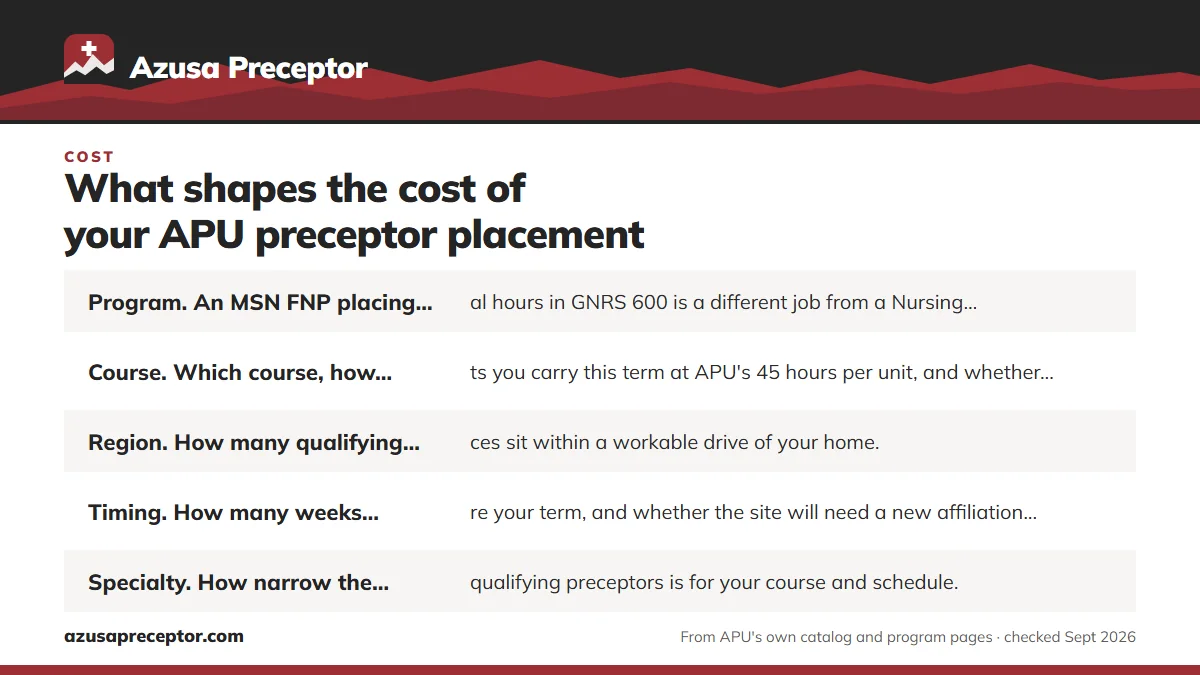
- Program. An MSN FNP placing clinical hours in
GNRS 600is a different job from a Nursing Education student placing a 135-hour capstone. - Course. Which course, how many units you carry this term at APU's 45 hours per unit, and whether it calls for a second kind of preceptor.
- Region. How many qualifying practices sit within a workable drive of your home.
- Timing. How many weeks remain before your term, and whether the site will need a new affiliation agreement.
- Specialty. How narrow the pool of qualifying preceptors is for your course and schedule.
Each factor changes how much searching, calling and preparation a placement takes, and your quote reflects that work. The sections below show how each one plays out for APU students.
Program and course: how much placing there is
APU's programs differ widely in how many hours need a preceptor. The MSN FNP and AGPCNP each carry 540 hours in GNRS 600, which students take 2 to 6 units a term with faculty approval, so one placement may cover a single term or several. The BSN-to-DNP APRN track stretches GNRS 600 to 17 units and 750 direct-care hours. Our clinical hours guide sets every program side by side.
Course sequences matter too. PMHNP students need a qualifying preceptor for each of four population courses, each carrying 135 hours, from GNRS 535 up to GNRS 538. PNP-PC students move through GNRS 590A, GNRS 532, GNRS 542 and GNRS 590B, and GNRS 532 splits its hours between a pediatric specialty and primary pediatric practice. A course that needs two settings usually means two searches.
Region: how many practices are within reach
Southern California is many markets, not one. HRSA lists 778 community health center sites in Los Angeles County, 259 in San Diego County and 162 in Orange County, against 76 in San Bernardino County and 55 in Ventura County. Health centers are only one kind of practice, but the spread hints at how much choice sits near home in each area; our region guides break it down, from the San Gabriel Valley to the High Desert.
The BRN's 2026 sunset report observes that rural parts of California often run short of both clinical sites and preceptors. APU's guidelines already accept that fit comes before distance and that commutes of 1 to 2 hours each way are common. A thinner region means more calls to reach a yes, and that shapes the quote.
Timing: weeks before the term
Lead time is the factor you control most. A search that begins a full term ahead can approach practices in order of fit, take a second look when a first choice hesitates, and leave room for APU's review. APU's 2023-24 guidelines ask for 6 to 8 weeks' notice when you bring a new preceptor, and a clinic without an existing agreement adds its own setup time on top.
A search that starts after registration, or once classes begin, has to run faster and wider, and APU's first-third drop rule sets a firm edge. Spring 2027's 16-week session begins January 4, 2027, and Summer 2027 begins May 3, 2027. If your term is close, our urgent placement page explains how a short-notice search runs.
Specialty, setting and schedule
Some preceptor pools are small. Psychiatric courses need a psychiatrist or PMHNP as preceptor, and APU wants each PMHNP student to spend a semester or more with a PMHNP. Pediatric and women's health hours count at a family practice only when it sees at least six such patients a day. CNS courses need a CNS or, for some courses, a nurse leader, and specialty clinics need faculty approval.
Schedule narrows it further. APU's guidelines call Saturday and evening clinicals scarce, especially in family practice, so a student who can attend only on weekends has fewer options. Oncology NP Fellowship hours are a special case: they run in hematology and oncology at a comprehensive cancer center, and APU says it holds several affiliation agreements with cancer center partners, so start with the program there. Tell us your constraints at the start so the quote matches the search you actually need.
APU's own costs stay separate
Your quote covers our search and preparation. The costs APU sets are paid under APU's rules, and a few are worth knowing before your first clinical course.
- CastleBranch or Complio. You buy the compliance subscription, Complio if you study at San Diego, and keep it active through the program.
- Background check. Most APU pages put it on the student; the School Nurse Services Credential page folds it into first clinical course lab fees.
- Clinical fee and malpractice. Several program pages show a nursing clinical fee that includes malpractice insurance, while the FNP certificate page asks you to document coverage.
- iHuman cases. Required virtual patient cases carry a per-case fee under the 2023-24 guidelines.
- Facility onboarding fees. APU says facilities that charge per student, MyClinicalExchange among them, invoice the School of Nursing.
The full breakdown, with each source, is on our APU placement costs page, and your program's current fee table has the final word.
How to get your quote
Send your program, city and term through the form below; that is enough to start. If you know the course number, the units you plan to take this term, a lead you are already talking to or any schedule limits, add them, since each one sharpens the quote. Your placement advisor replies with a quote built for your course and region and an outline of how the search will run.
Every quote covers the whole service: a preceptor who fits the course, the site details APU's request form asks for, an early flag on the affiliation agreement, and a fresh search if your preceptor steps away during the term. Our how it works page walks through each step.
Questions APU students ask
Why doesn't this page list prices?
Because two APU students rarely need the same search. A PMHNP student placing four population courses, an FNP student who needs pediatric hours and a Nursing Education student placing a capstone each need different work, in different regions, on different timelines. A quote built from your details is more accurate than a posted range, and the form below is all it takes.
Is APU's CastleBranch subscription or clinical fee part of my quote?
No. Those are APU charges and vendor subscriptions, paid under APU's rules whatever route you take to a site. Your quote covers the preceptor search, the preparation of the details APU's request form needs, the affiliation agreement flag and replacement support if a preceptor leaves mid-term.
Does starting early change what my placement involves?
Yes. An early start lets the search follow fit rather than availability and leaves time for an affiliation agreement if the clinic is new to APU. A late start squeezes the same work into fewer weeks, often across a wider area. Either way, the quote reflects the work your timing requires.
Do I need a new quote for each clinical term?
Tell us every term and course you expect to place when you first write. Some students need one preceptor for a single term of GNRS 600; others, such as PMHNP students moving through four population courses, need a new preceptor for each. We quote around the whole plan you describe, so you see the full picture from the start.
Does a specialty placement cost more than primary care?
It can, because the pool is smaller. A psychiatric course needs a psychiatrist or PMHNP, and pediatric hours need a pediatric practice or a family practice with enough young patients, so reaching a yes takes more outreach than a typical adult primary care search. Your quote shows how your specialty shapes the work.
Related pages
Last checked 2026-09-25
We check these pages against APU's own catalog and program pages. Your syllabus, your clinical faculty and APU's student placement coordinators have the final word.
APU says the clinical site and preceptor are yours to find. We make that the easy part.
Tell us your APU program, where you live in Southern California and when your next clinical term starts. We find preceptors who fit the course and prepare what APU and the site need before anything is approved.
- Preceptors matched to the course: primary care for
GNRS 600, pediatrics for the PNP courses, psychiatric care for PMHNP - Credentials, license and site details ready for APU's review and the affiliation agreement
- Close to home, from the San Gabriel Valley and the Inland Empire to San Diego
Start your placement plan
Program, city and term is all we need to begin.