Finding NP preceptors in Southern California as an APU student
Most nurse practitioner preceptors in Southern California work in community clinics, private practices and medical groups rather than in the hospital systems with the best-known names. Those large systems publish strict routes: a school affiliation agreement first and requests sent by the school, often months ahead. For an Azusa Pacific University (APU) student, the strongest search starts close to home in outpatient care, with the big systems handled as a parallel, school-routed track.
Find a preceptor near home
Tell us your city, program and term start.
On this page
Where preceptors workCommunity clinicsHospital systemsShortage areasLead timesMatching the preceptorWhy students choose usQuestionsWhere NP preceptors practice
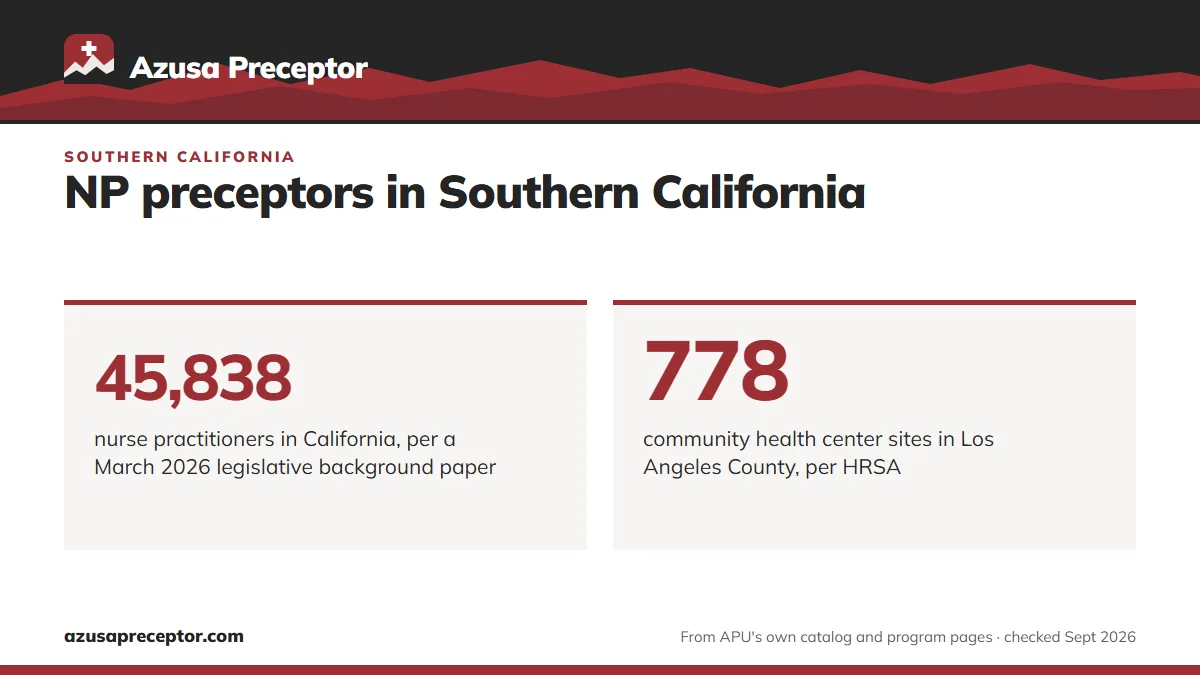
A March 2026 Senate background paper on the Board of Registered Nursing counted 45,838 nurse practitioners in California, and new NP applications rose 31% over the last four fiscal years. Most of them practice outside hospital walls: primary care offices, medical groups, specialty clinics and community health centers. That is the ground APU's primary care clinical hours cover, and where a near-home search pays off.
Physicians and PAs widen the field. APU's NP request forms list MD, DO and NP preceptors, and PAs when a physician is on site, so a family medicine or pediatric practice with no NP on staff can still host you, provided your sequence includes at least one semester precepted by an NP.
Community clinics and health centers
Federally qualified health centers and look-alikes form the region's largest outpatient network. HRSA counts active service delivery sites by county:
| County | Sites | Organizations running them |
|---|---|---|
| Los Angeles | 778 | 86 |
| San Diego | 259 | 15 |
| Orange | 162 | 27 |
| Riverside | 116 | 17 |
| San Bernardino | 76 | 19 |
| Kern | 72 | 7 |
| Ventura | 55 | 2 |
| Santa Barbara | 53 | 4 |
Few publish a student process. In San Diego County, Imperial Beach Community Clinic takes rotation applications straight from NP students, and Neighborhood Healthcare's internship interest form names FNP students among those it will hear from. Most others checked, including AltaMed, JWCH, Venice Family Clinic and Family Health Centers of San Diego, advertise NP residencies for new graduates or say nothing about students, so the way in is a direct, well-prepared request. None of these pages mentions APU, and each site would still need an APU affiliation agreement.
What the large systems publicly require
The region's best-known systems publish tight routes for students, and none of their public pages names APU.
- Kaiser Permanente Southern California places no student of any kind without an affiliation agreement already in force with the school, and its Nursing Pathways requests are submitted by the school's clinical coordinator.
- UCLA Health takes NP preceptorship requests from schools during set windows and asks that students not recruit UCLA staff as preceptors on their own.
- UC San Diego Health now weighs new nursing affiliations only where the student is a UCSDH employee or the specialty is one it needs.
- Scripps Health requires an agreement and takes requests through Complio, though most graduate students must identify their own preceptor first.
- Riverside University Health System names the departments open to NP students, psychiatry excepted, and takes applications through Clinician Nexus.
No public NP student process turned up for Cedars-Sinai, Keck Medicine of USC, Hoag or CHOC. How each route works, from CCPS to compliance portals, is on our Southern California placement systems page, and Riverside County has local detail on RUHS.
Shortage areas and what they mean for you
Federal shortage designations show where clinicians are stretched. Counting primary care HPSAs marked Designated or Proposed For Withdrawal, HRSA's September 2026 data lists 122 in Los Angeles County, 40 in Kern, 34 in San Bernardino, 28 in San Diego, 22 in Orange and 21 in Riverside. Mental health HPSAs follow a similar shape, with 109 in Los Angeles County and 34 in San Bernardino.
For a student, a shortage area cuts both ways. Clinics there serve communities short on clinicians, which makes a prepared student useful, but their providers may have little time to spare for teaching. A concise request with your course, hours and start date in hand respects that. Each of our region guides lists local shortage detail.
Lead times to plan around
- APU: its 2023-24 guidelines want word of a new preceptor 6 to 8 weeks ahead of the semester, plus time for an affiliation agreement if the site has none.
- Scripps Health: 6 to 8 weeks to set up an agreement.
- Kaiser Permanente Southern California: requests at least three months ahead, per its 2022 FAQ.
- UC San Diego Health: a decision within 30 days, but about 6 to 12 months for a signed agreement, with students urged to line up a backup.
Private practices and community clinics set no published lead time, which is one reason they suit a student working to APU's term calendar. A practice can agree in a single conversation; APU's review and any new agreement set the pace from there, so a search that starts a term ahead leaves room for both.
Matching the preceptor to your course and to California law
Before any call, know which preceptor your course needs. GNRS 600 is primary care, and a family practice qualifies for pediatric hours only with six or more pediatric patients a day, the same six-a-day test APU applies to women's health. PMHNP courses need a psychiatrist or PMHNP, and CNS courses a CNS or nurse leader. Relatives, close friends and your own unit are ruled out. The full list is on APU's preceptor requirements page.
State law adds one more check: under 16 CCR 1484, anyone precepting a California rotation must hold a current California license in their own discipline and be clinically current. Our California NP practice page explains how standardized procedures and AB 890 shape who precepts.
Why APU students choose us for the search
We search Southern California the way placements actually happen: outpatient practice by outpatient practice, outward from your home, with hospital systems that take only school-routed requests set aside for you to raise with APU's placement team rather than cold-called. Every preceptor we bring you fits your course and holds the California license the state requires, and the site details APU's request form needs arrive with the yes.
Whether you live in the San Gabriel Valley, the Inland Empire or San Diego, send your city, program and term through the form below. Your placement advisor maps the practices worth approaching near you, starting with the settings your next course needs, and keeps going until one of them says yes.
Questions APU students ask
Do Southern California hospitals take APU NP students?
Some large systems publish NP student routes, but each requires a school affiliation agreement and most want APU, not you, to make the request. None of the public pages reviewed for this guide names APU, so check with APU's Graduate Placement Team about existing agreements before you contact any hospital system.
Is it better to look for an NP or a physician preceptor?
Either can work for most APU NP courses. APU's forms accept physicians, NPs, and PAs who work alongside an on-site physician, but every NP student must complete at least one semester with an NP. A mix across terms, such as a family physician one term and an NP the next, keeps you within APU's rules while widening your options.
Can I do NP clinicals at a community health center?
Yes, if the center agrees, the setting fits your course and APU puts an affiliation agreement in place. Health centers serve large primary care and pediatric populations, which suits GNRS 600 and the pediatric courses. Few publish a student process, so a direct request with your course, hours and start date in hand is the usual way in.
Are clinics in shortage areas easier to get into?
Not necessarily. A shortage designation describes where clinicians are scarce, not where preceptors are available. A clinic in a shortage area may welcome help but have little time to teach. What matters most is a clear, complete request and a practice whose patients match your course, wherever it sits.
How early should I contact a Southern California practice?
Well before APU's own point for reporting a new preceptor, 6 to 8 weeks before the semester, since a clinic new to APU also needs an affiliation agreement. For a Spring 2027 term starting January 4, 2027, reaching practices during the fall leaves room for both steps.
Related pages
Last checked 2026-09-25
We check these pages against APU's own catalog and program pages. Your syllabus, your clinical faculty and APU's student placement coordinators have the final word.
APU says the clinical site and preceptor are yours to find. We make that the easy part.
Tell us your APU program, where you live in Southern California and when your next clinical term starts. We find preceptors who fit the course and prepare what APU and the site need before anything is approved.
- Preceptors matched to the course: primary care for
GNRS 600, pediatrics for the PNP courses, psychiatric care for PMHNP - Credentials, license and site details ready for APU's review and the affiliation agreement
- Close to home, from the San Gabriel Valley and the Inland Empire to San Diego
Start your placement plan
Program, city and term is all we need to begin.