APU's MSN Family Nurse Practitioner: planning your 540 clinical hours
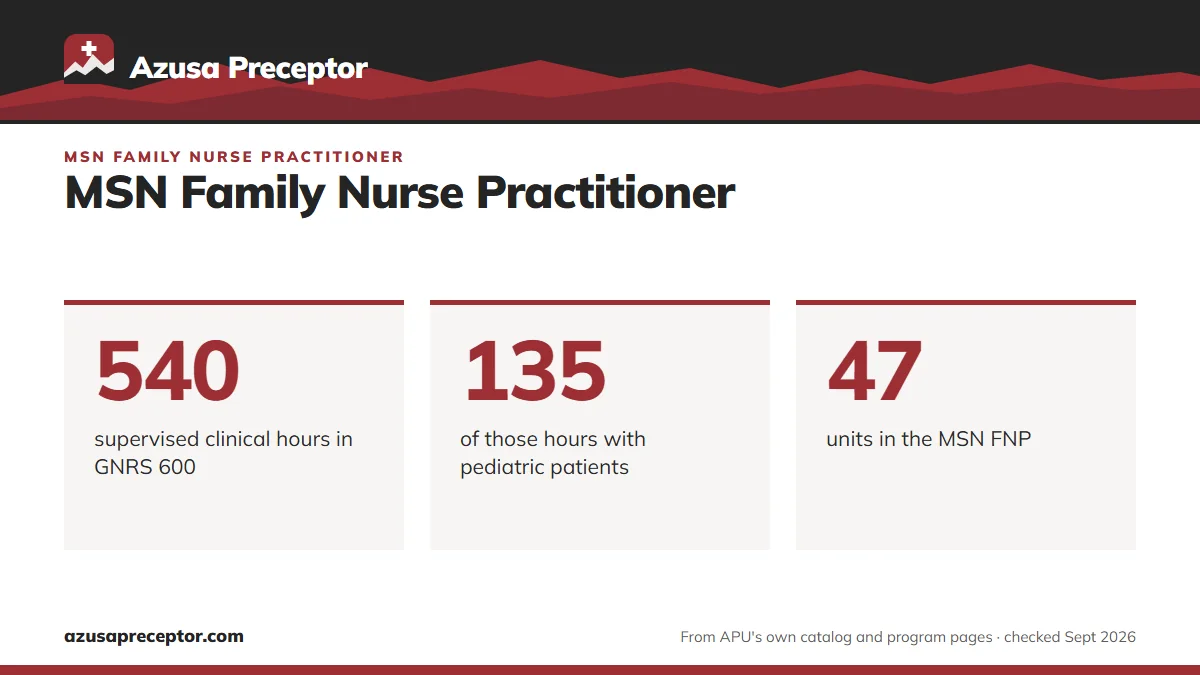
Azusa Pacific University (APU) builds its MSN Family Nurse Practitioner around one long clinical course, GNRS 600, where you log 540 hours with approved preceptors, 135 of them with children. You find a primary care site near home in Southern California with help from APU's placement staff, and the Graduate Placement Team clears it before your first day. This page maps the whole program from the clinical side, so each term's hours are planned before the term begins.
Plan your FNP clinicals
Campus, city and your first GNRS 600 term is enough to start.
On this page
Program at a glanceFirst clinical termCourses and hoursPreceptor profileResidence and experienceCertificationWhy students choose usQuestionsThe FNP program at a glance, from the clinical side
The MSN FNP prepares you to care for patients of every age in outpatient primary care. APU's 2026-27 catalog lists 47 units in four blocks: a 10-unit academic core (GNRS 504, GNRS 506, GNRS 508A), a 12-unit advanced practice core (GNRS 513 plus the GNRS 610-to-GNRS 612 chain), a 21-unit FNP specialty (GNRS 600 through GNRS 603), plus GNRS 590D Primary Health Care of the Young Family and the 1-unit GNRS 597.
You can take it in Azusa, in San Bernardino at the Inland Empire campus, or in San Diego's Mission Valley. APU says its MSN takes 6 to 9 semesters depending on specialty, with fall starts (priority deadline April 1, final June 15) and spring starts (priority deadline October 20). Your campus shapes the paperwork: the preceptor request form asks for it, and APU's onboarding hub had not yet posted its San Diego NP form, so San Diego students confirm the current route with the placement team.
Of the whole curriculum, only GNRS 600 puts you in a clinic. The rest is theory, the GNRS 612 lab or a seminar that runs beside it, so one course carries all 540 hours. That makes the FNP simpler to map than tracks with several clinical courses, and it makes each term's unit choice the decision that matters most.
When your first clinical term arrives
Your first precepted hours come in GNRS 600, which you begin alongside GNRS 601 Primary Healthcare I. Before that, the advanced practice core runs in a fixed chain: GNRS 610, then GNRS 611, then GNRS 612 with its lab. APU publishes no semester-by-semester sample plan for the FNP, so the program plan you build with your advisor is the document that names that term.
APU's recent graduate clinical guidelines (2023-24) put two gates in the way. Each of the three advanced courses, pathophysiology, pharmacology and health assessment, has to show a grade of B- or higher before a clinical course opens to you, and only students with a finished program plan are counted for placement. The current handbook and your advisor have the final word on both, and the GNRS 612 page explains the three-course gate.
Then count backward. Those guidelines expect six to eight weeks' warning to the placement coordinator whenever a new preceptor enters the picture, and the Fall 2026 compliance deadline was August 1, 2026. In practice, the search for your first FNP preceptor starts while you are still sitting in GNRS 611.
GNRS 600 and the FNP course sequence
The table lists every FNP course tied to clinical work. Units follow the catalog, and the hour figure is the one APU prints for the MSN.
| Course | Units | Clinical hours | Role in your plan |
|---|---|---|---|
GNRS 612 Advanced Health Assessment and Diagnostic Reasoning | 4 (3 class, 1 lab) | Lab only | Last step of the gate before clinicals |
GNRS 600 Nurse Practitioner Clinical Experience | 12 in total, 2-6 per term | 540 (stated), 135 pediatric | Every precepted hour of the program |
GNRS 601 Primary Healthcare I | Part of the 21-unit specialty | None | Corequisite with GNRS 600 |
GNRS 602 Primary Healthcare II | Part of the 21-unit specialty | None | Corequisite with GNRS 600 |
GNRS 603 and GNRS 590D | Specialty theory; 590D is 3 units | None | Primary care content, including young families |
Each term you may carry between 2 and 6 units of GNRS 600, with faculty approval, so a term's precepted load lands between 90 and 270 hours at APU's 45 hours per unit. Three terms of 4 units reach the 12; so do four terms of 3. APU's 2023-24 guidelines add that extra units need director or chair approval, because preceptor resources are shared. The GNRS 600 guide covers unit loads and the catalog's 540-765 range.
APU's current request form still lists some older course numbers, such as GNRS 592B and GNRS 593. Under the 2026-27 catalog, every FNP hour is logged in GNRS 600.
Who precepts FNP students, and where
The request form APU uses for NP students in Azusa and the Inland Empire lists who may precept you: physicians (MD or DO), NPs, and PAs who work with a supervising physician in the building. It adds a rule that shapes the FNP plan: for one full semester at minimum, your preceptor has to be a nurse practitioner. If your first site is physician-led, line up an NP for a later term, or the other way around.
The setting is outpatient primary care across the lifespan, which in practice means family practices and other primary care offices where adults, older adults and children all come through the door. A specialty clinic can count too, but only once faculty sign off.
The pediatric share has its own test. APU's form treats two kinds of site as pediatric: a pediatric clinic, or a family practice seeing six or more children daily. Either can carry your 135 hours; the pediatric hours page walks through both routes.
APU publishes no minimum years of experience, preceptor ratio or site-visit rule. It does bar precepting by a relative or close friend, and it keeps clinicals off the unit where you are employed. The preceptor requirements page has the exact wording.
Southern California residence and the experience gate
Two admission conditions in APU's catalog travel with you into clinicals: you must reside in Southern California, and you need a year or more of nursing experience. For an FNP, the residence rule is really a clinical rule. Your hours happen near where you live, and distance is one of the things APU's placement staff consider when a site comes in. The 2023-24 guidelines also ask you to stay put, since moving mid-program is discouraged and campus transfers are generally off the table.
Near home is relative. The guidelines rank fit with your level and patient population ahead of distance, call a drive of an hour or two in each direction common, and warn that Saturday and evening clinical slots are scarce, and scarcest in family practice. If you work weekday shifts, build your GNRS 600 terms around the clinic's hours, not the other way around.
APU's MSN also requires you to keep working clinically while enrolled, and your California RN license has to be current on file before clinical coursework starts. The license and residence page covers both rules in full.
Certification after the FNP
When you finish, two credentials are in reach: state NP certification, granted by the California Board of Registered Nursing (BRN), and national FNP board certification. As graduates of a California program, APU FNPs apply under the BRN's Method One, which the BRN's instructions (2019) describe as the application, a program verification form and a transcript. The BRN certification page covers timing.
National FNP certification comes from AANPCB, which now brands itself NPCB, or from ANCC. GNRS 611 Advanced Pharmacology, done before your first clinical term, is the course APU points to for the BRN's furnishing-number coursework.
The BRN's list of approved NP programs includes APU's Family Primary Care NP track, and CCNE accredits APU's master's programs through December 31, 2028. Both facts are worth having ready if a clinic asks about the program before agreeing to host you.
Why APU FNP students choose us
An FNP plan rests on primary care preceptors who can take you for a full term, and on getting the pediatric and NP-semester pieces right before APU sees the request. That is where our work goes.
- We search family practices and primary care offices near your home, from the San Gabriel Valley to San Diego, that fit your campus and your term.
- We check pediatric volume up front, so a family practice counted toward your 135 hours meets APU's six-children-a-day bar.
- We track which terms you spend with an NP and which with a physician or PA, so the NP-semester rule is covered by graduation.
- We gather each preceptor's credential and email along with the practice's legal name, who signs for it and how to reach the office manager: the full set of details the Graduate Preceptor Request form asks for.
- If a preceptor drops mid-term, we go straight back to the search for a replacement near you.
No FNP site is final until APU's Graduate Placement Team clears it in writing, and our job is to send that team a request with nothing missing and every FNP rule already met. Share your campus, your city and the term GNRS 600 begins, and the search starts there.
Questions APU students ask
What is the FNP clinical hour requirement at APU?
For MSN FNP students the catalog sets 540 supervised hours of direct patient care, every one of them logged in GNRS 600, and 135 or more must be pediatric. The GNRS 600 course description shows 540-765 because it also covers BSN-to-DNP students, who complete 750 direct-care hours on a longer path. If you are in the MSN, 540 is your number.
Can I do all my FNP hours at one clinic?
One clinic can work if it passes both of APU's tests: at least one semester of your time must be with an NP preceptor, and pediatric hours must come from a pediatric office or a family practice whose day includes at least half a dozen young patients. A family practice with NPs on staff and strong pediatric volume can do both. Confirm the plan with clinical faculty first.
Is the FNP offered at APU's San Diego campus?
Yes. APU's MSN NP page names San Diego among its three NP campuses, and the FNP post-master's certificate is offered there too. San Diego students track compliance in Complio rather than CastleBranch, and the onboarding hub had not yet posted a San Diego NP preceptor request form, so ask the placement team which route to use.
Do APU FNP students find their own preceptors?
APU runs a shared model for MSN NP students. It pays staff to help place you, and they take your commute into account, but it also relies on you to scout a site and preceptor close to where you live and tell the placement team about them; its request form even asks how you found the placement. The recent guidelines state that no placement is assured. The finding your own site page explains the model.
How early should I start looking for an FNP preceptor?
Start at least a term ahead. APU's 2023-24 guidelines set a six-to-eight-week notice period for any new preceptor, a new site needs an affiliation agreement that APU warns can take time, and Fall 2026 compliance was due August 1, 2026. Two terms ahead is the safer plan when a clinic has never hosted an APU student.
Related pages
Last checked 2026-09-25
We check these pages against APU's own catalog and program pages. Your syllabus, your clinical faculty and APU's student placement coordinators have the final word.
- APU Academic Catalog 2026-27: MSN, Family Nurse Practitioner
- APU Academic Catalog 2026-27: Graduate Nursing Programs and GNRS course descriptions
- APU: MSN with Nurse Practitioner Specialties
- APU School of Nursing student hub: Advanced Practice NP onboarding
- California BRN: Nurse practitioner certification instructions
APU says the clinical site and preceptor are yours to find. We make that the easy part.
Tell us your APU program, where you live in Southern California and when your next clinical term starts. We find preceptors who fit the course and prepare what APU and the site need before anything is approved.
- Preceptors matched to the course: primary care for
GNRS 600, pediatrics for the PNP courses, psychiatric care for PMHNP - Credentials, license and site details ready for APU's review and the affiliation agreement
- Close to home, from the San Gabriel Valley and the Inland Empire to San Diego
Start your placement plan
Program, city and term is all we need to begin.