The rules that govern an APU clinical rotation
Once Azusa Pacific University (APU) clears your site, a second set of rules governs how you earn the hours. APU's recent MSN Advanced Practice Guidelines require your clinical and didactic courses to run together, keep your hours steady across the term, bar a night shift before a clinical day and strip hours logged during a faculty-ordered pause. Knowing them before week one keeps every hour you work on the record.
Plan a rotation that fits the rules
Share your course, units and work schedule.
On this page
At a glanceConcurrent coursesNo front- or back-loadingNight shifts and workPauses and incompletesLogging and evaluationInjury or exposureWhy students choose usQuestionsAPU's rotation rules at a glance
Every rule below traces to APU's MSN Advanced Practice Guidelines dated 2023-24, the newest copy open to the public. Later editions require an APU sign-in, so check each point against your syllabus and ask your clinical instructor whenever a detail matters.
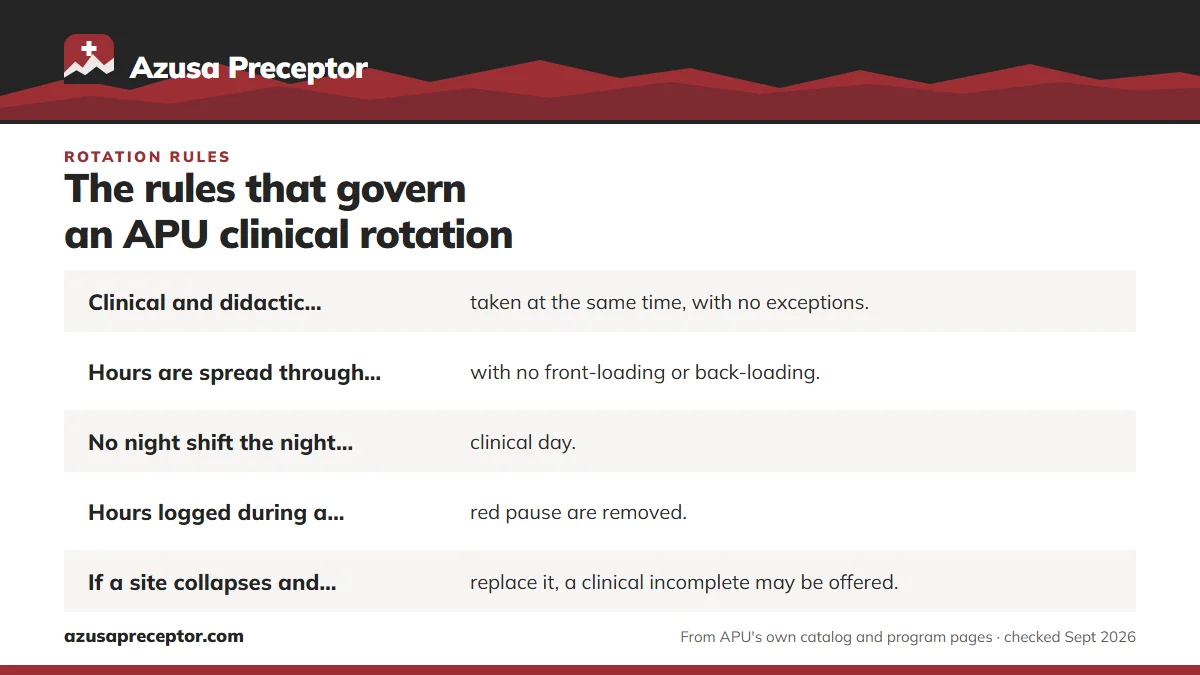
- Clinical and didactic courses are taken at the same time, with no exceptions.
- Hours are spread through the term, with no front-loading or back-loading.
- No night shift the night before a clinical day.
- Hours logged during a faculty-ordered pause are removed.
- If a site collapses and nobody can replace it, a clinical incomplete may be offered.
- Failing a course erases the hours logged in it.
- Hours are documented weekly in Medatrax.
Each rule has consequences you can plan for, and the sections below take them one at a time.
Clinical and didactic courses run together
APU pairs each clinical course with its classroom work and allows no exceptions. That is why the Graduate Preceptor Request form asks for both your clinical course number and your paired lecture course, and why you cannot bank clinical hours in a term when you are not enrolled in the matching lecture.
APU's catalog makes the pairing visible. FNP students meet it in the two Primary Healthcare courses, GNRS 601 and GNRS 602, each of which names GNRS 600 as a corequisite. Adult-gerontology NP students add GNRS 580 Gerontology in the same term as GNRS 600, and PMHNP students may carry GNRS 539 Psychopharmacology while they are in GNRS 535.
The practical upshot is that your preceptor's calendar has to fit your lecture term, not the other way around. A preceptor who can take you only in a term when your lecture is not offered is not a workable match, however good the clinic.
Keep your hours steady across the term
APU does not allow hours to be front-loaded at the start of a term or back-loaded at the end. Hours are meant to build week by week alongside the lecture content, which means a preceptor who can host you only during the final month is a poor fit even if the total would add up.
The weekly load follows from your units. APU counts 45 clinical hours per clinical unit, so 3 units in a 16-week session works out to roughly 8.4 hours each week; the full math for other loads is on our 45 hours per clinical unit page.
Two realities from APU's guidelines shape that weekly rhythm. Saturday and evening clinical time is scarce, most of all in family practice, so plan on weekday hours. APU also puts fit ahead of geography: a site that suits your level and population beats a nearby one, and the guidelines call a commute of one to two hours in each direction ordinary.
Night shifts and working while enrolled
Working the night before a clinical day is off the table under APU's guidelines. That matters more than it sounds, because the MSN and DNP programs require ongoing clinical employment during enrollment. If you work nights as a staff nurse, build the rule into your schedule request before the term starts, and give your preceptor clinic days that follow a night off.
Rotating at the hospital or clinic that employs you is allowed with conditions. The employer signs a document dividing your job duties from your student duties, clinical hours stay unpaid and separate from your usual duties, and the current request forms keep you out of your home unit. The organization also needs an APU affiliation agreement. Our preceptor requirements page covers the impartiality rules that come with it.
APU counts a concealed close relationship with a preceptor as an ethics breach that can end in course failure, so disclose any connection at the request stage.
Pauses, incompletes and failed courses
Faculty can order a pause in a rotation, and any hours logged during it are removed. The public guidelines state the rule without listing reasons for a pause, so treat any instruction to stop as applying to the whole site until faculty lift it in writing.
When a site collapses partway through the term and no substitute turns up, APU may grant a clinical incomplete, letting you finish the remaining hours once the term closes. That differs from the start-of-term rule for students who were never placed, explained on our no-placement drop rule page. If a preceptor has just stepped away, our preceptor dropped out page covers what to do next.
A failed clinical course forfeits its hours, and the repeat begins its tally at zero. Partner facilities can also halt a rotation: APU itself leaves COVID-19 vaccination optional, yet a facility may turn away a student who misses its standard, and time lost that way cannot always be recovered within the term, so an incomplete or a withdrawal request can follow.
Logging and evaluation while you rotate
Document your hours every week in Medatrax. Missing weekly entries can lead to an academic warning, and entries from a site APU has not approved are struck by the department chair. Our Medatrax page explains the log in detail.
Your preceptor and your clinical faculty both evaluate you. APU treats the clinical evaluation and the preceptor evaluation as minimum-standard tools, and falling below the standard in any category triggers a remediation plan with clinical faculty. Most clinical courses also include OSCEs, covered on our evaluations and OSCEs page.
Ask your preceptor early how they like to give feedback, and tell clinical faculty about any problem at the site before it grows. Leaving a site without letting faculty try to fix the problem is one of the reasons APU withholds a late-drop fee waiver.
Injury, exposure and emergencies at a site
Under the 2024-25 SON Student Handbook, a clinical injury or exposure is handled as an APU workers' compensation matter. The first call goes to your instructor, who brings in Human Resources, and treatment starts at a Concentra urgent care. For an emergency at a regional campus, the Regional Site Director is the person to reach.
Your own coverage matters here as well. Signing the Clinical Participation Form commits you to carry comprehensive health insurance from the first practicum day to the last, and a site may ask to see the card. Respirator fit is handled by the SON: post-licensure students have no standing N95 requirement, yet the school arranges the fit test and masks whenever a facility calls for them.
The annual training modules belong to the same preparation. Bloodborne Pathogens and Aerosol Transmissible Diseases, the Cal/OSHA standard that covers COVID-19, are repeated every year in Canvas, and their certificates go into CastleBranch or Complio. Letting one lapse mid-rotation can stall your clearance at the site, so check expiry dates before each term.
How we keep your rotation on schedule
The best rotation is one built to fit these rules before it starts. When we match you, we check your preceptor's clinic days against your lecture term, your unit load and your work schedule, so steady weekly hours are realistic from week one. Credentials, license and site facts for APU's review arrive as one complete package, so the clearance paperwork is right the first time.
Should a preceptor leave partway through, our team stays reachable and starts a replacement search at once, which gives you the best chance to finish your hours on time. We also plan around the night-shift rule and your paired lecture course when we propose clinic days, so the schedule APU sees is one you can keep. Read how it works, or send your course and term through the form below.
Questions APU students ask
Can I finish all my APU clinical hours in the first half of the term?
APU's guidelines bar front-loading, so hours are expected to build steadily across the term alongside the lecture course. If a preceptor can host you for only part of the term, raise it with your clinical faculty before agreeing to the schedule, since a compressed block may not be accepted.
Can I work a night shift before an APU clinical day?
Not under APU's guidelines, which prohibit a night shift the night before clinical. Because APU also expects graduate students to keep working clinically, plan your work schedule and clinic days together. Confirm the current rule in your syllabus, since the public guidelines are the 2023-24 edition.
What happens to my hours if my clinical faculty pauses my rotation?
Any hours logged during a faculty-ordered pause are removed, so stop attending the site the moment a pause begins and wait for written word that it has ended. If the pause leaves you short near the end of the term, ask your clinical faculty whether a clinical incomplete is an option for you.
Do my hours carry over if I fail an APU clinical course?
No. Under APU's guidelines, a failed course's hours are lost, and the repeated course starts from zero. APU's graduate repeat policy caps attempts at three, and a program may allow fewer, so talk with your advisor about the plan before you re-enroll.
Can my clinical rotation be at the hospital where I work?
Yes, if APU's conditions are met. You need a division of labor in writing from your employer, your clinical time has to be separate from paid work, and the 2026 request forms exclude your own unit. The hospital also needs an APU affiliation agreement before the placement team can clear it.
Related pages
Last checked 2026-09-25
We check these pages against APU's own catalog and program pages. Your syllabus, your clinical faculty and APU's student placement coordinators have the final word.
APU says the clinical site and preceptor are yours to find. We make that the easy part.
Tell us your APU program, where you live in Southern California and when your next clinical term starts. We find preceptors who fit the course and prepare what APU and the site need before anything is approved.
- Preceptors matched to the course: primary care for
GNRS 600, pediatrics for the PNP courses, psychiatric care for PMHNP - Credentials, license and site details ready for APU's review and the affiliation agreement
- Close to home, from the San Gabriel Valley and the Inland Empire to San Diego
Start your placement plan
Program, city and term is all we need to begin.