GNRS 600 at APU: the NP clinical course, unit by unit
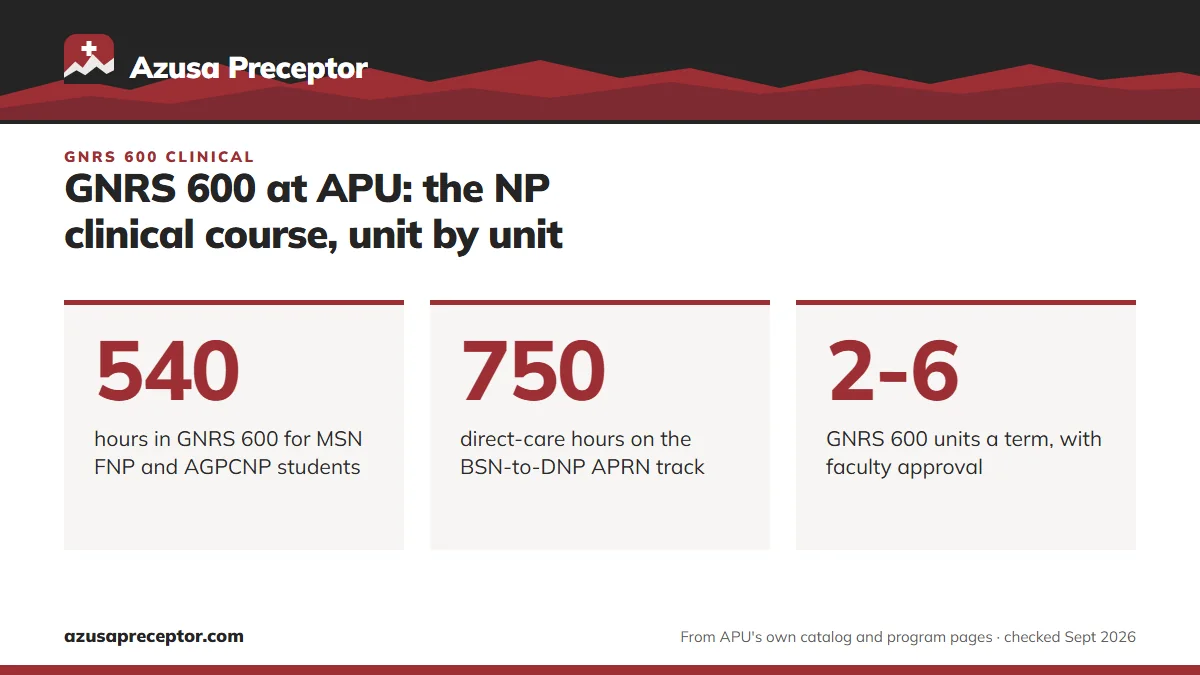
GNRS 600 Nurse Practitioner Clinical Experience is where Azusa Pacific University (APU) Family NP and Adult-Gerontology Primary Care NP students earn their direct patient care hours. MSN and certificate students complete 12 units and 540 hours; BSN-to-DNP APRN students go up to 17 units with at least 750 direct-care hours, taken 2 to 6 units a term.
Plan your GNRS 600 preceptors
Tell us your track, campus and next term.
On this page
Who takes GNRS 600MSN and certificatesBSN-to-DNP APRN trackUnits per termCorequisites and gatesPreceptors and settingsHow we helpQuestionsWhat GNRS 600 is and who enrolls in it
GNRS 600 is APU's primary care clinical course for the two nurse practitioner tracks built on it: the Family Nurse Practitioner (FNP) and the Adult-Gerontology Primary Care NP (AGPCNP). The catalog describes you working as a student NP under approved preceptors and logging the hours you complete.
Students meet it on several paths: the MSN FNP and MSN AGPCNP, the post-master's FNP and AGPCNP certificates, the MSN that pairs the FNP with the School Nurse Services Credential, and the APRN track of the BSN to DNP. ELM-MSN students who pick the FNP or AGPCNP follow the matching MSN courses once they pass the NCLEX. The PNP-PC, PMHNP and CNS tracks use their own course numbers; pediatric students should read the PNP course sequence instead.
12 units and 540 hours on the MSN and certificate paths
For MSN and post-master's certificate students, GNRS 600 totals 12 units, and APU's catalog states the hours in plain words: 540 supervised direct patient care hours. That printed pairing is one of the sources of APU's 45 hours per clinical unit ratio. The catalog also attaches a 135-hour pediatric share to the FNP, which has its own page.
| Path | GNRS 600 units | Clinical hours | How APU shows it |
|---|---|---|---|
| MSN Family NP (47 units) | 12 | 540, with 135 pediatric | Stated in the catalog |
| MSN Adult-Gerontology Primary Care NP (46 units) | 12 | 540 | Stated in the catalog |
| Post-master's FNP certificate (36 units) | 12 | 540 | Stated for GNRS 600 |
| Post-master's AGPCNP certificate (35 units) | 12 | 540 | Stated for GNRS 600 |
| MSN FNP with School Nurse Services Credential (56 units) | 12 | 540, plus 135 in GNRS 550A | 540 stated; the 135 works out from units |
| BSN to DNP, APRN track (70-71 units) | Up to 17 | At least 750 direct-care | 750 stated; 17 units works out to 765 |
The printed 540 also sits above California's floor: the BRN's NP program regulation, 16 CCR 1484, calls for at least 500 supervised direct patient care hours and 12 semester units of supervised clinical practice. The 540-765 span in the course entry exists only because one description serves both the master's and the doctoral route.
17 units and 750 hours on the BSN-to-DNP path
BSN-to-DNP students on the FNP or AGPCNP track carry GNRS 600 further. For this pathway the catalog allows up to 17 units and sets a floor of 750 direct-care hours, with a 135-hour share reserved for children on the family track or for older adults on the adult-gerontology track. Multiply 17 units by 45 and you reach 765, the top of the printed span.
APU's dated 2023-24 guidelines go further: anyone on the APRN track who entered after Fall 2023 remains registered in GNRS 600 every term, without a break, and finishes at least 750 hours at a pace of 90 to 270 a semester. With no gap terms, a preceptor who leaves shows up in your hours immediately, so the next site should be ready before the current one wraps. The current handbook and your program director have the final word for your cohort.
Those 750 hours are the NP portion of a doctorate that requires 1,000 clinical hours overall. How they combine with the GNRS 732 residency is covered on the DNP residency hours page.
Spreading 2 to 6 units across your terms
Faculty can approve anywhere from 2 to 6 GNRS 600 units in a single term for FNP and AGPCNP students; at 45 hours apiece, a term's clinical load therefore runs from 90 hours up to 270. APU's graduate calendar has three terms a year in which clinical units can be scheduled, fall, spring and summer, and each offers a 16-week session.
| Plan | Units each term | Hours each term | Terms needed |
|---|---|---|---|
| Steady | 4 | 180 | 3 |
| Heavier | 6 | 270 | 2 |
| Lighter | 3 | 135 | 4 |
| Ramp up | 2, then 4, then 6 | 90, then 180, then 270 | 3 |
Over a 16-week session, 4 units comes to roughly 11 hours weekly and 6 units to about 17. APU's recent guidelines bar front-loading and back-loading, so build the plan around a weekly pace rather than a rush at the end; the rotation rules page covers the rest.
Going past your approved load takes sign-off from a program director or department chair, since every added unit draws on the same shared pool of preceptors. Ask before you register.
Courses that run beside GNRS 600
GNRS 600 never runs on its own. GNRS 601 Primary Healthcare I and GNRS 602 Primary Healthcare II list it as a corequisite, and APU's recent guidelines say didactic and clinical courses are taken together, with no exceptions. AGPCNP students must also take GNRS 580 Gerontology together with it, while FNP students complete GNRS 603 and GNRS 590D as theory courses.
Before your first unit, the catalog's prerequisite chain runs from GNRS 610 to GNRS 611 to GNRS 612 and its lab (BSN-to-DNP students can take GNRS 611 without GNRS 610). APU's dated guidelines add a grade floor, B- or higher in each of the three P's (pathophysiology, pharmacology and advanced assessment), and they leave students who lack a finished program plan out of the placement count. The GNRS 612 page explains that gate.
Older numbers still surface. The catalog keeps legacy courses such as GNRS 581, GNRS 591, GNRS 592B and GNRS 593 in its course list, and the GNRS 592B entry still says clinical hours are completed there. Today's FNP and AGPCNP students record their hours under GNRS 600; if your plan shows an older number, you may be on an earlier catalog, so confirm it with your advisor.
Preceptors and settings that fit GNRS 600
The FNP course is outpatient primary care across the lifespan. The AGPCNP track runs from young adults to older adults, and APU's description points to settings that range from community health centers and private offices to long-term care and visits in patients' homes.
On APU's current request form, MDs, DOs, NPs, and PAs who have a supervising physician on site all qualify, and at least one of your terms must be spent learning from a nurse practitioner. Relatives and your own work unit are excluded; preceptor requirements lists the full rules.
Two practical limits come from APU's dated guidelines. Weekend and after-hours clinic time is hard to come by, family practice most of all, and because fit for level and population outranks distance, an hour-plus commute each way is routine.
How we line up GNRS 600 preceptors term after term
APU students choose us because we plan GNRS 600 as a sequence of terms rather than one placement. We map your units per term, find primary care preceptors near home in Southern California who can carry that weekly load, and make sure your NP semester and your pediatric or geriatric share land somewhere in the plan.
For each preceptor we gather what APU's Graduate Preceptor Request form asks for: who the preceptor is and how to reach them, the practice's registered legal name, the person authorized to sign for it and the office manager. We find out at the start whether APU and the practice already have an affiliation agreement on file, since a new one takes longer to put in place. Clearance is APU's call; what we control is handing the team a request with nothing missing.
Should a preceptor bow out mid-sequence, a replacement search opens at once, so your hour count keeps climbing. Send your track, campus and next term through the form below.
Questions APU students ask
Is GNRS 600 one course or several?
It is one course number that you register for across several terms. MSN and certificate students accumulate 12 units in total, and BSN-to-DNP APRN students go up to 17. Each term you enroll in a portion, between 2 and 6 units with faculty approval, paired with its didactic course. Your program plan sets which portion falls in which term.
Why does APU's catalog list 540-765 hours for GNRS 600?
The range covers two paths in one description. MSN and post-master's students finish 12 units, which the catalog states as 540 hours. BSN-to-DNP students can take up to 17 units, and 17 times 45 gives 765, while their printed minimum is 750 direct-care hours. Neither figure is an error.
Can I take more than 6 units of GNRS 600 in one term?
The catalog tops out at 6 units a term with faculty approval, and the dated guidelines ask for a director's or chair's sign-off on anything heavier, because preceptors are a shared resource across APU students. Six units is already 270 hours in one term. Talk to your advisor before building a plan above that.
Do I need a different preceptor each term of GNRS 600?
APU publishes no rule that forces a change every term. What it does publish: one Graduate Preceptor Request form per preceptor, at least one term learning from a nurse practitioner, and written clearance before you start at any new site. Whether to stay with one preceptor for a second term is a question for your clinical faculty, who weigh your level and the patients you still need.
Can GNRS 600 units fall in the summer?
APU's graduate calendar treats summer as a full term, so clinical units can be scheduled in fall, spring and summer. Summer 2027 offers a 16-week session, a 12-week session and two 8-week sessions. Whether your units land in summer depends on your program plan and the paired didactic course, so check the plan with your advisor.
Related pages
Last checked 2026-09-25
We check these pages against APU's own catalog and program pages. Your syllabus, your clinical faculty and APU's student placement coordinators have the final word.
APU says the clinical site and preceptor are yours to find. We make that the easy part.
Tell us your APU program, where you live in Southern California and when your next clinical term starts. We find preceptors who fit the course and prepare what APU and the site need before anything is approved.
- Preceptors matched to the course: primary care for
GNRS 600, pediatrics for the PNP courses, psychiatric care for PMHNP - Credentials, license and site details ready for APU's review and the affiliation agreement
- Close to home, from the San Gabriel Valley and the Inland Empire to San Diego
Start your placement plan
Program, city and term is all we need to begin.