APU affiliation agreements: the contract behind every clinical site
Azusa Pacific University (APU) needs an affiliation agreement with the organization behind every clinical site before you can train there. When the clinic already holds one, clearance can move quickly; when it does not, APU warns the process takes time. This page covers what the agreement needs from you, who signs it and how to give it the lead time it deserves.
Find a site that is ready for APU
Tell us your course, city and term.
On this page
What it isFields that feed itLead timeExisting vs new sitesWritten clearanceYour employer as a siteWhy students choose usQuestionsWhat an affiliation agreement is at APU
An affiliation agreement is the contract between APU and the organization that runs your clinical site. APU's BSN-to-DNP FAQ says each clinical site must have one, and the same requirement shows up across the MSN nurse practitioner, clinical nurse specialist, nursing education and leadership tracks. It is signed at the organization level, which is why APU asks for the clinic's legal name and an authorized signer rather than only your preceptor's details.
Two other documents travel with it. Your preceptor receives a preceptor handbook and signs a Preceptor Agreement Form, both handled by APU's placement coordinator. APU's recent guidelines also describe a general liability contract set up once the placement team has vetted a preceptor you propose. The affiliation agreement is the piece that covers the organization itself.
The paperwork itself is not public. The Preceptor Handbook, the Preceptor Agreement Form and the current MSN Advanced Practice Guidelines sit behind APU's login, so the SON student hub and your placement coordinator are where current versions live.
The request form fields that feed the agreement
The agreement process starts with the Graduate Preceptor Request form you submit once a preceptor has said yes. Three of its fields exist mainly for the contract, and they are the ones students most often fill in loosely.
- Clinic legal name. The registered name of the organization, which can differ from the sign on the door or the name on the website. The form notes this name is needed for the affiliation agreement.
- Legal signer with credentials. The person authorized to sign contracts for the organization. That may be a practice owner, an administrator or someone in a central office, and it is often not your preceptor.
- Office manager contact. The person who handles the clinic's paperwork day to day and can keep the agreement moving.
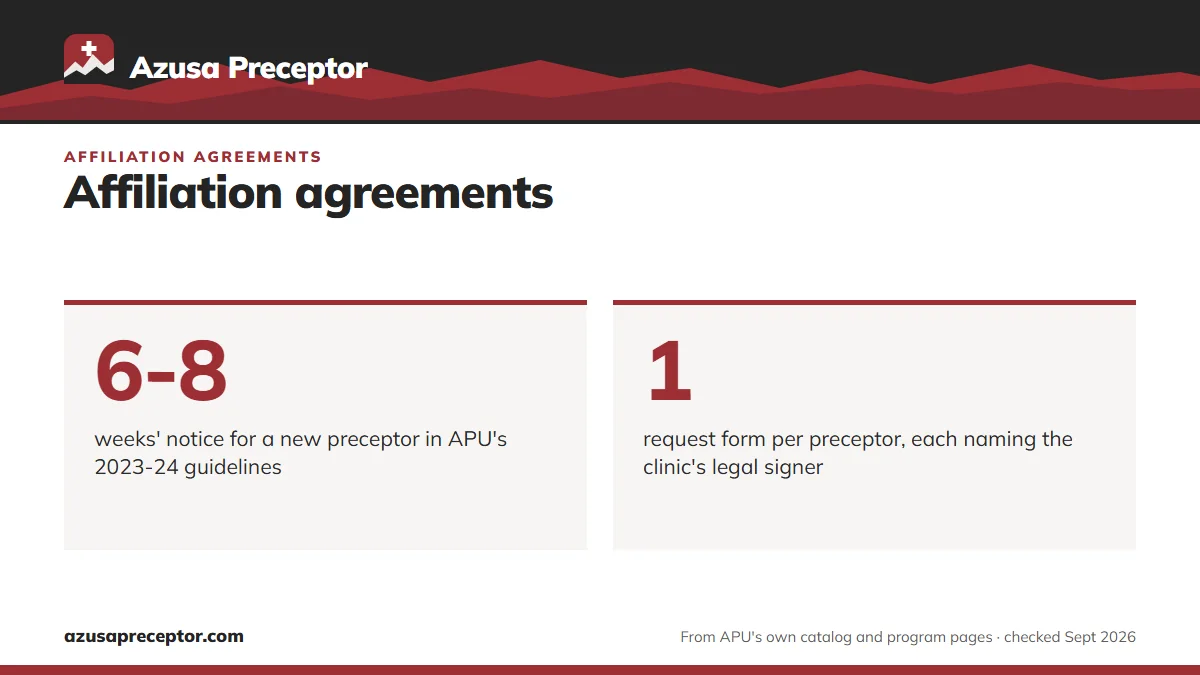
The same form collects your campus, city, course number and paired lecture course, plus the preceptor's name, credential and email. Our Graduate Preceptor Request form guide walks through every field. One form goes in per preceptor, so a second preceptor at a different organization brings a second organization for APU to check.
Why a new site needs lead time
APU states plainly that an affiliation agreement can take time, especially when the organization has no current agreement with the university. It publishes no exact turnaround, and the organization's own review is part of the wait, so the safest plan is to start as soon as a preceptor agrees.
The clearest timing guidance sits in APU's 2023-24 MSN Advanced Practice Guidelines: give the placement coordinator six to eight weeks' warning of any new preceptor before the term begins, which leaves APU time to vet that person and arrange a liability contract. Treat that window as a minimum for an organization APU has never worked with, and confirm the current figure with the Graduate Placement Team, since the current guidelines are behind APU's login.
The one track with a published calendar shows how APU spaces the steps. In the Healthcare Administration and Leadership practicum, about two weeks separate the student's site survey from the SON's target date for confirming the agreement, and roughly three and a half months separate that survey from the target start date.
Sites with an agreement and sites without one
Whether an organization already holds an APU agreement changes the whole timeline, and APU's forms say as much. The Nursing Education site form says a requested site hinges either on a contract APU already holds or on whether the agency will agree to begin one. The NP request forms warn that current APU preceptors may not be available, so a clinic that hosted an APU student last year is a lead, not a promise.
Ask the question early. An office manager can often tell you whether the organization has hosted APU nursing students and who handled the contract. If the answer is no, you need a signer who is willing to start one, and you need to start sooner.
Some programs lean on agreements APU already holds. APU reports holding several such agreements with partners that operate cancer centers, where Oncology NP Fellowship hours happen, and prelicensure BSN and ELM clinical groups are assigned once partner facilities confirm. For NP, CNS and educator students who bring their own site, agreement status is the first thing to check. Never assume a hospital or clinic has an agreement because a classmate trained there; the placement team confirms it.
Written clearance comes before your first shift
Both current NP request forms put the site off-limits until the Clinical Placement Team clears it, and APU's guidelines add that you do not set foot there as a student until the placement coordinator has confirmed approval in writing. The coordinator's side of that clearance covers vetting the preceptor, securing the organization's agreement and confirming your own practicum requirements are up to date.
The stakes are concrete. Hours earned before approval get deleted from your record by the department chair, so a week of early shifts can vanish from your total. Our Medatrax guide covers how the hour log works once you are cleared.
A verbal yes from the clinic is not clearance. Wait for APU's written approval before you log a single hour.
When the site is your own employer
Training where you work does not skip the agreement: the organization still needs one on file with APU. On top of that, your employer must sign off on a written split between your job and your student role, your usual duties and paycheck stay out of clinical time, and the 2026 forms rule out clinicals in the unit where you work.
In a larger organization the authorized signer may sit in a central office rather than on your unit, so the legal signer you list may be someone you have never met. Put that person on the form rather than your manager, unless your manager holds signing authority. The wider preceptor rules, including the limits on family members and close friends, are on our preceptor requirements page.
How we prepare an agreement-ready site
APU students choose us because we treat the affiliation agreement as part of the match from day one. Once we line up a preceptor suited to your course within reach of your Southern California home, we ask the organization early whether it already holds an APU affiliation agreement and tell you the answer before you commit. What we gather for APU's review:
- The clinic's legal name exactly as registered
- The legal signer with credentials, confirmed with the office
- The office manager contact who will handle the paperwork
- The preceptor's credential, license and email
- The site's own onboarding needs, such as a facility portal, Live Scan or CB Bridges
Every site is cleared in writing by APU's placement team; our part is making sure the file they receive is complete and fits APU's rules the first time. If a preceptor drops later, we stay on call and search for a replacement with the same care. See how it works or use the form below to start.
Questions APU students ask
Does my clinic need a new APU affiliation agreement if it has hosted APU students before?
Not always, but past hosting is not proof. APU's forms warn that current APU preceptors may not be available, and an agreement covers a specific organization. Put the clinic's exact legal name on the Graduate Preceptor Request form and let the Graduate Placement Team confirm whether a current agreement covers your site before you plan around it.
How long does an APU affiliation agreement take?
APU publishes no fixed turnaround. It warns that agreements take time, especially with an organization that has no current agreement, and its 2023-24 guidelines want six to eight weeks of warning before the semester whenever a preceptor is new. For a brand-new organization, start earlier than that and confirm the current window with the placement team.
Who signs the affiliation agreement for my clinical site?
An authorized legal signer for the organization, whose name and credentials go on your request form. Depending on the setting, that could be a practice owner, an administrator or a central contracts office, and it is often not your preceptor. The office manager is usually the best person to ask who holds that authority.
Can I start clinical hours while the agreement is being finalized?
No. The request forms say you may not report until the Clinical Placement Team clears the site, and APU's guidelines require written approval first. Hours from an unapproved site are struck from Medatrax, so early shifts cost time rather than saving it. Use the wait to finish CastleBranch or Complio items and any facility onboarding.
Is the affiliation agreement the same as the Preceptor Agreement Form?
No. The affiliation agreement is between APU and the organization that runs the site. The Preceptor Agreement Form is signed by your individual preceptor, who also receives APU's preceptor handbook from the placement coordinator. Neither document is posted publicly, so your coordinator is the place to see current copies.
Related pages
Last checked 2026-09-25
We check these pages against APU's own catalog and program pages. Your syllabus, your clinical faculty and APU's student placement coordinators have the final word.
APU says the clinical site and preceptor are yours to find. We make that the easy part.
Tell us your APU program, where you live in Southern California and when your next clinical term starts. We find preceptors who fit the course and prepare what APU and the site need before anything is approved.
- Preceptors matched to the course: primary care for
GNRS 600, pediatrics for the PNP courses, psychiatric care for PMHNP - Credentials, license and site details ready for APU's review and the affiliation agreement
- Close to home, from the San Gabriel Valley and the Inland Empire to San Diego
Start your placement plan
Program, city and term is all we need to begin.