Who can precept Azusa Pacific nursing students
Azusa Pacific University (APU) sets preceptor rules course by course rather than in one list for every student. NP students train with physicians, NPs or physician assistants, PMHNP students with psychiatrists or PMHNPs, and CNS, educator and leadership students with preceptors from their own field. One rule runs through all of them: the preceptor has to be impartial, which rules out relatives, close friends and anyone from your own unit.
Get your placement plan
Tell us your APU program and where you live. A placement advisor replies with the preceptor and site options that fit your APU course.
On this page
At a glanceNP preceptorsPMHNP preceptorsCNS, educator, leaderFamily and own-unit rulesUnpublished rulesWhy students choose usQuestionsAccepted preceptors at a glance
The table draws on APU's 2026 request forms, its program guidelines and the SON student site. For any single course, your syllabus and clinical faculty settle the question.
| Program or course | Accepted preceptors | Conditions |
|---|---|---|
NP tracks (FNP, AGPCNP, PNP-PC), including GNRS 600 | MD, DO, NP, or PA | A PA needs a supervising physician on site; one semester or more with an NP |
PMHNP, GNRS 535 to GNRS 538 | Psychiatrist (MD) or PMHNP | LMFT or psychologist in GNRS 535 only; one semester or more with a PMHNP |
CNS, GNRS 520, GNRS 521, GNRS 543 | CNS, or a nurse leader in GNRS 521 and GNRS 543 | Working in leadership, unit care or nursing education |
Nursing Education, GNRS 663 | Nurse educator | A 135-hour capstone practicum |
Healthcare Administration and Leadership, GNRS 567 | Nurse administrator with proven leadership | Preceptor Handbook qualifications also apply |
Pre-licensure preceptorships, such as the ELM residency in GNRS 573 | An RN employed by the health care agency | Meets the BRN qualifications in Title 16 CCR 1426.1 |
Nurse practitioner tracks: physicians, NPs and PAs
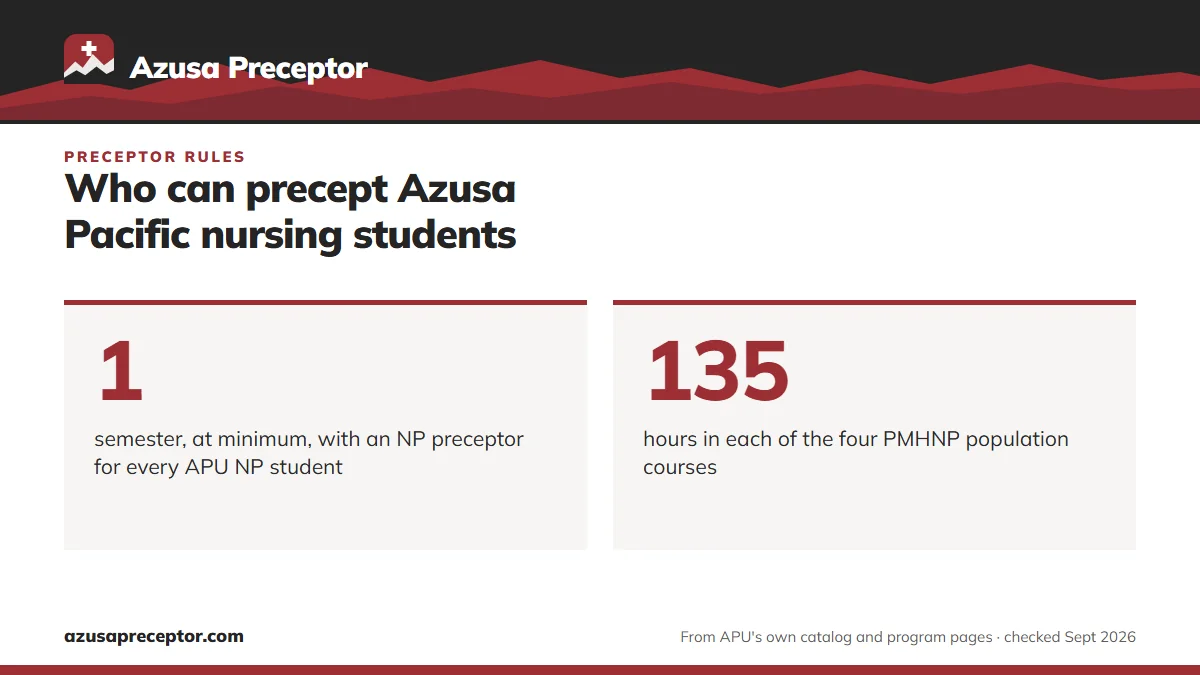
For FNP, AGPCNP and PNP-PC courses, the Azusa and Inland Empire form names four credentials that can precept: physicians holding an MD or DO, nurse practitioners, and physician assistants whose supervising physician works on site. Two conditions shape a multi-term plan. Each student has to spend at least one semester under a nurse practitioner, and a PA works as a preceptor only where the supervising physician is physically present.
Setting matters as much as credential. GNRS 600 runs in outpatient primary care, and for pediatric and women's health courses a family practice qualifies only if it sees six or more patients a day from that population; specialty clinics need faculty approval. FNP pediatric hours applies that test to the 135 pediatric hours.
The form's credential dropdown also offers CNS, CNM and PNP. A pediatric nurse practitioner counts as an NP; for a CNM or CNS in an NP course, ask your clinical faculty before you file.
PMHNP preceptors: psychiatrists and PMHNPs
The PMHNP Preceptor Request form narrows the field. A psychiatrist (MD) or a PMHNP can precept any of the population courses (GNRS 535, GNRS 536, GNRS 537, GNRS 538), at 135 hours apiece. A psychologist or an LMFT (licensed marriage and family therapist) is acceptable for GNRS 535 alone, the lifespan interventions course, and across the program every student needs a semester or more with a PMHNP.
Specialty clinics need faculty review, a rule worth keeping in mind for the later population courses: adults and older adults in GNRS 536, children and adolescents in GNRS 537, and a selected population in GNRS 538. Because each course centers on a different population, line up the preceptor for each one before its term opens. PMHNP clinical courses maps each course to its settings.
CNS, educator and leadership preceptors
CNS students in GNRS 520, GNRS 521 and GNRS 543 precept with a CNS. For the second and third of those courses, APU also accepts a nurse leader, provided the leader works in leadership, unit care or nursing education, and the form lists 180 hours for each course. CNS clinical courses covers the pediatric track numbers too.
Nursing Education students take the GNRS 663 capstone, 135 hours under a nurse educator preceptor, plus a separate supervised practicum in GNRS 518. The student's own nursing license must be active, with no encumbrance, in the state hosting the practicum.
For Healthcare Administration and Leadership, the 2025-26 guidelines want a nurse administrator with proven leadership in GNRS 567. The same guidelines place a care-management practicum under GNRS 543, ideally led by someone who runs interdisciplinary care-management teams, with business or management degrees a strong fit, while the 2026-27 catalog lists the HAL care coordination course as GNRS 562. Check your syllabus for the number that applies to you.
Family, friends, employers and your own unit
APU insists on an impartial preceptor. A family member or close friend cannot precept you, and you may not share a clinical site with a family member who is also enrolled in the School of Nursing. Concealing a close relationship counts as an ethics breach, and the penalty can go as far as failing the course.
Your employer can host you under three conditions: the employer signs a written division of labor, your clinical hours are unpaid and exclude your usual job duties, and, per the 2026 request forms, you train outside your home unit. Another clinic or department inside the same employer can satisfy all three. Finding your own clinical site covers how to turn a work contact into a lead.
A relative, a close friend or a colleague from your own unit is ruled out as a preceptor, and hiding the relationship is an ethics violation. Choose someone else before you file.
What APU keeps in the Preceptor Handbook
APU's public sources leave several preceptor questions open. They set no minimum years of experience, say nothing on whether the preceptor's license or board certification must be from California, and publish no student-to-preceptor ratio and no faculty site-visit policy. Those details, where APU has them, sit in the Preceptor Handbook and Preceptor Agreement Form, neither of which is public.
The placement coordinator sends the handbook to each preceptor and collects the signed agreement, so the preceptor sees the full terms at the start. If a preceptor asks about experience or supervision ratios before agreeing, send that question to APU's Graduate Placement Team before you file the Graduate Preceptor Request form. Preceptors weighing a yes can read precepting an APU student.
Why APU students choose us to vet preceptors
The costly mistake is a preceptor who looks right and still does not fit the course: a PA with no physician on site, a therapist lined up for a PMHNP course after GNRS 535, or a colleague from the student's own unit. We screen for each of those before a single form is filled in.
We match the preceptor's credential and practice setting to your APU course, test the patient mix against APU's six-a-day rule where it applies, and assemble the license, credential and site details APU's reviewers look at. Faculty and placement staff at APU approve every preceptor, and the preceptor we bring them already meets APU's published rules. Tell us your course and city through the form below.
Questions APU students ask
Can a PA serve as preceptor for an APU NP student?
Yes, on APU's Azusa and Inland Empire form, as long as the supervising physician is on site. You still owe at least one semester to a nurse practitioner before you finish, so a PA works best as one of several preceptors rather than the only one.
Is there an experience minimum for APU preceptors?
APU's public sources set no minimum. Any experience floor, license-state or board-certification rule, or student-to-preceptor ratio would sit in the Preceptor Handbook, which the placement coordinator sends to each preceptor. If your preceptor is newly certified, ask the Graduate Placement Team before you file.
Can an LMFT or psychologist supervise APU PMHNP clinical hours?
Only in GNRS 535. APU's PMHNP form lets an LMFT or a psychologist precept that first population course and no other. GNRS 536, GNRS 537 and GNRS 538 call for a psychiatrist or a PMHNP, and every PMHNP student needs a semester or more with a PMHNP preceptor.
Can a friend or relative precept me at APU?
No. APU requires an impartial preceptor, which excludes family members and close friends, and you may not share a site with a relative enrolled in the School of Nursing. Concealing a close relationship is an ethics violation that can end in course failure, so choose a preceptor you know only professionally.
Does my APU preceptor need a California license?
APU's public documents do not say. They do require your own current California RN license, and APU admits MSN APRN students only from Southern California, so in practice the search happens among clinicians working in California. Confirm any preceptor license rule with the placement team, which holds the Preceptor Handbook.
Related pages
Last checked 2026-09-25
We check these pages against APU's own catalog and program pages. Your syllabus, your clinical faculty and APU's student placement coordinators have the final word.
APU says the clinical site and preceptor are yours to find. We make that the easy part.
Tell us your APU program, where you live in Southern California and when your next clinical term starts. We find preceptors who fit the course and prepare what APU and the site need before anything is approved.
- Preceptors matched to the course: primary care for
GNRS 600, pediatrics for the PNP courses, psychiatric care for PMHNP - Credentials, license and site details ready for APU's review and the affiliation agreement
- Close to home, from the San Gabriel Valley and the Inland Empire to San Diego
Start your placement plan
Program, city and term is all we need to begin.