APU's MSN Clinical Nurse Specialist: three 180-hour clinical courses
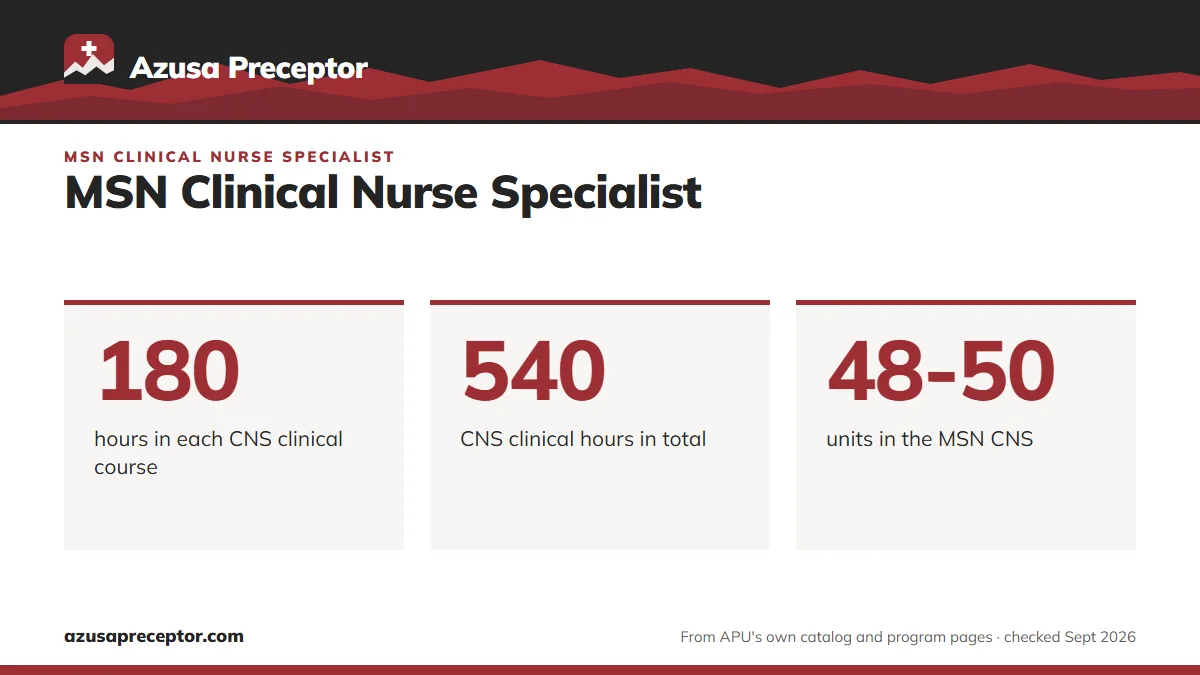
Azusa Pacific University (APU) offers the MSN Clinical Nurse Specialist (CNS) for two populations, adult-gerontology and pediatric, and both run on three clinical courses of 180 hours each. That adds up to 540 hours, largely in hospitals, with CNS or nurse leader preceptors. Below are the sequence, the preceptor profile and the certification path, with APU's conflicting campus listings set out as they stand.
Plan your CNS clinicals
Tell us your track, campus and first CNS course term.
On this page
Two CNS tracksCampus conflictCourses and hoursPreceptor profileResidence and experienceCertificationWhy students choose usQuestionsTwo populations, one clinical structure
APU's CNS prepares you to work in acute, primary or long-term care as a clinical nurse specialist for adults and older adults, or for children. The MSN runs 48 to 50 units. Compared with APU's NP tracks, its academic core adds GNRS 613 Graduate Statistics, and GNRS 548, a 2-unit health promotion course, is required on both tracks.
The adult-gerontology and pediatric tracks mirror each other course for course. Adult-gerontology students take GNRS 520 and GNRS 521, plus GNRS 580 Gerontology; pediatric students take GNRS 530 and GNRS 531, plus GNRS 589 or GNRS 510. Both tracks finish with GNRS 543 Transitions Across the Care Continuum.
Admission runs on the same calendar as APU's other APRN tracks: a fall start has an April 1 priority deadline and a June 15 final deadline, and a spring start has an October 20 priority deadline. There is no published semester-by-semester plan, so your advisor's program plan sets the term of each clinical course.
Where CNS courses meet: APU's conflicting lists
APU gives more than one answer on CNS locations. The MSN CNS program page lists Azusa and San Diego. By APU's 2023-24 graduate guidelines, CNS specialty courses are Azusa-only, which matches what the Adult-Gerontology CNS certificate page shows. Then the Pediatric CNS certificate page adds San Diego and the Inland Empire to Azusa.
The difference affects your class days and which campus's placement staff receive your request, and it affects compliance: students at San Diego use Complio, while every other campus uses CastleBranch. Confirm your campus with admissions and the placement team before you contact any hospital unit.
APU's own wording on approval also varies. The catalog says all graduate nursing programs are BRN-approved, while APU's accreditation blurb names only the prelicensure and NP programs. The campus guide sets out how APU lists each program.
The CNS clinical sequence and hours
Your first precepted course is GNRS 520 (adult-gerontology) or GNRS 530 (pediatric), taken after both the academic core and the advanced practice core. Each clinical course is 6 units, split 2 class and 4 clinical, so each works out to 180 hours; APU's current request form lists 180 hours for each as well.
| Step | Adult-gerontology | Pediatric | Units (class/clinical) | Hours | Focus |
|---|---|---|---|---|---|
| 1 | GNRS 520 Theory and Practice of the CNS | GNRS 530 Theory and Practice of the CNS | 6 (2/4) | 180 | Critical care or medical-surgical rotations |
| 2 | GNRS 521 Clinical Specialization | GNRS 531 Clinical Specialization | 6 (2/4) | 180 | Acute illness management |
| 3 | GNRS 543 Transitions Across the Care Continuum | GNRS 543 Transitions Across the Care Continuum | 6 (2/4) | 180 | Transitions of care |
In a 16-week session, 180 hours comes to roughly 11 and a quarter hours of precepted time each week; squeeze it into 8 weeks and the weekly figure is about 22 and a half. Build your work schedule around that number early. The CNS clinical courses page covers each course's settings and preceptors in more depth.
One catalog quirk to watch: the PNP-PC track lists GNRS 543 as an optional 4-unit course with 90 hours, while in the CNS it is required at 6 units and 180 hours. Check that your syllabus is the CNS version.
CNS preceptors: specialists and nurse leaders
APU's request form for Azusa and Inland Empire students sets the CNS rule. GNRS 520 calls for a practicing CNS; the later two courses, GNRS 521 and GNRS 543, can instead go to a nurse leader who works in leadership, direct unit care or nursing education. The form lists the adult-gerontology course numbers; confirm the rule for GNRS 530 and GNRS 531 with clinical faculty.
That makes a CNS search different from an NP search. Instead of outpatient clinics, you are mostly looking inside hospitals and health systems: critical care and medical-surgical units for the first course, then nurse leaders and educators for the later two. Some facilities route students through their own onboarding channels, such as MyClinicalExchange, and every site needs an APU affiliation agreement, which APU warns can take time when none exists yet. The affiliation agreements page explains that step.
No published APU rule sets a minimum number of years for CNS preceptors or a cap on how many students each may take. Relatives and close friends are excluded.
Residence, experience and working in a hospital
Because the CNS sits in APU's APRN department, its admission gates are the APRN ones: a home in Southern California and twelve months or more of nursing experience. APU also requires MSN students to keep working clinically, so you carry a clinical job the whole way through, and if that job is in a hospital, one rule matters more than the rest.
That rule covers training at your own employer. The 2026 request forms keep clinical time off your home unit, and the 2023-24 guidelines add two conditions: clinical hours cannot double as your normal paid shift or duties, and a written division of labor needs your employer's signature. A different unit in your own hospital can therefore host hours that your home unit cannot.
For the residence rule and the RN license requirement in full, see the license and residence page.
CNS certification in California and nationally
At the state level, CNS graduates can seek California CNS certification from the Board of Registered Nursing (BRN); nationally, the catalog points to ANCC. The BRN's own program list includes APU's CNS offerings, both the MSN and the certificate, in the adult-gerontology and pediatric tracks, while noting that CNS programs, unlike NP programs, get BRN review but no formal approval.
The BRN also lists the foci currently eligible for national certification: Acute Care CNS (adult-gerontology, neonatal or pediatric) and CNS-Gerontology. Check with faculty which exam fits your track well before your last clinical course.
APU's licensure disclosures mark its CNS programs Yes for California and Not Determined for other states, so a CNS who might move later should read that disclosure early. For how state certification works after graduation, see BRN certification.
Why CNS students choose us
A CNS placement is usually a hospital placement, and hospitals move on their own timelines. We start early and keep every detail straight for APU and the facility.
- We identify CNS preceptors near your home in critical care or medical-surgical settings for your first course.
- We line up nurse leaders and educators for
GNRS 521orGNRS 531and forGNRS 543well before those terms begin. - We flag early whether a hospital already has an APU affiliation agreement, since a new one takes time.
- We gather the legal name, the legal signer and the unit contacts APU's request form asks for.
APU's placement team approves each CNS site in writing before your first shift; we see that the request carries everything they need from the start. Share your track and campus, and we take it from there.
Questions APU students ask
What are the total CNS clinical hours at APU?
Three courses times 180 hours, or 540. Each CNS clinical course has 4 clinical units, and APU's current request form prints 180 hours beside each course, in line with 45 hours per unit. With no program-wide total published by APU, each course's syllabus has the final figure.
Can a nurse manager precept me in APU's CNS program?
Yes, for the later two courses. APU's form lets a nurse leader in a leadership, unit care or education role precept GNRS 521 and GNRS 543, while GNRS 520 needs a CNS. The form prints only the adult course numbers, so ask clinical faculty how the rule maps onto the pediatric courses.
Is there a CNS post-master's certificate at APU?
Yes. APU offers an Adult-Gerontology CNS certificate and a Pediatric CNS certificate, each 37 units with the same three clinical courses and 540 hours as the MSN. APU's pages list the adult certificate at Azusa and the pediatric one at Azusa, the Inland Empire and San Diego. The certificates page compares them.
Do CNS students log hours in Medatrax?
Yes. APU's graduate clinical guidelines have students document hours weekly in Medatrax, and missing entries can bring an academic warning. Any hours from a site that lacks APU approval come off your record. Compliance runs through CastleBranch, or Complio at San Diego. See the Medatrax page for the logging rules.
How early should I contact a hospital for CNS clinicals?
A full term ahead is sensible for a hospital that has never hosted an APU CNS student. APU's recent guidelines call for six to eight weeks of lead time on any new preceptor, and APU warns that a site without a current affiliation agreement takes longer to clear, so hospital paperwork sets the real pace.
Related pages
Last checked 2026-09-25
We check these pages against APU's own catalog and program pages. Your syllabus, your clinical faculty and APU's student placement coordinators have the final word.
APU says the clinical site and preceptor are yours to find. We make that the easy part.
Tell us your APU program, where you live in Southern California and when your next clinical term starts. We find preceptors who fit the course and prepare what APU and the site need before anything is approved.
- Preceptors matched to the course: primary care for
GNRS 600, pediatrics for the PNP courses, psychiatric care for PMHNP - Credentials, license and site details ready for APU's review and the affiliation agreement
- Close to home, from the San Gabriel Valley and the Inland Empire to San Diego
Start your placement plan
Program, city and term is all we need to begin.