APU's ELM-MSN: assigned clinicals first, your own preceptor search later
Azusa Pacific University (APU) assigns every clinical in the prelicensure phase of its Entry-Level Master of Science in Nursing (ELM): the school places you in clinical groups at partner facilities. Once you pass the NCLEX and move into an NP or CNS specialty, the model changes, and your advanced practice clinicals follow the same graduate process as every other APU MSN student. This page covers both halves and the handoff between them.
Plan your specialty clinicals
Tell us your ELM track and when specialty clinicals begin.
On this page
Two phasesPrelicensure sequenceHow APU assigns clinicalsCampuses and startsNCLEX and experience gateSpecialty phaseWhy students choose usQuestionsTwo phases, two placement models
The ELM is an accelerated, BRN-approved program for people whose bachelor's degree is in another field. You complete four prelicensure semesters and a clinical residency, earn a BSN, take the NCLEX, and then continue into an MSN specialty. Graduates can also apply for the California Public Health Nurse certificate.
Placement works differently in each phase. In the prelicensure phase, APU's program administrators assign you to clinical groups once partner facilities confirm; you then enroll yourself in that facility's onboarding course in Canvas, with five business days to finish its paperwork. Finding these sites is APU's job, not yours.
In the specialty phase, NP and CNS students move to APU's graduate model. Placement staff help and weigh distance, but you are expected to bring forward a site and preceptor close to home, and APU's recent guidelines add that no clinical placement is promised. The handoff between the two phases is where ELM students need a plan, because the habits of an assigned-placement program do not carry over.
Prelicensure clinicals, semester by semester
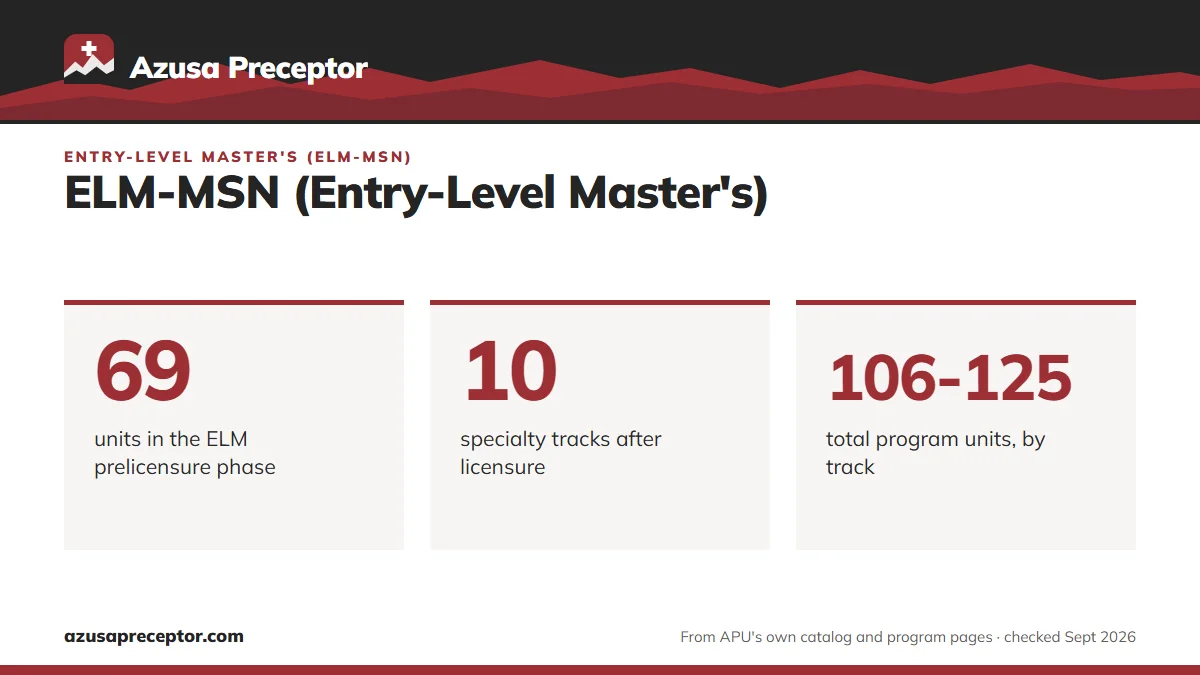
The prelicensure phase is a full-time, face-to-face cohort on a fixed schedule: 69 units and roughly 945 to 990 clinical hours by APU's 45-hours-per-unit math. APU publishes the semester table, which makes this the most predictable stretch of the program.
| Semester | Clinical courses | Hours |
|---|---|---|
| 1 | GNRS 554 Medical-Surgical Care of the Adult and Geriatric Patient; GNRS 578 Health Assessment | 90; 45 |
| 2 | GNRS 558 Intermediate Medical-Surgical Care of the Adult; GNRS 584 Mental Health Nursing | 135; 90 |
| 3 | GNRS 575 Maternal, Newborn, and Women's Health; GNRS 583 Nursing Care of Children and Young Adults | 90; 90 |
| 4 | GNRS 587 Community Health Nursing; GNRS 588 Advanced Nursing Care of Adults-Leadership | 135; 135 |
| Residency | GNRS 573 Clinical Residency | 180 |
GNRS 517 Fundamentals is a 2-unit skills lab in semester one rather than a placement. GNRS 558 runs in telemetry, restorative and long-term care settings, GNRS 587 carries a gerontological focus, and GNRS 588 sits in critical care. The optional GNRS 544 Clinical Specialization Residency (2 to 4 units) adds a precepted specialty experience.
How APU runs the prelicensure clinicals
APU arranges every prelicensure placement. It cites partnerships with dozens of Southern California hospitals and health networks, and the GNRS 573 residency is a partnership between the School of Nursing and selected inpatient organizations, with a clinical preceptor supervising you directly. That residency is an intensive acute-care internship with NCLEX review built in, and your BSN is awarded when it is complete.
Expect a wide schedule. APU's catalog says prelicensure clinicals may fall on any day, Monday through Sunday, on any shift; the ELM web FAQ says classes and clinicals run Monday through Saturday, days and evenings. The two sources conflict, so plan around the wider window until your cohort's calendar arrives.
Compliance still applies to assigned sites. The School of Nursing's onboarding pages list ELM cohorts at Monrovia and the Inland Empire in CastleBranch, with San Diego prelicensure students handled in Complio, and APU's hub says facility onboarding fees, such as those charged through MyClinicalExchange, are invoiced to the School of Nursing. For Fall 2026, prelicensure students had to be fully compliant by August 1, ahead of the August 24 start. The CastleBranch and Complio page covers the tracking.
Where the ELM runs: APU's campus lists
APU's sources name different ELM locations. The catalog lists San Diego, the Inland Empire (San Bernardino) and Monrovia. The ELM program page's FAQ says starts are at the main Azusa campus, the Inland Empire or San Diego. The BRN's list of prelicensure programs shows Azusa/Monrovia, the Inland Empire and San Diego. Confirm your cohort's campus with admissions.
Cohorts start three times a year, with application deadlines of September 15 for spring, January 15 for summer and May 15 for fall. Fall and spring terms run 16 weeks and summer runs 12, per the ELM FAQ. Your campus matters twice: once for the prelicensure cohort and the compliance system it uses, and again in the specialty phase, when you look for preceptors near home. The campus guide lays out APU's listings side by side.
The gate between phases: NCLEX and experience
The NCLEX comes first: the catalog bars every advanced practice clinical course until you have passed it. APU's 2023-24 graduate guidelines add a second hurdle, a year of professional nursing experience ahead of any clinical course, and they apply it to ELM graduates by name. Today's version of those guidelines is behind the APU login, so confirm the rule with your advisor when you map the specialty phase.
Two tracks write the experience rule into the catalog itself. In the ELM Healthcare Administration and Leadership track, GNRS 567 waits until you have the equivalent of a year of RN clinical work; in ELM Nursing Education, GNRS 663 waits on the same year. The catalog also expects ELM students in the postlicensure phase to have outside clinical work experience.
The months after the NCLEX are your runway: working as an RN, building the experience APU asks for, and lining up the first specialty preceptor near home. APU's MSN APRN tracks admit Southern California residents, and your specialty sites are reviewed with distance in mind; see the license and residence page for the residence rule and the RN license you need on file.
The NP or CNS phase follows the graduate process
APU offers ten postlicensure tracks: Adult-Gerontology or Pediatric CNS, AGPCNP, FNP, PNP-PC, PMHNP, Healthcare Administration and Leadership, Nursing Education, SNSC with FNP, SNSC with PNP-PC, and SNSC alone. Each uses the matching MSN's clinical courses and hours. Because GNRS 504 and GNRS 508A are finished during prelicensure, the postlicensure core is GNRS 506 plus 7 elective units, and specialty study may be part time. Delivery varies by track, face-to-face or online.
For NP and CNS clinicals, the assigned model no longer applies. You find and propose a preceptor near home with help from APU's placement staff, file one Graduate Preceptor Request form per preceptor, and wait for the placement team's written clearance before your first visit. The site also needs an affiliation agreement. The placement process page walks through each step, and the FNP and CNS pages cover two of the specialty tracks in detail.
Why ELM students choose us
ELM students reach the specialty phase after a prelicensure phase of assigned placements, so the first NP or CNS preceptor search may be the first one you have ever run. That is the gap we fill.
- We start the specialty search while you are still building RN experience, so a preceptor is ready when APU clears you for clinicals.
- We match preceptors to your track's first clinical course:
GNRS 600for FNP or AGPCNP,GNRS 590Afor PNP-PC,GNRS 535for PMHNP,GNRS 520orGNRS 530for CNS. - We prepare every detail the preceptor request and the affiliation agreement need, from the clinic's legal name to its legal signer.
- We stay on call through the specialty phase and find a replacement if a preceptor drops.
APU's placement team clears every specialty site in writing; we make sure your first request as a graduate student arrives complete and fits APU's rules. Tell us your track and when you expect specialty clinicals to begin, or see how it works.
Questions APU students ask
Does APU find clinical placements for ELM students?
For the prelicensure phase, yes. APU's program administrators assign you to clinical groups at partner facilities, and the GNRS 573 residency is arranged with selected inpatient organizations. For NP and CNS clinicals after licensure, you follow the graduate model: APU's placement staff help, and you are expected to find and propose a preceptor near home.
Can I start NP clinicals right after passing the NCLEX?
Not under APU's recent guidelines. Passing the NCLEX unlocks advanced practice courses in the catalog, but the 2023-24 guidelines also ask ELM graduates for a year of professional nursing experience first. Ask your advisor what the current handbook says and plan your specialty courses around it.
Can I choose my hospital for ELM prelicensure clinicals?
APU assigns prelicensure students to clinical groups once partner facilities confirm, so the site comes from the program rather than from you. After an assignment, the facility's onboarding runs through a Canvas course, and its paperwork is due within five business days. The catalog adds that clinicals may fall on any day or shift.
Is the ELM specialty phase online?
It depends on the track. APU says postlicensure delivery varies: some tracks meet face-to-face, others are online asynchronous or online synchronous, and part-time study is allowed. Clinical hours for NP and CNS tracks still take place in person, at sites APU's placement team has approved near where you live.
Do ELM FNP students need the same hours as MSN FNP students?
Yes. Each ELM specialty follows the matching MSN track's clinical courses and hours, so an ELM FNP completes 540 hours in GNRS 600, with 135 pediatric, and an ELM PMHNP completes four 135-hour population courses. Only the core differs, because two core courses are finished during prelicensure. Total program units run 106 to 125.
Related pages
Last checked 2026-09-25
We check these pages against APU's own catalog and program pages. Your syllabus, your clinical faculty and APU's student placement coordinators have the final word.
APU says the clinical site and preceptor are yours to find. We make that the easy part.
Tell us your APU program, where you live in Southern California and when your next clinical term starts. We find preceptors who fit the course and prepare what APU and the site need before anything is approved.
- Preceptors matched to the course: primary care for
GNRS 600, pediatrics for the PNP courses, psychiatric care for PMHNP - Credentials, license and site details ready for APU's review and the affiliation agreement
- Close to home, from the San Gabriel Valley and the Inland Empire to San Diego
Start your placement plan
Program, city and term is all we need to begin.