APU's placement help, your own search, or a placement service
Azusa Pacific University (APU) students reach a clinical site by three routes: searching on their own, working with APU's placement staff, or bringing in a placement service. All three finish in the same place, a Graduate Preceptor Request form and written clearance from APU. The right choice depends on your timing, your region, your course and how many evenings you can spare for calls.
Compare your options with us
Tell us your program, city and term start.
On this page
Three routesYour own searchAPU's placement teamA placement servicePick your routeCombining routesQuestionsThree routes, one finish line
Whichever route you take, the end point is fixed: a request form, an affiliation agreement and written clearance from APU before your first clinical day. The routes differ in who does the searching and how much say you keep over where you land.
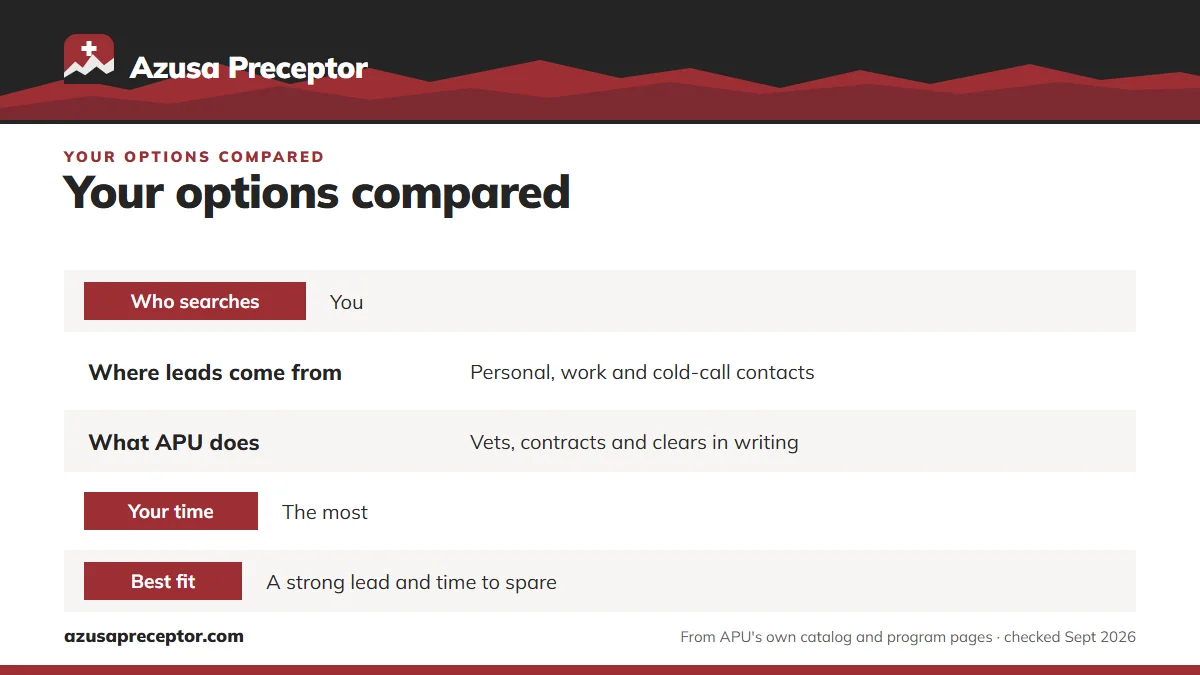
| Your own search | APU's placement staff | A placement service | |
|---|---|---|---|
| Who searches | You | APU's student placement coordinators, alongside your own efforts | We do, on your behalf |
| Where leads come from | Personal, work and cold-call contacts | APU's existing preceptors and partner sites | Practices near your home that fit the course |
| What APU does | Vets, contracts and clears in writing | Makes the offer, then clears in writing | Vets, contracts and clears in writing |
| Your time | The most | Little, but an offer can sit far from home | Little: you file the form and stay compliant |
| Best fit | A strong lead and time to spare | Flexible travel and schedule | A near-home site on a set timeline |
Searching on your own
A solo search suits students with a real lead. APU's Azusa and Inland Empire request form asks how you found the placement and offers personal connections, cold calling and work connections as examples, so APU expects many placements to begin this way. A former colleague who now runs a clinic, or a practice near home that has hosted students before, can move quickly.
The price is time. You are already working clinically, as APU's MSN and DNP programs require, and carrying graduate courses. Every call needs a clear ask, and every yes needs the preceptor's credentials and the clinic's legal details before APU can act. APU's rules on relatives, close friends and your own unit also take the easiest leads off the table. Our guide to finding your own site lays out a search plan.
Working with APU's placement team
APU invests real staff time in placement. Its 2023-24 guidelines describe full- and part-time employees who place students and take travel distance into account, and the Graduate Placement Team vets preceptors, arranges contracts and obtains the affiliation agreements. When the team makes you an offer, you have one week to confirm it.
This route rewards flexibility. APU matches on course level and patient population before distance, so an offer can sit an hour or two from home, and the same guidelines describe Saturday and evening clinicals as scarce. Placement staff draw on a pool shared by every APRN student, which is why APU says a placement is not promised and why the current request forms note that existing APU preceptors may not be available.
Using a placement service built around APU
A service does the searching and hands APU a complete request. Ours is built around APU's process: we find a preceptor whose credential and setting fit your exact course, within a sensible drive of home; we gather the preceptor's license and credential details, the clinic's legal name and signer and the office manager's contact; we raise the agreement question early; and we restart the search if a preceptor leaves mid-term.
APU's review is identical whichever route you use. The same form, the same vetting and the same written clearance apply, so the gain is speed and fit rather than a shortcut. For APU students who want a near-home site without spending every evening on the phone, it is the most thorough route there is. The step-by-step version is on how it works, and choosing a placement service lists what the best service should deliver.
Five questions to pick your route
- How soon does your clinical term start? Months away leaves room for any route; weeks away favors whoever can search fastest and wide.
- Do you already have a lead? A willing preceptor at a clinic near home makes a solo search short.
- How far can you travel? If a two-hour drive is workable, an APU offer may suit you. If it is not, a near-home search matters more.
- How narrow is your course? Psychiatric, pediatric and CNS courses draw on smaller preceptor pools than adult primary care; the PMHNP clinical courses page shows why.
- How much time can you give it? Count the evenings you can spend calling practices on top of work, classes and family.
If most of your answers point to little time, a narrow course or a firm need to stay close to home, a service is usually the better fit. If you have a strong lead and a flexible calendar, start on your own and keep APU informed.
Combining the routes
The routes work best together. Keep APU's placement team informed of your own leads, since the request form is how every lead reaches APU anyway. If you work with a service, tell the team what is being pursued so no practice is approached twice for the same student.
One caution matters more than the rest. APU's guidelines rule out a late-drop fee waiver for a student who refuses an offered placement or fails to confirm an offer within a week. If APU offers you a site while a near-home option is still pending, talk to the placement team before declining anything. The no-placement drop rule explains why that waiver is worth protecting.
Declining an APU placement offer can cost you the late-drop fee waiver. Talk to the placement team before you say no.
Questions APU students ask
Will APU place me if I cannot find a site myself?
APU's placement staff work to place students and take distance into account, but its recent guidelines say a clinical placement is not promised, and the request forms ask students who have secured a preceptor to report it. Many APU students run their own search, or use a service, alongside APU's help so that a site is ready either way.
Does APU treat a site found through a service differently?
No. Every site goes through the same Graduate Preceptor Request form, preceptor vetting, affiliation agreement and written clearance, however the lead was found. What changes is how complete and well matched the request is when it lands with the placement team, which is where a thorough service earns its place.
Can I keep searching myself while a service searches for me?
Yes, and sharing your leads helps, so no practice hears from two people about the same student. If your own lead comes through first, tell us, and we switch to preparing its details for APU's request form and checking it against your course. Parallel effort is often the fastest path to a cleared site.
Is a placement service worth it for a PMHNP or PNP student?
Specialty tracks are where a focused search saves the most time. PMHNP students need a psychiatrist or PMHNP for each of four population courses, and PNP-PC students need pediatric settings, including hours in a pediatric specialty inside GNRS 532. Those pools are smaller than adult primary care, so a targeted search tends to reach a yes sooner.
What if my employer offers to host my clinical?
That can be a strong route if it meets APU's conditions: a written division of duties signed by your employer, a unit other than the one you work on, and no regular job duties or pay during clinical time. Confirm the setting fits your course before you commit, then file the request as you would for any site.
Related pages
Last checked 2026-09-25
We check these pages against APU's own catalog and program pages. Your syllabus, your clinical faculty and APU's student placement coordinators have the final word.
APU says the clinical site and preceptor are yours to find. We make that the easy part.
Tell us your APU program, where you live in Southern California and when your next clinical term starts. We find preceptors who fit the course and prepare what APU and the site need before anything is approved.
- Preceptors matched to the course: primary care for
GNRS 600, pediatrics for the PNP courses, psychiatric care for PMHNP - Credentials, license and site details ready for APU's review and the affiliation agreement
- Close to home, from the San Gabriel Valley and the Inland Empire to San Diego
Start your placement plan
Program, city and term is all we need to begin.