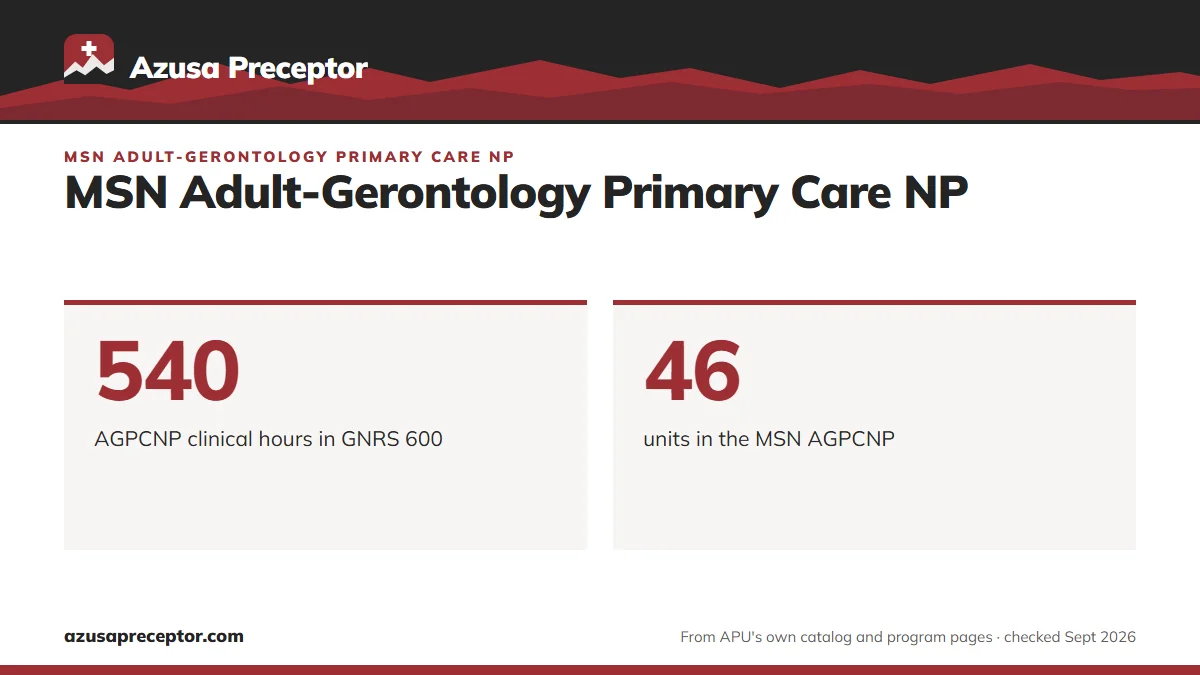
APU's MSN AGPCNP: adult and older-adult primary care in 540 hours
Azusa Pacific University (APU) runs its Adult-Gerontology Primary Care Nurse Practitioner (AGPCNP) as a 46-unit MSN whose precepted work sits in a single course, GNRS 600, for 540 hours. Your patients range from young adults to the very old, and your sites can include community clinics, private practices, long-term care and patients' homes. Here is how the courses, preceptors and rules of this track fit together, term by term.
Plan your AGPCNP clinicals
Tell us your campus and the term GNRS 600 begins.
On this page
AGPCNP vs FNPCampuses and first termCourses and hoursPreceptors and settingsResidence and experienceCertificationWhy students choose usQuestionsHow the AGPCNP differs from the FNP
On paper APU's two primary care NP tracks look alike: the same academic core, the same advanced practice core, and the same GNRS 600, GNRS 601, GNRS 602 and GNRS 603 specialty courses. The difference is one swap. AGPCNP students take GNRS 580 Gerontology, a 2-unit course, in place of the FNP's GNRS 590D, which is why the total is 46 units rather than 47.
That swap shapes your clinical plan more than the unit count suggests. The catalog says AGNP students must take GNRS 580 together with GNRS 600, so gerontology theory and your precepted hours share a term. And because the population starts at young adulthood, the 135-hour pediatric block that FNP students schedule has no place in your plan; all 540 hours can be spent with adults.
What the MSN catalog wording does not print is a geriatric minimum. The 135 geriatric hours APU names belong to the BSN-to-DNP version of the track, where they sit inside 750 direct-care hours. For the MSN, ask clinical faculty whether a set share of your 540 must be with older adults, and plan for it either way.
Campuses and the road to your first clinical term
All three NP campuses list the MSN AGPCNP: Azusa, the Inland Empire in San Bernardino, and San Diego. The post-master's AGPCNP certificate is a narrower offer: its APU page lists Azusa only. Deadlines follow the MSN NP calendar, with an April 1 priority date and a June 15 final date for fall, and an October 20 priority date for spring.
Your precepted hours begin in GNRS 600, taken with GNRS 601 and GNRS 580, once the GNRS 612 health assessment lab is behind you. The core before it runs GNRS 610, GNRS 611, then GNRS 612 and its lab. Under APU's 2023-24 guidelines, a grade below B- in any of the three advanced core courses (pathophysiology, pharmacology, health assessment) keeps you out of clinicals; the current handbook confirms whether that still holds.
Work the calendar backward from there. Graduate fall 2026 classes began August 24 and spring 2027 starts January 4, so a spring start in GNRS 600 means a preceptor confirmed and cleared during the fall. The clinical placement process page lays out each step between finding a preceptor and your first day.
Clinical courses and hours for the AGPCNP
Every AGPCNP hour lives in GNRS 600. Its 12 units can be split across terms in chunks of 2 to 6 with faculty approval; at APU's rate of 45 hours per clinical unit, a 2-unit term means 90 precepted hours and a 6-unit term means 270.
| Course | Units | Hours | How it connects |
|---|---|---|---|
GNRS 612 Advanced Health Assessment and Diagnostic Reasoning | 4 (3 class, 1 lab) | Lab hours only | Finish it before any precepted hours |
GNRS 600 Nurse Practitioner Clinical Experience | 12, taken 2-6 per term | 540 (stated) | Holds every precepted hour |
GNRS 580 Gerontology | 2 | None | Must be taken with GNRS 600 |
GNRS 601 and GNRS 602 Primary Healthcare I and II | Specialty theory | None | List GNRS 600 as a corequisite |
GNRS 603 | Specialty theory | None | Completes the specialty block |
The GNRS 600 guide explains how units turn into hours and why the catalog prints 540-765 for this course. Students on an older catalog may still see GNRS 581, an internal medicine and gerontology course APU's request form lists at 135 hours; under the 2026-27 catalog, AGPCNP hours are logged in GNRS 600. APU's recent guidelines place the summative OSCE for FNP and AGNP students in GNRS 592B, and your syllabus confirms where it falls for you.
Preceptors and settings for adult and older-adult care
The catalog names the places AGPCNP graduates work: community health centers and clinics, private practices, long-term care facilities and patients' homes. Each can host clinical hours when the preceptor qualifies and APU clears the site; a specialty clinic also needs a faculty yes.
The preceptor pool is the same as for APU's other NP tracks: a physician, a nurse practitioner, or a physician assistant practicing with an on-site supervising physician. One rule deserves a place in your term plan: at least one semester of your clinical time has to be with an NP. Internal medicine and geriatric practices are the closest fit for this population, and a family practice can also serve if faculty agree its patient mix suits the course.
Long-term care and home-based practices add paperwork. The site's legal name and legal signer go on the affiliation agreement, and some facilities run their own onboarding channel, such as MyClinicalExchange; APU's hub says onboarding fees of that kind are invoiced to the School of Nursing. Rules on relatives, friends and your own unit are on the preceptor requirements page.
Residence, experience and a wider map of sites
APU's catalog limits MSN APRN admission to Southern California residents who have practiced as nurses for a year or longer, and the MSN expects you to keep working clinically while enrolled. APU's 2023-24 guidelines apply the year of experience before any clinical course to ELM graduates as well, so an ELM student heading into the AGPCNP plans for it too.
The BSN-to-DNP version of this track sets its own bar: eight months of RN experience, which new RNs may finish during the program before year two. If you are choosing between the MSN and that pathway, the experience rule and the 750-hour total are the two clinical differences to weigh; the BSN to DNP page has the rest.
The residence rule matters more when your sites vary in type. A clinic, a long-term care facility and a home-visit practice can sit in different directions from home, and each gets a distance check when APU's placement staff review it. The license and residence page covers the rule, plus the RN license requirement.
Certification for adult-gerontology NPs
Two credentials follow the AGPCNP: state NP certification from the California Board of Registered Nursing (BRN) and a national adult-gerontology primary care board exam. APU's AGPCNP certificate page names both national boards, AANPCB and ANCC. On the BRN's list of approved NP programs, APU's adult track appears under a combined heading, Pediatric and Adult Primary NP.
Graduates of California programs apply to the BRN under Method One; the BRN certification page explains what goes in the application and when. GNRS 611 Advanced Pharmacology, which you complete before your first GNRS 600 term, is the course APU says satisfies the BRN's coursework requirement for a furnishing number.
If you plan to finish through the post-master's certificate instead of the MSN, note that APU issues those certificates only once national certification and BRN requirements are met.
Why AGPCNP students choose us
Adult and older-adult primary care preceptors are spread across clinics, private practices and long-term care, and each kind of site brings its own onboarding. We are built for exactly that search.
- We look for internal medicine, geriatric and adult primary care preceptors near your home, sized to the units you plan for each term.
- We confirm early what kind of site each one is and what its onboarding asks of you, before APU's review begins.
- We map your NP semester and, when faculty set one, an older-adult share across the terms of
GNRS 600. - We collect the practice's registered name, who signs contracts for the site and how to reach its office manager, so the affiliation agreement can start without a second round of questions.
Every AGPCNP site gets APU's written clearance before you start there, and what we send ahead makes that review straightforward: complete, accurate and matched to the course. Start with the form below, or read how it works.
Questions APU students ask
How many clinical hours is APU's MSN AGPCNP?
MSN students complete 540 supervised hours in GNRS 600, spread over 12 clinical units. The course's printed range of 540-765 also covers the BSN-to-DNP version, which requires 750 direct-care hours with 135 of them geriatric. The MSN wording prints no geriatric minimum, so ask clinical faculty how many of your 540 must be with older adults.
Can I do AGPCNP clinicals in a long-term care facility?
The catalog lists long-term care facilities among AGPCNP practice settings, so it is a real option. The preceptor still has to qualify, the facility needs an APU affiliation agreement, and specialty settings need faculty approval. Ask clinical faculty whether the facility's patient mix fits your course level before you commit a term to it.
Is the AGPCNP certificate offered outside Azusa?
APU's AGPCNP post-master's certificate page lists the Azusa campus only, while the MSN AGPCNP is listed at Azusa, the Inland Empire and San Diego. If the certificate route interests you, ask admissions whether any other campus is open to your cohort before you plan clinical sites. The certificates page compares the routes.
What does GNRS 580 have to do with my clinicals?
GNRS 580 Gerontology is the 2-unit course that replaces the FNP's young-family course, and APU requires AGNP students to take it together with GNRS 600. So the term you start precepted hours also carries gerontology theory and GNRS 601. Plan your work schedule around three courses that term, not one.
When should I start looking for my first AGPCNP preceptor?
About two terms before GNRS 600 if the site is new to APU, and no later than one term before. APU's recent guidelines want new preceptors reported six to eight weeks before term, compliance for Fall 2026 was due August 1, and affiliation agreements with new sites take time, so the earlier start gives every step room.
Related pages
Last checked 2026-09-25
We check these pages against APU's own catalog and program pages. Your syllabus, your clinical faculty and APU's student placement coordinators have the final word.
- APU Academic Catalog 2026-27: MSN, Adult-Gerontology Primary Care NP
- APU Academic Catalog 2026-27: Graduate Nursing Programs and GNRS course descriptions
- APU: Adult-Gerontology Primary Care NP certificate
- APU: MSN with Nurse Practitioner Specialties
- California BRN: Approved advanced practice nursing programs
APU says the clinical site and preceptor are yours to find. We make that the easy part.
Tell us your APU program, where you live in Southern California and when your next clinical term starts. We find preceptors who fit the course and prepare what APU and the site need before anything is approved.
- Preceptors matched to the course: primary care for
GNRS 600, pediatrics for the PNP courses, psychiatric care for PMHNP - Credentials, license and site details ready for APU's review and the affiliation agreement
- Close to home, from the San Gabriel Valley and the Inland Empire to San Diego
Start your placement plan
Program, city and term is all we need to begin.