GNRS 732 at APU: building to 1,000 DNP residency hours
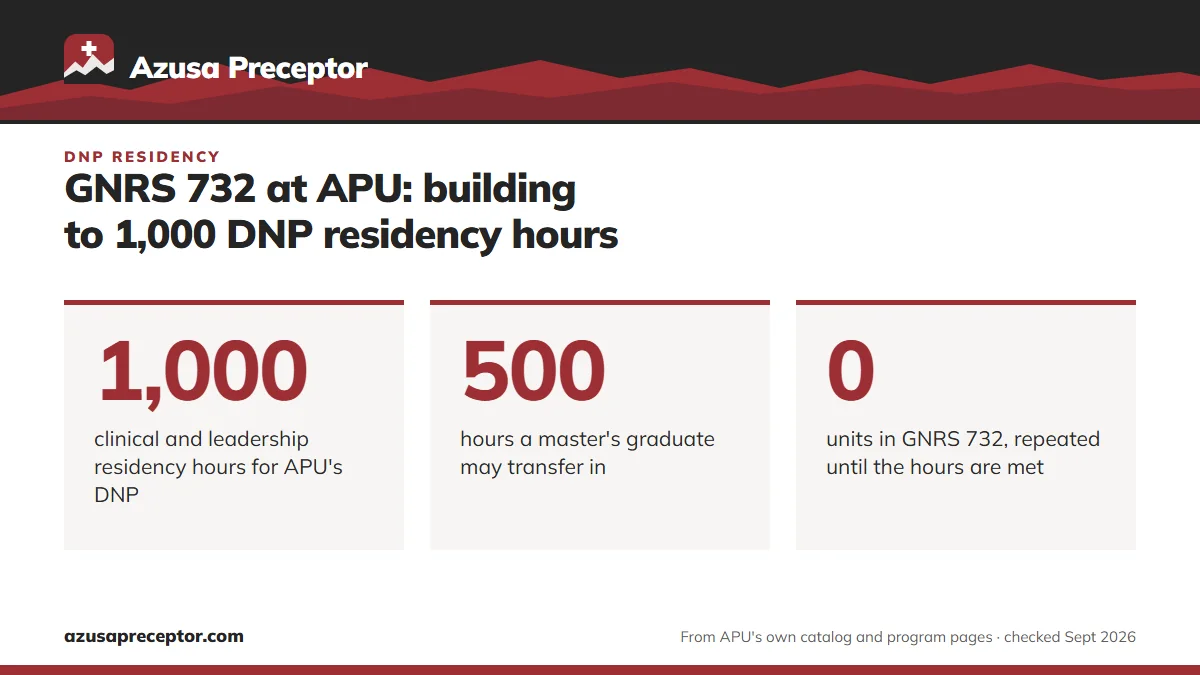
Azusa Pacific University (APU) sets the Doctor of Nursing Practice residency at 1,000 hours, split between clinical and leadership work and recorded through GNRS 732, a zero-unit course you repeat until the total is met. Post-master's students can transfer up to 500 hours from an accredited APRN program or another nursing master's, and BSN-to-DNP students may start GNRS 732 at admission.
Plan your DNP residency site
Tell us your DNP path, specialty and where you live.
On this page
The 1,000-hour ruleTransfer hoursBSN-to-DNP hoursPacing by termFinding a residency siteHours after graduationHow we helpQuestions1,000 hours, recorded through GNRS 732
Both the catalog and the DNP program page fix the total at 1,000 hours, and APU points out that the figure lines up with the AACN minimum for the degree. The hours run through GNRS 732 DNP Clinical Residency, which carries 0 units and is repeated term after term until your total is complete. A clinical fee applies, and the BSN-to-DNP page says it includes malpractice insurance; the malpractice and clinical fee page covers what APU's sources say about coverage.
The residency has two strands. On the clinical side you work in an advanced practice specialty; on the leadership side you develop organizational leadership, and that strand is also where the DNP scholarly project lives, threading through every term of the residency. The catalog also expects doctoral students to keep ongoing clinical work experience while enrolled.
GNRS 732 requires nothing beyond admission to the DNP, so it can begin in your first term. Starting early lets you spread the hours thinly and keep the project moving; waiting pushes the heavy terms toward the end, where they collide with the project defense that graduation requires.
Transferring up to 500 hours from your master's
A master's degree can carry part of the load. If your master's was an accredited APRN program, whether NP, CNS, CRNA or nurse-midwifery, as many as 500 of its clinical hours can come with you. A master's outside the APRN roles can bring as many as 500 direct clinical hours. For the APRN route, APU wants a letter from that program confirming the hours you finished, so request it early.
| Starting point | Hours that may transfer | Left for GNRS 732 |
|---|---|---|
| Accredited APRN master's with 500 or more documented clinical hours | Up to 500 | At least 500 |
| Accredited APRN master's with fewer documented hours | Up to the hours the program letter confirms | 1,000 minus those hours |
| Non-APRN nursing master's | Up to 500 direct clinical hours | At least 500 |
| APU Oncology NP Fellowship taken with the DNP | Up to 500 of the fellowship's 540 | At least 500 |
The fellowship row comes from the catalog's Oncology NP entry, which lets DNP students apply up to 500 fellowship hours to the residency; the Oncology NP Fellowship page explains that program. APU does not say how a fellowship credit combines with a transfer from your master's, so settle that with the DNP program before you plan around both.
How hours build on the BSN-to-DNP path
BSN-to-DNP students arrive without a master's to transfer from, so all of their hours are earned at APU. The catalog sets 1,000 DNP clinical hours for the pathway and says hours from earlier graduate clinical courses may count toward GNRS 732, which is why residency totals vary from student to student.
| Track | Clinical courses | Hours APU states |
|---|---|---|
| APRN (FNP or AGPCNP) | GNRS 600, up to 17 units, plus GNRS 732 | 750 direct-care hours in GNRS 600; 1,000 DNP clinical hours in all |
| Health Systems Leadership | GNRS 732, with no NP clinical course | 1,000 residency hours |
| Nurse Faculty Loan Program option | Four of GNRS 660-664, including GNRS 663 | 135 practicum hours in GNRS 663 |
APU does not publish the exact arithmetic for how the 750 NP hours and the residency hours combine on the APRN track, so confirm your own count with the DNP program director before you map the terms. The NP portion itself is explained on the GNRS 600 page.
Pacing the residency across terms
APU's DNP page ties 135 hours a semester to each 3-unit DNP course, which makes a handy yardstick. At that pace, 500 residency hours works out to about four semesters, and 135 hours spread over 16 weeks is roughly eight and a half hours weekly. Fall and spring DNP terms run 16 weeks, per the program FAQ, while summer DNP courses last 8 or 12 weeks.
Coursework runs alongside. The post-master's DNP is a 39-unit online program in which full-time students take 6 to 7 core units a semester, starting with GNRS 716 and moving to GNRS 712 and GNRS 718, then GNRS 780. Add ongoing clinical employment and the scholarly project, and a steady residency pace protects every other part of the program.
Older course numbers can confuse the picture. The catalog's course list still carries two older residency series, GNRS 733 and GNRS 734 (sections A through C), yet neither appears among today's DNP requirements.
GNRS 732 carries 0 units but still has a clinical fee attached. Ask how the fee applies across repeated terms before you set your pace.
Who arranges the residency site
APU has not published who locates the residency site for post-master's students. Its general SON onboarding directions point DNP students either to their program manager or to the DNP Clinical Residency Coordinator, a job the DNP page assigns to the DNP Program Director. The full DNP program guidelines require an APU sign-in.
For BSN-to-DNP students the answer is published: the program FAQ puts finding the clinical site and preceptor on the student, backed by help from APU's staff, faculty and placement coordinators. Either way, every clinical site needs an APU affiliation agreement, and a site without one needs extra lead time; the affiliation agreements page explains why.
Compliance runs on its own track. CastleBranch uses a separate package code for DNP students, and the CastleBranch and Complio page covers the setup.
Why doctoral direct-care hours matter after graduation
Residency hours can keep working for you in California. Under AB 890, an NP who has practiced as a 103 NP for three full-time-equivalent years, or 4,600 hours, may apply to become a 104 NP with independent practice. The BRN's regulation, 16 CCR 1482.4, lets a DNP holder count direct patient care hours from the doctoral part of the degree toward that total, though not hours already credited toward a master's.
Neither category is mandatory, and NPs may keep practicing under standardized procedures, so this matters most if independent practice is part of your long-term plan. If it is, NPs in the DNP have a practical reason to document direct patient care carefully and to place clinical residency hours in real patient settings where the specialty allows. The California NP practice page explains the 103 and 104 categories in more depth.
How we help DNP students with residency sites
DNP students choose us because a residency site has to do two jobs at once: host clinical hours in your advanced practice specialty, and give your scholarly project an organization where it can take shape. We look for both near your home in Southern California, with leaders and clinicians who can support a doctoral project over several terms.
We prepare the site details APU needs for review and an affiliation agreement, including who can legally sign for the organization and its exact legal name, and we flag early whether an agreement already exists. APU's faculty and placement staff approve every site in writing, and what we send is complete and fits APU's rules. We also help you map hours to terms so the total arrives with the project. Tell us your DNP path, specialty and city through the form below.
Questions APU students ask
Can I transfer more than 500 hours into APU's DNP?
APU caps the transfer at 500 hours, whether you graduated from an accredited APRN program or from a non-APRN nursing master's. Any master's hours beyond 500 stay with your earlier degree, and the rest of the 1,000 comes through GNRS 732. Ask your APRN program early for the letter confirming your completed hours, since APU requests it.
Does GNRS 732 count toward the DNP's 39 units?
GNRS 732 carries 0 units, so it adds nothing to the 39-unit total of the post-master's DNP. You enroll in it and repeat it until your residency hours are complete, and a clinical fee applies. That is why the residency can stretch across many terms while your unit count follows the core course sequence.
Do BSN-to-DNP APRN students need 1,000 hours on top of the 750 NP hours?
APU sets 1,000 DNP clinical hours for the pathway and 750 direct-care hours in GNRS 600 for the APRN track. The catalog says hours from earlier graduate clinical courses may count toward GNRS 732, but it does not publish the exact arithmetic. Your DNP program director confirms how your own hours combine.
Is a California RN license required for APU's DNP residency?
APU's DNP page makes a current California RN license mandatory at entry, even though the program is fully online and low-residency. The requirement applies before your first term of GNRS 732, so check that your license is active and will stay current through the residency years.
Does APU's 1,000-hour residency match national DNP standards?
APU describes its 1,000-hour residency total as matching the AACN minimum for the DNP. The transfer allowance of up to 500 hours recognizes clinical time from an earlier master's, so the full 1,000 can reflect your whole graduate record rather than the doctorate alone.
Related pages
Last checked 2026-09-25
We check these pages against APU's own catalog and program pages. Your syllabus, your clinical faculty and APU's student placement coordinators have the final word.
APU says the clinical site and preceptor are yours to find. We make that the easy part.
Tell us your APU program, where you live in Southern California and when your next clinical term starts. We find preceptors who fit the course and prepare what APU and the site need before anything is approved.
- Preceptors matched to the course: primary care for
GNRS 600, pediatrics for the PNP courses, psychiatric care for PMHNP - Credentials, license and site details ready for APU's review and the affiliation agreement
- Close to home, from the San Gabriel Valley and the Inland Empire to San Diego
Start your placement plan
Program, city and term is all we need to begin.