APU's PMHNP clinical courses: four populations, 135 hours each
The Psychiatric Mental Health Nurse Practitioner (PMHNP) track at Azusa Pacific University (APU) splits its clinical hours across four population-based courses numbered GNRS 535 through GNRS 538, at 135 hours apiece. APU's PMHNP request form asks for a psychiatrist or a PMHNP as preceptor in most of them, so each preceptor has to match both the credential rule and the population that course covers.
Get your placement plan
Tell us your APU program and where you live. A placement advisor replies with the preceptor and site options that fit your APU course.
GNRS 535, where an LMFT or psychologist may precept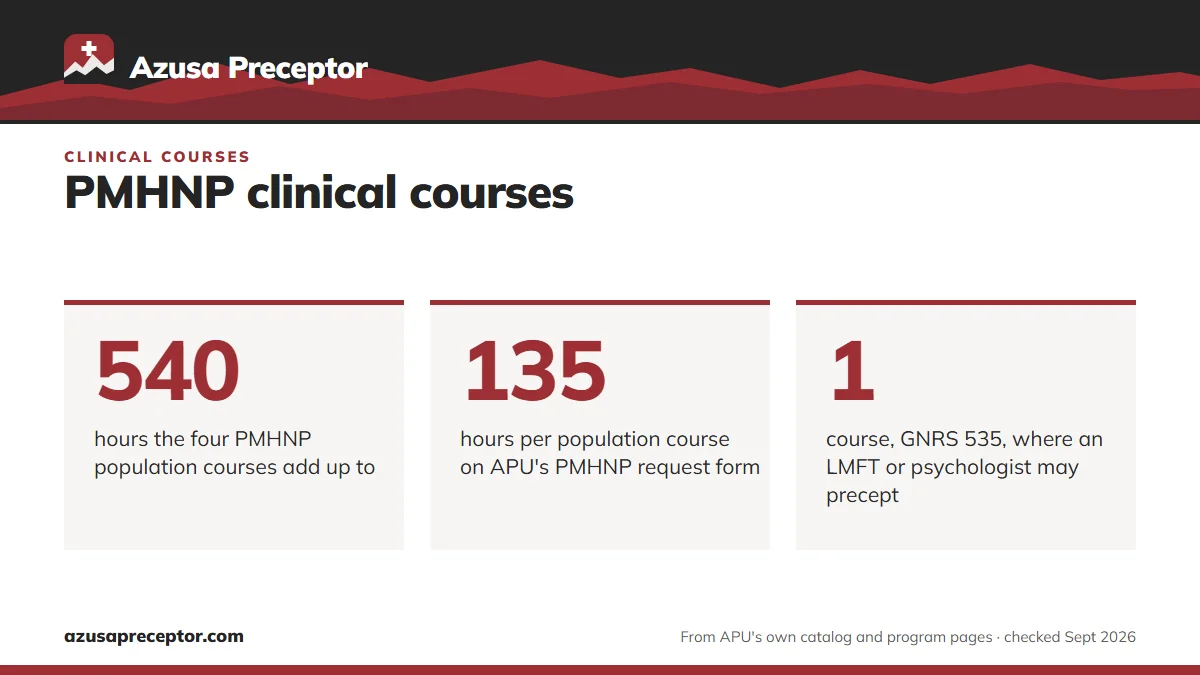
On this page
The four coursesBefore GNRS 535GNRS 535 preceptorsAdults vs. childrenGNRS 538PMHNP request formOur PMHNP searchQuestionsFour population courses at 135 hours each
APU's catalog sets out the PMHNP clinical courses in prerequisite order, and the PMHNP Preceptor Request form assigns 135 hours to each one. Across the four courses that adds up to 540 hours, the same total as APU's other NP tracks, but spread across four separate placements rather than one continuing course like the FNP's GNRS 600.
| Course | Units (class/clinical) | Hours | Population |
|---|---|---|---|
GNRS 535 Psychiatric Interventions and Health Promotion across the Life Span | 6 (3/3) | 135 | Across the life span |
GNRS 536 Psychiatric Mental Health Care with Adults and Older Adults | 6 (3/3) | 135 | Adults and older adults |
GNRS 537 Psychiatric Mental Health Care with Children and Adolescents | 6 (3/3) | 135 | Children and adolescents |
GNRS 538 Psychiatric Mental Health Care with Selected Populations | 5 (2/3) | 135 | A selected population |
The catalog prints units, not hours, for this track, and 3 clinical units per course work out to the same 135 at APU's rate. GNRS 538 has one fewer classroom unit than the others but the same 3 clinical units, so its hours match. The 45 hours per clinical unit page explains the conversion.
What comes before GNRS 535
The PMHNP sequence opens later than the primary care tracks. Ahead of GNRS 535 sit the advanced practice core, with GNRS 510 Family Theory added for this track, and GNRS 612 with its lab. Next come two classroom-only courses of 2 units each, GNRS 534 on integrated psychiatric and health assessment and GNRS 533 on psychiatric theories, and neither logs clinical hours. Our GNRS 612 guide covers the B- gate that applies before any clinical course.
According to the catalog, you may pair GNRS 535 with GNRS 539 Psychopharmacology in one term. If you pair them, a preceptor who manages medications gives you daily practice with what the pharmacology course is teaching, which is worth mentioning when you describe your needs to a site.
The MSN PMHNP runs 54 to 56 units, and the post-master's PMHNP certificate runs 43 units with the same GNRS 533 to GNRS 539 block, so certificate students follow this same clinical path. Admission and degree details are on the MSN PMHNP page.
GNRS 535: the one course with a wider preceptor list
The PMHNP request form names a psychiatrist (MD) or a PMHNP as the standard preceptor. It makes one exception: in GNRS 535 alone, the form also accepts a psychologist or an LMFT (licensed marriage and family therapist). That lines up with the course's focus on psychiatric interventions and with the program's training in individual, family and group psychotherapy.
The exception ends after the first course. From GNRS 536 onward, plan on a psychiatrist or a PMHNP for every remaining course. The form also requires every PMHNP student to spend at least one semester with a PMHNP, so a therapist in GNRS 535 has to be balanced by a psychiatric nurse practitioner later in the sequence.
If a counseling practice offers you a GNRS 535 spot, check with clinical faculty that the setting gives enough psychiatric patient contact for the course objectives before you submit the form. A quick answer from faculty now saves you from logging hours that do not count later.
GNRS 536 and GNRS 537: matching the panel to the population
The middle two courses are defined by who the patients are. GNRS 536 covers adults and older adults, and GNRS 537 covers children and adolescents. Each carries 6 units, 3 classroom and 3 clinical, for 135 hours. The practical test for any site is whether the preceptor's daily schedule consists mostly of that age group.
For GNRS 536, adult psychiatric care comes in many forms, and APU names people with severe or chronic mental illness as the program's focus, so outpatient psychiatry and programs serving that group both fit the course title. For GNRS 537, a general adult practice with an occasional teenage patient will not fill 135 hours with the right age group. Look for a psychiatrist or PMHNP whose panel is mostly children and adolescents, and begin that search early.
Any specialty clinic needs faculty review on the PMHNP form before it counts. If the best available child or adult site is a specialty program, send it to faculty first and put it on the form second.
GNRS 538: selected populations and faculty review
GNRS 538 Psychiatric Mental Health Care with Selected Populations carries 5 units, 2 classroom and 3 clinical, and still 135 hours. The catalog publishes no fixed list of populations for it, so the syllabus and your clinical faculty decide which settings qualify.
This is where the specialty clinic rule matters most. Because the population is selected rather than set by age, the setting is often a specialty program, and each specialty clinic needs faculty review before it counts. Build that review into your timeline, together with an affiliation agreement if the site has never hosted an APU student.
GNRS 538 is also the last course in the sequence, which makes it a sensible place to complete the required PMHNP semester if you have not had one yet. Hours are logged weekly in Medatrax, and hours at a site that has not been cleared are removed, so wait for written approval before your first day.
The PMHNP request form and the rest of the paperwork
PMHNP students use their own form. The student hub lists a separate PMHNP Preceptor Request form beside the Nursing Education form and the Azusa and Inland Empire NP form, one submission per preceptor. It collects your course number, the preceptor's contact and credential details, and the details the affiliation agreement and site contact depend on: the clinic's exact legal name, the person authorized to sign, and an office manager contact. The request form guide walks through each field.
Two rules on the form catch people out. Relatives and close friends are ruled out as preceptors, and a rotation inside your own employer has to happen away from your home unit. The whole list is on our preceptor requirements page.
Campus lists conflict for this track. The MSN NP page names three campuses, Azusa, San Diego and the Inland Empire, for every NP specialty, yet both the PMHNP certificate page and APU's recent guidelines stop at two for this track: Azusa and the Inland Empire. Confirm your campus with the program before you plan a search around it.
How we match PMHNP students with psychiatric preceptors
We plan the four courses as a set. For GNRS 535 we work from the full list the form allows; for GNRS 536 and GNRS 537 we look for psychiatrists and PMHNPs whose patients match the age group; for GNRS 538 we find a setting that fits the selected population and prepare it for faculty review. Along the way we make sure one of the four terms is spent with a PMHNP.
For each preceptor we gather what the PMHNP form asks for, from the credential to the clinic's legal name, signer and office manager, and we check whether APU already holds an affiliation agreement with the site. The Graduate Placement Team confirms each placement in writing before you start; our work is putting a complete, rule-ready request in front of them. See how it works or share your start term in the form below.
Questions APU students ask
May an LMFT or psychologist supervise my PMHNP hours?
For one course only. APU's PMHNP request form opens GNRS 535 to psychologists and LMFTs, but the three later population courses call for a psychiatrist or a PMHNP, and every student needs at least one semester precepted by a PMHNP. Check with clinical faculty that a therapy practice offers enough psychiatric contact.
How many clinical hours does the APU PMHNP program require?
540, split evenly. The PMHNP request form puts 135 hours against every population course from GNRS 535 through GNRS 538, and the catalog's 3 clinical units per course reach the same 135 at APU's 45 hours per unit. Your syllabus confirms the figure for each course.
Can I take GNRS 539 Psychopharmacology with my first clinical course?
Yes, the catalog permits it: GNRS 535, the opening PMHNP clinical course, can share a term with GNRS 539 Psychopharmacology. Your program plan sets the actual term. If you pair them, a preceptor who prescribes and explains medication choices lets you apply the course content with real patients each week.
Can a family nurse practitioner precept a PMHNP course?
APU's PMHNP form names a psychiatrist (MD) or a PMHNP as the preceptor, plus an LMFT or psychologist in GNRS 535 only. An FNP or other NP who is not a PMHNP is not on that list, so ask clinical faculty before proposing one. The NP form's broader list covers the primary care tracks, not the PMHNP courses.
Do PMHNP certificate students take the same clinical courses?
Yes. APU's post-master's PMHNP certificate is 43 units and covers the advanced practice core with GNRS 510, the GNRS 612 lab and the whole GNRS 533 to GNRS 539 block, so it carries the same four population courses and 540 hours. If you already hold California NP, nurse-midwife or CNS certification, ask about challenging or waiving courses.
Related pages
Last checked 2026-09-25
We check these pages against APU's own catalog and program pages. Your syllabus, your clinical faculty and APU's student placement coordinators have the final word.
- APU Academic Catalog 2026-27: MSN Psychiatric Mental Health Nurse Practitioner
- APU School of Nursing: PMHNP Preceptor Request form
- APU Academic Catalog 2026-27: Graduate Nursing course descriptions
- APU: Psychiatric Mental Health Nurse Practitioner certificate
- APU SON student hub: advanced practice NP onboarding
APU says the clinical site and preceptor are yours to find. We make that the easy part.
Tell us your APU program, where you live in Southern California and when your next clinical term starts. We find preceptors who fit the course and prepare what APU and the site need before anything is approved.
- Preceptors matched to the course: primary care for
GNRS 600, pediatrics for the PNP courses, psychiatric care for PMHNP - Credentials, license and site details ready for APU's review and the affiliation agreement
- Close to home, from the San Gabriel Valley and the Inland Empire to San Diego
Start your placement plan
Program, city and term is all we need to begin.