APU's School Nurse Services Credential courses and field hours
Azusa Pacific University (APU) builds the clinical side of its School Nurse Services Credential (SNSC) from two 6-unit courses, GNRS 550A, the school nursing theory and practice course, and GNRS 590C, plus a California-approved audiometry course with hours on site. How much more you log depends on whether you pair the credential with an FNP or PNP-PC specialty.
Get your placement plan
Tell us your APU program and where you live. A placement advisor replies with the preceptor and site options that fit your APU course.
GNRS 550A and GNRS 590C work out to, before audiometryGNRS 559 Audiometry for School Nurses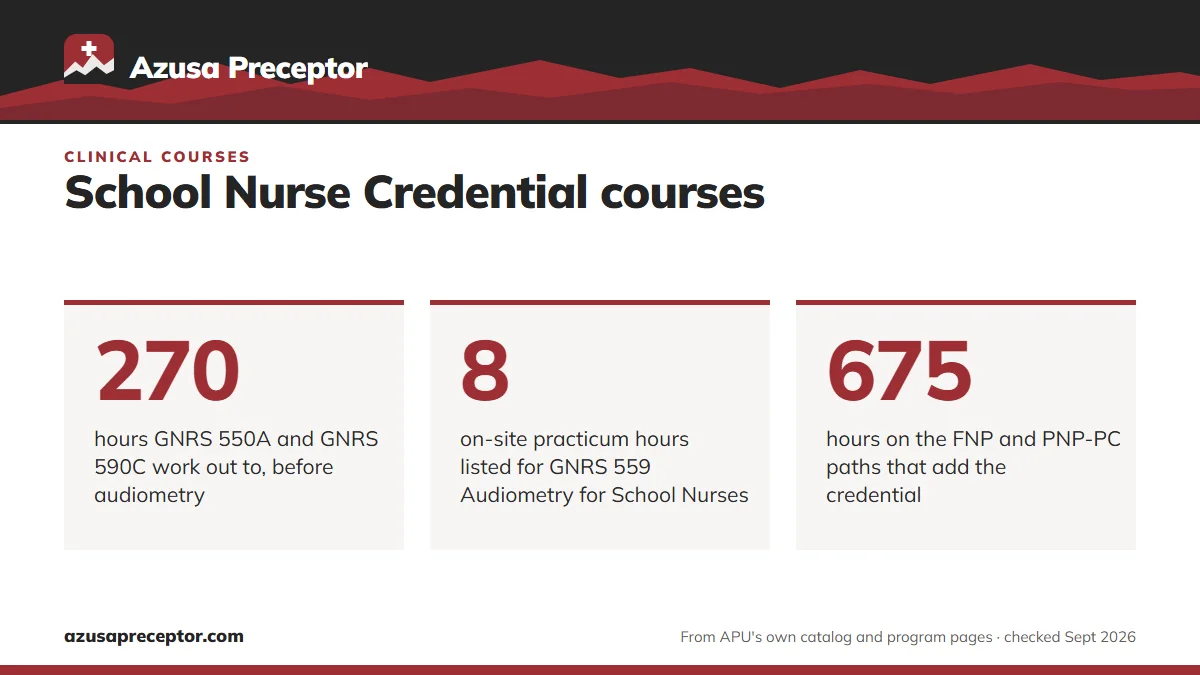
On this page
SNSC pathsGNRS 550AGNRS 590CAudiometrySNSC with FNP or PNP-PCSNSC paperworkOur SNSC planningQuestionsFour paths, one set of school nursing courses
APU offers the credential four ways, all listed at the Azusa campus: the SNSC alone as a nondegree credential, the MSN with SNSC, the MSN FNP with SNSC and the MSN PNP-PC with SNSC. The California Commission on Teacher Credentialing approves the credential program. The table shows how the clinical courses stack up on each path, with hours shown as clinical units at 45 hours each unless APU prints them.
| Path | Units | Clinical courses | Clinical hours |
|---|---|---|---|
| SNSC only (nondegree) | 24 | GNRS 550A, GNRS 590C | 270 (works out to), plus audiometry |
| MSN with SNSC | 37-39 | GNRS 550A, GNRS 590C | 270 (works out to), plus audiometry |
| MSN FNP with SNSC | 56 | GNRS 600 (12 units), GNRS 550A | 675: 540 printed for GNRS 600 plus 135 worked out, audiometry extra |
| MSN PNP-PC with SNSC | 53-55 | GNRS 590A, GNRS 532, GNRS 542, GNRS 590B, GNRS 550A | 675 (works out to), plus audiometry |
On every path, add an audiometry course that California approves, and expect to open with an assessment lab, GNRS 511 or GNRS 612; the FNP pairing lists GNRS 612. Admission, delivery and deadlines for all four live on the school nurse programs page.
GNRS 550A: field experience in school settings
GNRS 550A Theory and Practice in School Nursing is the course every SNSC path shares. It carries 6 units, 3 in the classroom and 3 in the field, or 135 hours at APU's rate. The catalog describes its clinical side as field experience in school settings. It requires GNRS 511 or GNRS 612 first.
APU's public pages leave open how the school site for GNRS 550A gets arranged, and the NP request forms' hour lists skip the course entirely. Ask your course faculty early how the school placement is set up, which school roles can supervise you, and whether the district must sign an affiliation agreement with APU first. Your syllabus and the School of Nursing student hub are where to confirm the answers.
APU's 2023-24 guidelines describe credential scheduling as shaped around the hours a school nurse already keeps, which suits students on a district payroll. If your own district is the natural site, the general graduate rule on training at an employer still applies, so raise it with faculty before you assume your school counts.
GNRS 590C: young family primary care for the credential
The second clinical course on the SNSC-only and MSN with SNSC paths is GNRS 590C, a young-family primary care course written for credential students. It also carries 6 units split 3 and 3, which works out to 135 hours, and it too requires GNRS 511 or GNRS 612.
Its title mirrors GNRS 590A, the first course of the PNP-PC sequence. APU's request form counts two kinds of setting for GNRS 590A: pediatric clinics, and family practices whose daily schedule includes six or more children. The form does not list GNRS 590C, so ask clinical faculty whether the same setting rule applies before you approach a practice.
Students weighing a later NP certificate have a choice here: the catalog allows a swap for MSN with SNSC students, and GNRS 590A can stand in for GNRS 590C after the courses it depends on (GNRS 610, GNRS 611, GNRS 513 and an assessment lab), which keeps a pediatric NP course on your transcript. Our PNP course guide covers how GNRS 590A runs.
The audiometry practicum
Every SNSC path requires a California-approved audiometry course. Among the catalog's courses is GNRS 559 Audiometry for School Nurses, with 8 practicum hours stated for on-site work. Keep those 8 apart from the 270 and 675 totals above when you plan your final terms.
The requirement tables call for a California-approved audiometry course rather than naming a single number, so confirm with your advisor whether you will take GNRS 559 or another approved course, and where its on-site hours take place. The practicum is short, yet it still has to happen on site, so put it on your calendar as early as any other clinical piece.
Audiometry is also easy to lose track of because the requirement tables list it apart from the larger clinical courses. Listing it in your program plan from the start keeps it from becoming the last item standing between you and the credential.
SNSC with an NP specialty: 675 hours
Pairing the credential with an NP specialty adds GNRS 550A to the full NP clinical load. On the FNP path that means the 12 units of GNRS 600, which APU prints as 540 hours with 135 of them pediatric, plus the 135 hours GNRS 550A works out to, for 675 before audiometry. The FNP pairing also includes EDUC 537 Curriculum Design. The GNRS 600 guide covers the primary care side.
On the PNP-PC path, the four pediatric courses from GNRS 590A to the GNRS 542 capstone work out to 540 hours, and GNRS 550A again adds 135. Either way you are running two kinds of placement at once: NP preceptors in clinics and a school setting for the credential.
APU's recent guidelines keep the classroom and clinical parts of a course in the same term, so any term that holds both GNRS 550A and an NP clinical needs two confirmed placements before it begins. Planning both kinds of site in the same conversation keeps the terms from colliding.
Paperwork and a cost conflict for credential students
Credential students meet the same compliance steps as other graduate students on the Azusa campus: a CastleBranch account, the SON Student Handbook acknowledgement, the training modules, a background check before placement, and proof of licensure, CPR, TB screening and immunizations. The CastleBranch and Complio guide covers the account itself.
One cost detail conflicts between APU pages. Most of them, the catalog included, put the background check on the student's bill; the School Nurse Services Credential page says lab fees attached to your opening clinical course already cover it. Ask the program which applies to your cohort; our placement costs page sets out the other items without figures.
Leave room for review time as well. APU's CastleBranch guidance notes that document review can take 7 to 10 business days, so upload records well before the program's deadline rather than on the day it falls.
How we help credential students plan
Credential students juggle two kinds of site, and we plan them together. On the NP side we source preceptors for GNRS 600 or the pediatric sequence close to where you live, and we map those terms around your school-setting course and audiometry so nothing overlaps. For GNRS 550A and GNRS 590C, we start from what your course faculty require and search for settings that match.
For every NP preceptor we prepare the credential, license, legal clinic name, legal signer and office manager contact that the Graduate Preceptor Request form asks for, and we check whether the site already has an APU agreement. APU's placement team clears each site in writing, and your request reaches them with nothing missing. See how it works or send us your path and first clinical term through the form below.
Questions APU students ask
What is the clinical hour total for APU's School Nurse Services Credential?
On the SNSC-only and MSN with SNSC paths, GNRS 550A and GNRS 590C carry 3 clinical units each and come to 270 hours at 45 per unit; audiometry's on-site hours are added on top. The FNP and PNP-PC paths that add the credential come to 675 hours before audiometry. Your syllabi confirm each course's figure.
Is GNRS 589 Adolescent Health Care a clinical course?
The catalog lists GNRS 589 Adolescent Health Care at 2 units, all classroom, with no clinical hours, and it is required on the MSN with SNSC and SNSC-only paths. APU's Azusa and Inland Empire request form, which still carries some older course numbers, lists 90 hours for an adolescent GNRS 589. Ask your advisor which version your catalog year uses.
Where are APU's school nurse credential programs offered?
APU lists the SNSC, the MSN with SNSC, the MSN FNP with SNSC and the MSN PNP-PC with SNSC at the Azusa campus. The FNP pairing mixes on-campus meetings, supervised clinical practice, and live and self-paced online classes. Clinical sites themselves are settled with your faculty and APU's placement team.
Does the audiometry course count toward my clinical hours?
The 270 and 675 totals on this page cover clinical units only, so audiometry hours are extra. GNRS 559 Audiometry for School Nurses lists 8 on-site practicum hours of its own. Your advisor confirms whether you take GNRS 559 or another California-approved audiometry course, and where the on-site hours happen.
Who approves APU's School Nurse Services Credential?
APU's credential program carries approval from California's Commission on Teacher Credentialing (CTC). The nursing side sits with the School of Nursing, whose programs are CCNE-accredited. Graduates of the NP pairings may also apply for BRN NP certification and for national certification in their specialty.
Related pages
Last checked 2026-09-25
We check these pages against APU's own catalog and program pages. Your syllabus, your clinical faculty and APU's student placement coordinators have the final word.
- APU Academic Catalog 2026-27: MSN with School Nurse Services Credential
- APU Academic Catalog 2026-27: School Nurse Services Credential
- APU Academic Catalog 2026-27: MSN FNP with School Nurse Services Credential
- APU: School Nurse Services Credential
- APU Academic Catalog 2026-27: Graduate Nursing course descriptions
APU says the clinical site and preceptor are yours to find. We make that the easy part.
Tell us your APU program, where you live in Southern California and when your next clinical term starts. We find preceptors who fit the course and prepare what APU and the site need before anything is approved.
- Preceptors matched to the course: primary care for
GNRS 600, pediatrics for the PNP courses, psychiatric care for PMHNP - Credentials, license and site details ready for APU's review and the affiliation agreement
- Close to home, from the San Gabriel Valley and the Inland Empire to San Diego
Start your placement plan
Program, city and term is all we need to begin.