APU's MSN PNP-Primary Care: four pediatric clinical courses in order
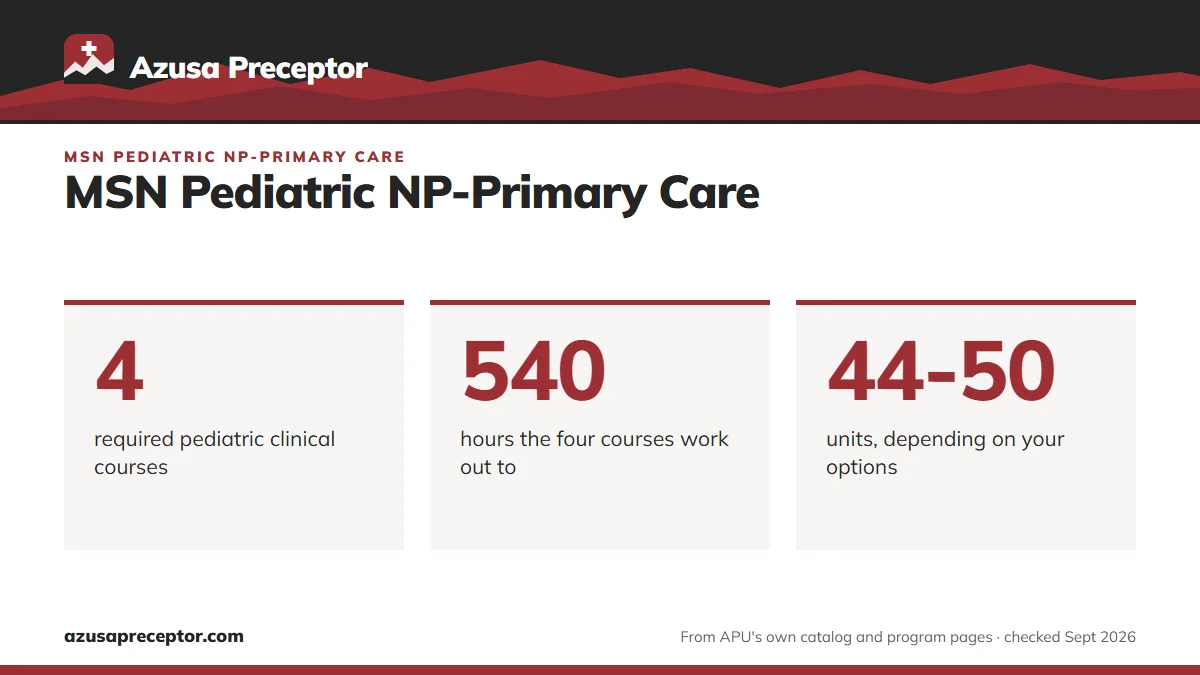
Azusa Pacific University (APU) spreads the clinical work of its Pediatric Nurse Practitioner-Primary Care (PNP-PC) MSN across four courses, from GNRS 590A at the start to the GNRS 542 capstone at the end, rather than one long course. At 45 hours per clinical unit they work out to 540 hours, or 630 with the optional GNRS 543. Each course can call for a different pediatric preceptor, so your plan is a sequence of searches, not a single one.
Plan your PNP-PC sequence
Share your campus and the next pediatric course on your plan.
On this page
Program in briefFirst clinical courseCourses and hoursPreceptor profileResidence and experienceCertificationWhy students choose usQuestionsThe PNP-PC program in brief
The PNP-PC prepares you for primary care of children and their families. The MSN runs 44 to 50 units, and the spread comes from two choices: whether you add the optional GNRS 543 Transitions Across the Care Continuum, and whether you finish with the comprehensive exam or a thesis (GNRS 598 plus GNRS 514).
The MSN PNP-PC appears on the program lists for Azusa, San Diego and the Inland Empire alike. Its health assessment course comes in two versions, the pediatric GNRS 511, which pairs assessment with health promotion, or the general GNRS 612; each is 4 units with a 1-unit lab. Ask your advisor which one your program plan uses.
APU prints no hour total for this track. The hours on this page come from the catalog's clinical units at APU's own ratio of 45 hours per unit, and they line up with the course hours on APU's current preceptor request form wherever the two overlap. Your syllabus remains the final word on each course.
When the first pediatric clinical begins
Precepted hours start in GNRS 590A, the young-family primary care course, once the advanced practice core is done. GNRS 532 requires GNRS 590A, so the order of your first two clinical courses is fixed, and the catalog lists GNRS 590B and then the GNRS 542 capstone after them. There is no published sample plan for the PNP-PC, so the term each course lands in comes from your own program plan.
Two gates stand in front of GNRS 590A, both from APU's 2023-24 graduate guidelines. Your grades in the advanced trio of pathophysiology, pharmacology and health assessment must each be B- or above, and you are not counted for placement until your program plan is complete. The handbook now in force sits behind the APU login and settles both.
Because you face several clinical terms in a row, the lead time repeats. Each new preceptor has to reach the placement coordinator's desk six to eight weeks before that term, per the same guidelines, so while one pediatric course is running, the search for the next one should already be moving.
Clinical courses and hours in sequence
The table follows the catalog's prerequisite order. Hours work out from clinical units at 45 per unit.
| Order | Course | Units (class/clinical) | Hours |
|---|---|---|---|
| Before | GNRS 511 or GNRS 612 health assessment | 4 (3/1 lab) | Lab, not a placement |
| 1 | GNRS 590A Primary Health Care of the Young Family | 6 (3/3) | 135 |
| 2 | GNRS 532 Advanced Nursing Practice in Pediatrics | 6 (3/3) | 135 (form: at least 60 specialty, 75 primary) |
| 3 | GNRS 590B Clinical Practicum in Pediatrics | 4 (0/4) | 180 |
| 4 | GNRS 542 Advanced Concepts and Competencies in Pediatric Primary Health Care | 3 (1/2) | 90, capstone with seminar |
| Optional | GNRS 543 Transitions Across the Care Continuum | 4 (2/2) | 90 |
The four required courses add up to 540 hours, and GNRS 543 lifts the figure to 630. The course that takes the most planning is GNRS 532, which covers critical and chronic conditions: APU's request form divides its 135 hours, asking for at least 60 in pediatric specialty care and 75 in general pediatric primary care, which can mean two preceptors in one term. GNRS 590B has no class units at all, so it is the heaviest single block of precepted time in the track. The PNP clinical courses page takes each course in turn.
Pediatric preceptors and qualifying settings
Who can precept you? APU's NP request form allows pediatricians and other MD or DO physicians, NPs, and PAs practicing alongside an on-site physician; PNP even appears in its credential dropdown. An NP has to precept you for one semester or more, and a pediatric NP in a primary care office covers that rule while suiting most of the sequence.
For pediatric courses the form accepts a pediatric office, or a family practice whose daily schedule includes six or more pediatric patients. That second route opens up family practices with a young panel, provided the daily count is real; the pediatric hours page explains how that test works.
The 60 specialty hours inside GNRS 532 are the part of the plan that points to a second site, such as a pediatric subspecialty clinic, and specialty clinics need faculty approval. APU sets no published minimum for preceptor experience or student ratio. Relatives, close friends and your own work unit are all ruled out; see preceptor requirements for the wording.
Living in Southern California and the year of experience
Two admission conditions follow you into the PNP-PC: a Southern California home and at least a year of nursing practice. With four or five clinical courses ahead, living near your campus is what keeps a multi-site plan workable. Placement staff factor in the distance to each site, and APU's 2023-24 guidelines discourage relocating mid-program and generally disallow campus transfers, so choose Azusa, the Inland Empire or San Diego with your likely clinic map in mind.
Those guidelines also want a year of professional RN practice behind you before your first clinical course, a rule they extend to ELM graduates entering the PNP-PC phase. APU's public pages do not list pediatric nursing experience as a requirement. A current California RN license stays on file throughout, and you keep working clinically while enrolled; the residence and license page has the details.
Certification as a pediatric primary care NP
After graduation, two applications follow: one to the California Board of Registered Nursing (BRN) for state NP certification, and one to sit for the national pediatric primary care exam, the CPNP-PC from the Pediatric Nursing Certification Board (PNCB). The BRN's approved-program roster groups APU's pediatric track under Pediatric and Adult Primary NP.
Before either step, you pass the summative OSCE, which APU's recent guidelines place in GNRS 542, the capstone; the evaluations and OSCEs page covers how clinical performance is judged along the way. California program graduates then apply under the BRN's Method One.
GNRS 611 Advanced Pharmacology sits in the core you finish before GNRS 590A, and APU says it satisfies the BRN's coursework rule for furnishing numbers. For the national exam, read PNCB's current eligibility page for its clinical-hour rules before you register.
Why PNP-PC students choose us
A pediatric sequence means several searches, one per course, each with its own preceptor profile. We plan all of them together, from the first course to the capstone.
- We map every required course,
GNRS 590Afirst andGNRS 542last, to preceptors near home before the first one starts. - We find the pediatric specialty site for the 60 specialty hours in
GNRS 532alongside the primary care site for the rest of that course. - We check a family practice's pediatric volume against APU's six-patients-a-day test before proposing it.
- We prepare one complete request per preceptor, with the legal name, signer and office manager contact APU asks for.
Every pediatric site still needs APU's written sign-off. What we add is a request for each course that arrives complete and matched to it. Send us your campus and your next pediatric course to begin.
Questions APU students ask
What do APU's PNP-PC clinical courses add up to?
APU does not print a total for this track. At its 45 hours per clinical unit, the four required courses work out to 540 hours: 135 in GNRS 590A, 135 in GNRS 532, 180 in GNRS 590B and 90 in GNRS 542. Adding the optional GNRS 543 brings the figure to 630. Your syllabus confirms the hours for each course.
Can a family practice count toward PNP clinical hours?
Yes, if six or more of its patients each day are children. APU's preceptor request form credits pediatric clinics and family practices at that daily volume toward pediatric courses, and a specialty clinic needs faculty approval first. Look at the practice's real pediatric schedule before you commit a term to it.
What is GNRS 543 in the PNP-PC track?
It is Transitions Across the Care Continuum, an optional 4-unit course with 2 clinical units, which works out to 90 more hours. Taking it moves the PNP-PC toward the top of its 44-50 unit range and the clinical total from 540 to 630. The same course number is a required, larger course in APU's CNS tracks.
Do I need a pediatric NP as my preceptor?
Not for every course. APU's request form accepts physicians, NPs and PAs with a physician on site, so a pediatrician can precept you. You do need at least one semester with an NP, and a pediatric NP in a primary care office is the most direct way to meet that rule inside your specialty.
Which campuses offer the PNP-PC?
For the MSN, all three NP campuses. The certificate is less clear: its own page names the same three, but APU's program finder shows Azusa alone. The PNP-PC paired with the School Nurse Services Credential is an Azusa program. Ask admissions to confirm your campus in writing before you build a site plan on it.
Related pages
Last checked 2026-09-25
We check these pages against APU's own catalog and program pages. Your syllabus, your clinical faculty and APU's student placement coordinators have the final word.
APU says the clinical site and preceptor are yours to find. We make that the easy part.
Tell us your APU program, where you live in Southern California and when your next clinical term starts. We find preceptors who fit the course and prepare what APU and the site need before anything is approved.
- Preceptors matched to the course: primary care for
GNRS 600, pediatrics for the PNP courses, psychiatric care for PMHNP - Credentials, license and site details ready for APU's review and the affiliation agreement
- Close to home, from the San Gabriel Valley and the Inland Empire to San Diego
Start your placement plan
Program, city and term is all we need to begin.