45 hours per clinical unit: APU's hours math, term by term
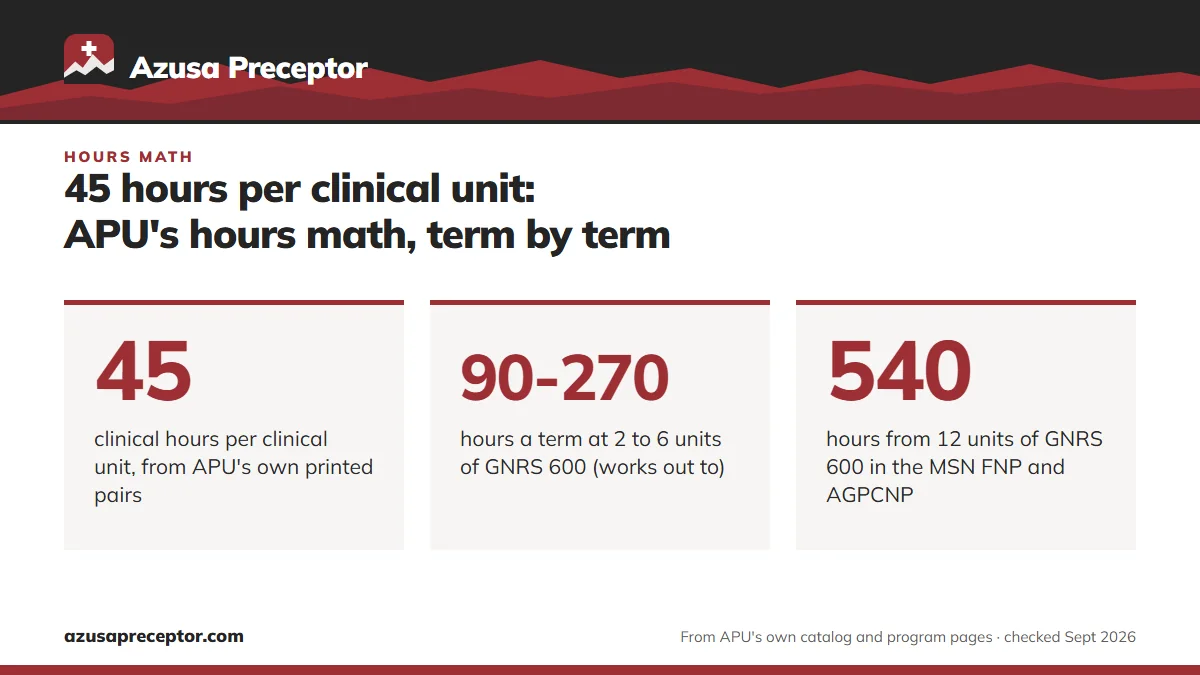
At Azusa Pacific University (APU), each clinical unit works out to 45 hours of clinical time. That ratio turns a unit load into a weekly schedule: 2 units is 90 hours in a term, 3 units is 135 and 6 units is 270. This page shows where the ratio comes from, how to read APU's unit notation and what each load asks of your week.
Match a preceptor to your unit load
Tell us your course, units and session.
On this page
Where the ratio comes fromReading unit notationWeekly hours by loadHours into clinic daysWhere the math stopsPlanning your termWhy students choose usQuestionsWhere the 45-hour ratio comes from
The ratio shows up wherever APU prints units and hours side by side, and every one of those pairs lands on 45. The clearest is the MSN nurse practitioner clinical course, GNRS 600: 12 units and 540 supervised direct patient care hours. The Nursing Education capstone, GNRS 663, is 3 units and 135 hours.
| Course or source | Clinical units | Hours APU prints |
|---|---|---|
| GNRS 600 Nurse Practitioner Clinical Experience (MSN) | 12 | 540 |
| GNRS 663 Nurse Educator Practicum | 3 | 135 |
| UNRS 212P Nursing Care of Adults and the Aging | 3 | 135 per semester |
| UNRS 310P Mental Health Nursing | 2 | 90 |
| UNRS 220 Health Assessment lab | 1 | 45 |
| A 3-unit DNP course (APU's DNP page) | 3 | 135 per semester |
Because the pairs agree across graduate, undergraduate and doctoral courses, this site uses the same ratio to work out hours where APU prints only units. Those figures are labeled 'works out to', since APU has not printed them itself. When an hour count matters, the syllabus and your clinical faculty settle it.
Reading APU's unit notation
APU's requirement tables list a course's total units with a split in parentheses: classroom units first, clinical units second. GNRS 535 appears as 6 (3/3), meaning 3 classroom units and 3 clinical units. Only the second number feeds the hour math, so GNRS 535 works out to 135 clinical hours, not 270.
| Course | Listed as | Clinical units | Hours |
|---|---|---|---|
| GNRS 538 Psychiatric Mental Health Care with Selected Populations | 5 (2/3) | 3 | 135 |
| GNRS 590B Clinical Practicum in Pediatrics | 4 (0/4) | 4 | 180 |
| GNRS 542 Advanced Concepts and Competencies in Pediatric Primary Health Care | 3 (1/2) | 2 | 90 |
| GNRS 520 Theory and Practice of the CNS | 6 (2/4) | 4 | 180 |
| GNRS 518 Supervised Practicum in Health Care | 3 (1/2) | 2 | 90 |
Two courses with different totals can hold the same hours. GNRS 538 is a 5-unit course and GNRS 535 a 6-unit course, yet each carries 3 clinical units and 135 hours, which matches the 135 hours per population course on APU's PMHNP preceptor request form. When the split is 0 in front, as in GNRS 590B, the whole course is clinical time.
What 2, 3, 4 or 6 units a term means for your week
The hour total for a term follows from your clinical units; the weekly load depends on how long the session runs. APU's graduate calendar uses 16-week sessions in fall and spring, and summer adds 12-week and 8-week options. The figures below are plain division, assuming hours spread evenly, which is also what APU's rule against front- and back-loading asks for.
| Clinical units | Hours in the term | 16-week session | 12-week session | 8-week session |
|---|---|---|---|---|
| 2 | 90 | 5.6 a week | 7.5 a week | 11.3 a week |
| 3 | 135 | 8.4 a week | 11.3 a week | 16.9 a week |
| 4 | 180 | 11.3 a week | 15 a week | 22.5 a week |
| 6 | 270 | 16.9 a week | 22.5 a week | 33.8 a week |
Shorter sessions compress the same total. Moving a load from 16 weeks to 12 raises the weekly figure by a third, and moving it to 8 weeks doubles it. Ask which session your clinical section runs on before you promise a preceptor a schedule.
Turning weekly hours into clinic days
Preceptors think in clinic days, not decimals, so translate the table before you ask. If your preceptor's clinic runs 8-hour days, 3 clinical units over 16 weeks is about one day a week plus a few extra hours across the term, and 6 units is two days a week plus roughly an hour more.
For scale, APU treats 6 units in a fall, spring or summer term as full time for nursing master's, credential and certificate students. A 6-unit clinical term therefore sits on top of any classroom units you carry, plus the job APU expects you to keep. Heavier clinical terms need sign-off, too: adding clinical units beyond the plan takes a director's or chair's approval, since APU's preceptor pool and placement staff serve every student.
GNRS 600 is the course where most NP students set their own pace: anywhere from two to six units per term, once faculty sign off, until the 12 units are done. How to spread those units is covered on our GNRS 600 page, and hours for every track are on the clinical hours hub.
Where the 45-hour math stops
The ratio covers most APU clinical courses, but four cases need care.
- The DNP residency.
GNRS 732is a zero-unit course you re-enroll in term after term until 1,000 residency hours are logged, and up to 500 of them can come from an earlier program, so unit math has nothing to multiply. See DNP residency hours. - 750 against 765. For BSN-to-DNP APRN students, 17 units of
GNRS 600works out to 765 hours, but the printed direct-care minimum is 750. The catalog's '540-765' range covers both the MSN and DNP paths. - Optional courses. The PNP-PC sequence works out to 540 hours, or 630 if you add the optional
GNRS 543. APU has not published a total for the track. - Labs. The lab unit in
GNRS 612Advanced Health Assessment is listed as a lab rather than clinical units, and the hours FNP and AGPCNP students earn today are recorded underGNRS 600.
When a figure matters for your graduation audit, ask clinical faculty to confirm it in writing rather than relying on arithmetic. Older course numbers such as GNRS 592B still sit in the catalog, and students on older catalogs may see hours attached to them.
Planning a term around the math
Knowing the number is half the job; finding a preceptor whose clinic can hold it is the other half. Match the weekly figure to real clinic days before you submit the Graduate Preceptor Request form, and remember that APU's guidelines call Saturday and evening clinical time scarce, especially in family practice.
Three APU rules shape the plan. Hours should be spread across the term rather than bunched at either end, they must be logged weekly in Medatrax, and nothing logged in a course you fail counts later. The first is covered on our clinical rotation rules page and the weekly log on our Medatrax page.
Working students should put their job into the same calendar. Since APU's MSN and DNP programs assume you are still practicing as a nurse, a 6-unit term on a 16-week session asks for about 17 clinical hours a week on top of that job and the paired lecture course.
How we match a preceptor to your unit load
APU students choose us because we start from the numbers. Tell us your course, your planned units and your session, and we look for a preceptor whose clinic days can carry that weekly load close to your home in Southern California, whether that is one steady day a week for 3 units or two days for a 6-unit term.
We assemble the credentials and site facts APU's placement team reviews, and we confirm with the office, before you commit, whether APU already has a contract with that organization. When your load rises, say from 3 approved units to 6, we look for a second clinic day with the same preceptor or a second preceptor whose patients fit the course, and we prepare the extra request form APU needs. If your preceptor bows out partway through, we get to work on a successor who can absorb the hours still owed. The form below takes a minute; how it works shows the rest.
Questions APU students ask
How many clinical hours is one unit at APU?
Each clinical unit works out to 45 hours. APU prints that ratio in several places, including GNRS 600 at 12 units and 540 hours and GNRS 663 at 3 units and 135 hours. Classroom units in a split listing such as 6 (3/3) add no clinical hours, so count only the second number.
How many hours a week is a 3-unit clinical course at APU?
Three clinical units is 135 hours. Spread evenly over a 16-week session, that works out to about 8.4 hours a week, roughly one clinic day. On a 12-week session it is about 11.3 hours a week, and on an 8-week session about 16.9. Confirm which session your section uses.
Do lab units count toward APU clinical hours?
Not as preceptor hours. A lab unit such as the one in GNRS 612 is listed as a lab, not as clinical units, and NP direct patient care hours are logged in the clinical course itself. Undergraduate descriptions do pair a 1-unit lab with 45 lab hours, but that is campus lab time, not a placement.
Why do some APU hour figures say 'works out to'?
APU prints clock hours for only a few courses, such as GNRS 600 and GNRS 663. For the rest it lists units, so hours are calculated at 45 per clinical unit. Those computed figures are consistent with APU's printed pairs, but they are not APU's own wording, so confirm them with your syllabus or clinical faculty.
Does the 45-hour rule apply to the DNP residency?
Not directly. The residency course, GNRS 732, has no units; you keep enrolling until 1,000 hours are complete, and as many as 500 can transfer in. APU's DNP page does pair a 3-unit doctoral course with 135 semester hours, which follows the same 45-hour ratio for that coursework.
Related pages
Last checked 2026-09-25
We check these pages against APU's own catalog and program pages. Your syllabus, your clinical faculty and APU's student placement coordinators have the final word.
APU says the clinical site and preceptor are yours to find. We make that the easy part.
Tell us your APU program, where you live in Southern California and when your next clinical term starts. We find preceptors who fit the course and prepare what APU and the site need before anything is approved.
- Preceptors matched to the course: primary care for
GNRS 600, pediatrics for the PNP courses, psychiatric care for PMHNP - Credentials, license and site details ready for APU's review and the affiliation agreement
- Close to home, from the San Gabriel Valley and the Inland Empire to San Diego
Start your placement plan
Program, city and term is all we need to begin.