Graduate grades, probation and repeats at APU
Azusa Pacific University (APU) graduate nursing students stay in good standing with a 3.0 cumulative GPA, and APU's advanced practice guidelines treat B- as the lowest passing grade in NP courses. A course can be attempted three times, an Incomplete can run 12 weeks past the term, and most programs must be finished within eight years. Here is how each rule reaches into your clinical plan.
Rebuild your clinical plan
Repeat term, incomplete or return from leave: tell us the course.
On this page
The 3.0 GPAThe B- lineRepeatsIncompletesWithdrawals and time limitWarnings and appealsWhy students choose usQuestionsGood standing: the 3.0 GPA
Master's, credential and certificate students at APU are in good standing while their cumulative GPA is 3.0 or higher. Drop below it and the catalog places you on academic probation, with one enrollment period to bring the average back. A student who does not recover may be disqualified from further graduate work, and dismissal actions are posted on the transcript.
Doctoral students work to a tighter standard. In 700-level courses a DNP student needs a 3.0 GPA and no grade below B-; anything less brings probation, and more than two terms on probation in total can lead to dismissal. APU's DNP page also lists a 3.0 GPA among the conditions for graduating, next to the residency hours and a defended project.
Probation soon shapes the clinical calendar, so see your advisor before you commit to a recovery-term preceptor.
The B- line in advanced practice courses
APU's graduate scale runs from A to F with pluses and minuses. A B- is worth 2.7 grade points and a C+ is worth 2.3, and the catalog lets a department set a minimum grade higher than the university's own.
The School of Nursing uses that option. Its 2023-24 MSN Advanced Practice guidelines, the latest edition APU has posted publicly, make B- the lowest passing grade in both theory and clinical MSN courses and state that a C+ falls short. The current per-course minimum and the repeat limit for clinical courses live in the SON handbooks behind the APU login, so read the edition for your catalog year.
The same line decides when clinicals can start. Each of the three P's, advanced pathophysiology, pharmacology and health assessment, needs a B- or better, taken in that order, before any clinical course. The GNRS 612 page explains that gate, and the GNRS 611 page shows why the pharmacology grade matters again at licensing.
| Code | What APU's catalog says |
|---|---|
| I | Incomplete, granted only in special circumstances with an approved form |
| IN | Incomplete, No Paperwork; becomes an F |
| W | Withdrawal during the first two-thirds of the term, with no grade penalty |
| FN | Failure, Nonattending |
Repeating a course
University policy allows a graduate student to repeat a course up to two times, three attempts in all, and only the most recent grade counts toward the GPA. A program may set a lower limit, and the School of Nursing's handbook holds the limit for its clinical courses.
A clinical repeat costs more than tuition. Under APU's guidelines, hours earned in a failed course stay behind when you repeat it, so the second attempt needs a cleared preceptor for the course's full hour count. When the failed course is one of the three gate courses, every clinical course behind it slides back as well.
Some exams allow no second try inside the course. Under the older guidelines, the summative OSCE in advanced health assessment needed at least 80 percent, with no remediation or retest; see evaluations and OSCEs.
A repeated clinical course starts its hour log at zero. Line up a preceptor who can host the whole course again, not just the hours you were short.
Incompletes: the standard kind and the clinical kind
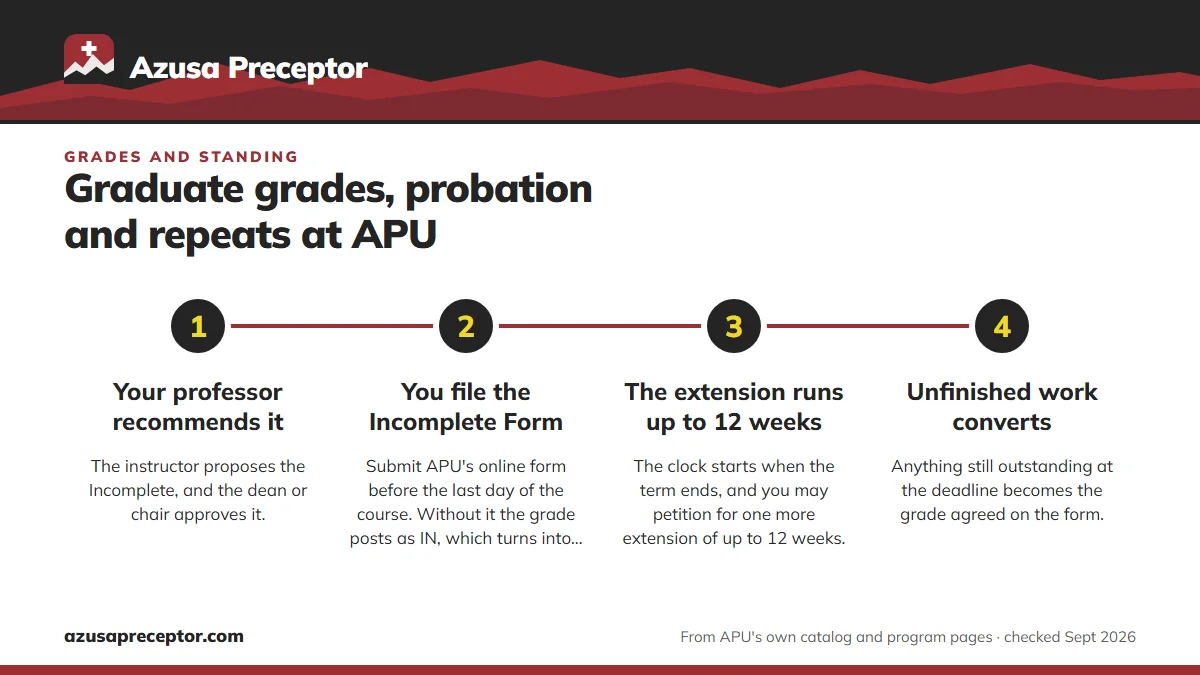
An Incomplete lets a course finish after the term ends, but APU grants one only in special circumstances. The catalog sets out the process:
- Your professor recommends itThe instructor proposes the Incomplete, and the dean or chair approves it.
- You file the Incomplete FormSubmit APU's online form before the last day of the course. Without it the grade posts as IN, which turns into an F.
- The extension runs up to 12 weeksThe clock starts when the term ends, and you may petition for one more extension of up to 12 weeks.
- Unfinished work convertsAnything still outstanding at the deadline becomes the grade agreed on the form.
The clinical version is narrower. Under the 2023-24 guidelines, faculty may offer a clinical incomplete when an unforeseeable event takes clinical sites away and no other site can be found; the student continues the didactic work, supervised by faculty, until the hours are done. The current onboarding hub adds another route: missing a clinical partner's onboarding requirements can mean an incomplete or a request to withdraw, after which the student works out a fresh progression plan with the Department Chair.
When the trouble is that no placement exists at all, a separate rule governs; the no-placement drop rule covers the first-third deadline and fee waivers.
Withdrawals, leaves and the eight-year limit
- Withdrawing from a course. Through the first two-thirds of a term, a withdrawal earns a W with no grade penalty. Past that point you need extreme circumstances on paper, plus approval from three people: your professor, the chair and the registrar. Walking away without withdrawing leaves you with an F.
- Leave of absence. A leave spans two or more consecutive terms, up to two years, and must be filed before the absence; backdated forms are refused. Federal loan rules do not treat it as a Title IV approved leave.
- Administrative withdrawal. Missing three consecutive terms, such as fall, spring and summer, ends your enrollment, and returning means reapplying under the catalog then in force.
- The eight-year limit. Most graduate programs must be completed within eight years of first enrollment, and extensions by petition are rare and may add requirements. APU's older APRN guidelines design the MSN advanced practice tracks for 8 to 9 semesters.
A long gap can also move you onto a newer catalog with different courses, so plan clinical terms around it early. Delayed graduation covers what a lost term does to your finish date.
Warnings, petitions and appeals
An academic warning is usually the first signal. The older guidelines issue one when a student's didactic, simulation or clinical performance falls below the expected competencies, and gaps in weekly Medatrax entries can bring one as well. The fix is a remediation plan the student and faculty write together, with dates and the evidence needed to show each competency is met.
Exceptions to policy go through an Academic General Petition, granted only for documented circumstances beyond your control. APU says work conflicts, a heavy work schedule, doing poorly in a class and a long trip to school do not qualify. To challenge a grade, raise it with the instructor, then petition the registrar within one year of the term's end.
Clinical warnings and failing clinical grades follow the order in the SON's older guidelines: lead faculty, the Department Chair or Assistant Chair, the Dean, then the catalog grievance process. That process runs from the faculty member (15 business days) to the chair and the dean (five business days each), then to a written grievance with the Office of the Provost designee within 10 working days; a Grievance Committee's majority decision is final.
Why APU students choose us when a term goes sideways
APU students come to us when grades and placements collide: a repeat term that needs every hour again, a clinical incomplete that needs a new site before the extension runs out, or a return from leave under a newer catalog. We rebuild the placement around the revised plan, searching close to home in Southern California for a preceptor whose credentials fit the course and whose clinic days can hold the hours.
For a repeat or make-up term the paperwork has to be right on the first pass, because the calendar has no slack. We assemble the preceptor's credential and license details with the site's legal entity and authorized signer for your Graduate Preceptor Request form, and we find out early whether APU already holds an agreement with that organization. APU's placement team gives the written clearance; we hand them a request with nothing missing. If the new preceptor falls through, we keep searching. Use the form below or read how it works.
Questions APU students ask
What GPA do APU graduate nursing students need?
A 3.0 cumulative GPA keeps master's, credential and certificate students in good standing; below it, APU places you on academic probation with one enrollment period to recover. DNP students also need a 3.0 in 700-level courses with no grade under B-, and a 3.0 GPA is a DNP graduation condition.
Is a C+ a passing grade in APU's NP program?
Not under APU's 2023-24 MSN Advanced Practice guidelines, which treat B- as the lowest passing mark in MSN theory and clinical courses; a C+ falls below that line. The current SON handbook, available behind the APU login, confirms the minimum for your catalog year before you plan a repeat.
How many times can I retake a clinical course at APU?
University policy allows three attempts at a graduate course, with only the latest grade in your GPA, but a program may allow fewer. The School of Nursing's limit for clinical courses is in its handbooks. Plan for the hours too: those from the failed attempt do not carry over to the repeat.
Can I get more than eight years to finish my APU degree?
Only by petition, and APU says extensions are rare and may add requirements. The eight years run from first enrollment. A leave of absence, or administrative withdrawal after three missed terms, can also change the catalog you finish under, so see your advisor before any break.
Does a full-time job count as grounds for an APU petition?
No. APU lists work conflicts and a heavy work schedule among the reasons that do not support an Academic General Petition, along with struggling in a class and traveling a long way to school. Petitions need documented circumstances beyond your control.
Related pages
Last checked 2026-09-25
We check these pages against APU's own catalog and program pages. Your syllabus, your clinical faculty and APU's student placement coordinators have the final word.
APU says the clinical site and preceptor are yours to find. We make that the easy part.
Tell us your APU program, where you live in Southern California and when your next clinical term starts. We find preceptors who fit the course and prepare what APU and the site need before anything is approved.
- Preceptors matched to the course: primary care for
GNRS 600, pediatrics for the PNP courses, psychiatric care for PMHNP - Credentials, license and site details ready for APU's review and the affiliation agreement
- Close to home, from the San Gabriel Valley and the Inland Empire to San Diego
Start your placement plan
Program, city and term is all we need to begin.