APU's PNP-PC clinical courses, one at a time
The Pediatric Nurse Practitioner-Primary Care (PNP-PC) track at Azusa Pacific University (APU) spreads its clinical hours across four required courses instead of one long block, opening with GNRS 590A, closing with the GNRS 542 capstone, and running GNRS 532 and GNRS 590B in between. Their clinical units work out to 540 hours, and each course asks for a slightly different pediatric setting, so your preceptor plan shifts from term to term.
Get your placement plan
Tell us your APU program and where you live. A placement advisor replies with the preceptor and site options that fit your APU course.
GNRS 532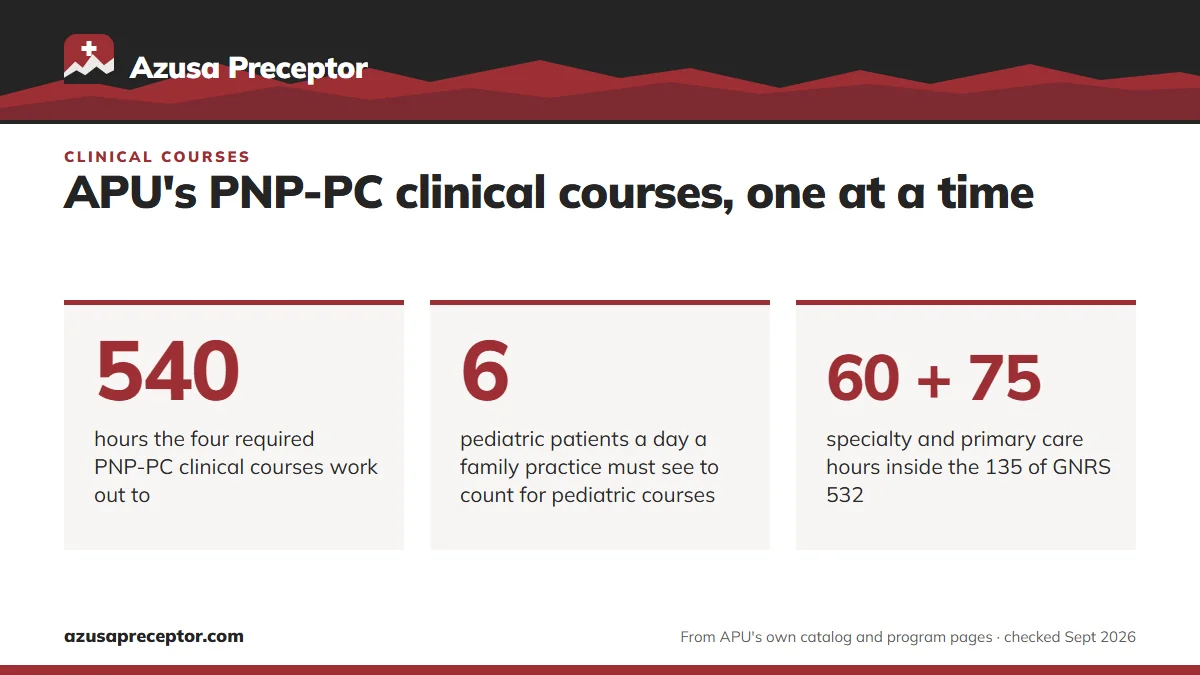
On this page
Sequence at a glanceGNRS 590AGNRS 532 hour splitGNRS 590B and GNRS 542PNP-PC preceptorsOther APU pathsOur PNP-PC planQuestionsThe PNP-PC clinical sequence at a glance
APU prints no hour total for the PNP-PC track, so the figures below come from the catalog's clinical units at 45 hours each, checked against APU's request form for Azusa and Inland Empire NP students wherever it names the course. The catalog lists the courses in this prerequisite order, after the advanced practice core and an assessment lab, either GNRS 511 or GNRS 612 (see our GNRS 612 guide).
| Course | Units (class/clinical) | Clinical hours | Focus |
|---|---|---|---|
GNRS 590A Primary Health Care of the Young Family | 6 (3/3) | 135; the request form also lists 135 | Pediatric primary care |
GNRS 532 Advanced Nursing Practice in Pediatrics | 6 (3/3) | 135; form: at least 60 in a pediatric specialty and 75 in primary pediatric practice | Critical and chronic conditions; requires GNRS 590A |
GNRS 590B Clinical Practicum in Pediatrics | 4 (0/4) | 180 (works out to) | All-clinical practicum, no classroom units |
GNRS 542 Advanced Concepts and Competencies in Pediatric Primary Health Care | 3 (1/2) | 90; the form lists 90 for PNP primary care | Capstone with seminar and practicum placement |
GNRS 543 Transitions Across the Care Continuum (optional) | 4 (2/2) | 90 (works out to) | Raises the total to 630 |
The four required courses come to 540 hours, and the optional GNRS 543 lifts the total to 630. Because APU publishes units rather than hours for this track, read each figure as what the units work out to, and let each syllabus set the number your clinical faculty signs off. The clinical hours overview sets the PNP-PC beside APU's other tracks.
GNRS 590A: the first pediatric primary care rotation
The first PNP-PC course that logs hours is GNRS 590A, which covers primary health care of the young family. It pairs 3 classroom units with 3 clinical units, which works out to 135 hours, and the request form lists the same 135. APU's recent guidelines require the classroom and clinical halves to run in the same term, so the preceptor has to be confirmed before the term opens rather than partway through it.
For pediatric courses, the request form accepts two kinds of office: a dedicated pediatric clinic, or a family practice with six or more children on its schedule each day. The second option widens the search beyond pediatric offices, provided the practice's daily schedule really reaches six children.
A specialty clinic only counts once faculty approve it, so a pediatric subspecialty office is a conversation with clinical faculty first and a request form second. FNP students meet a related pediatric requirement inside GNRS 600, and the FNP pediatric hours page covers that version of the rule.
GNRS 532: splitting 135 hours between specialty and primary care
GNRS 532 Advanced Nursing Practice in Pediatrics moves from primary care of the young family to critical and chronic conditions, and it requires GNRS 590A first. It keeps the same 6 units, 3 classroom and 3 clinical, and the same 135 hours, but the request form carves them up: 75 hours belong in primary pediatric practice, and no fewer than 60 in a pediatric specialty setting.
That split can mean two settings in one term. A primary pediatric practice covers the 75 hours, while the 60 specialty hours call for a setting that sees children with complex or chronic conditions. Whether one preceptor can supervise both parts is a question for your clinical faculty, because APU asks for a separate request form for every preceptor you use.
Start on the specialty piece first. Specialty settings are the ones that need faculty approval, and a site with no current APU affiliation agreement needs time to contract before you can report there. Lining up both halves a term ahead keeps GNRS 532 from stalling while paperwork catches up.
GNRS 590B and GNRS 542: the practicum and the capstone
GNRS 590B Clinical Practicum in Pediatrics is the only PNP-PC course with no classroom units: 4 clinical units, or 180 hours at 45 per unit, the largest single block in the sequence. The request form's hour list does not name it, so confirm the figure in the syllabus. APU's recent guidelines forbid front-loading or back-loading hours, so those 180 hours need a preceptor with room on the schedule every week of the term.
GNRS 542 Advanced Concepts and Competencies in Pediatric Primary Health Care is the capstone: 3 units, 1 in seminar and 2 in practicum placement, which works out to 90 hours, the same figure the form gives for PNP primary care. APU's recent guidelines also place the PNP summative OSCE here. The evaluations and OSCEs page explains how that exam sits beside preceptor and faculty evaluations.
Keeping one primary care preceptor through the last two courses can give you continuity with the same patients and routines. Each course still needs its own confirmed placement, though, and any new preceptor needs a new request form.
Who can precept a PNP-PC course
APU's NP request form accepts an MD, DO or NP as preceptor, or a PA who works with a supervising physician on site. Its dropdown of credentials adds CNS, CNM and PNP. Every NP student must spend at least one semester with a nurse practitioner, and a PNP preceptor meets that rule while modeling the role you are training for.
Relationship rules matter as much as the credential. The preceptor cannot be a family member or close friend, and training at your own workplace takes an employer-signed split of duties and a unit other than your own. Our preceptor requirements page lists the full set.
APU publishes no minimum years of experience, student-to-preceptor ratio or site-visit rule for preceptors. Those questions go to your clinical faculty and the Graduate Placement Team, and APU's preceptor handbook, which is not public, covers the rest.
Where the PNP-PC courses also appear
The same clinical courses run through three other APU paths. The MSN PNP-PC with School Nurse Services Credential adds GNRS 550A, 135 more hours in school settings for 675 in total, plus a California-approved audiometry course; our school nurse credential courses guide covers those pieces. The post-master's PNP-PC certificate, 33 to 37 units, uses the same courses and the same 540 hours, or 630 with GNRS 543.
ELM students on the PNP-PC track take the matching MSN courses once they have passed the NCLEX, which APU requires before any advanced practice clinical course. Campus lists differ by page: the certificate page names three campuses, Azusa, San Diego and the Inland Empire, while APU's program finder names Azusa only, and APU's student hub had no San Diego NP request form posted yet. Admission and degree details sit on the MSN PNP-PC program page.
How we build a PNP-PC placement plan
Pediatric placements reward planning the whole sequence rather than one term at a time. When you work with us, we map all four courses together: a pediatric office or high-volume family practice for GNRS 590A, a primary care site plus a specialty setting for the GNRS 532 split, a preceptor with steady weekly capacity for the 180 hours of GNRS 590B, and a primary care home for the GNRS 542 capstone.
For each preceptor we collect the license and credential, the practice's legal name, the person who signs for it and the office manager contact that the request form asks for, and we check up front whether the practice is already under an APU affiliation agreement. Clearance in writing still comes from APU's placement team; what we add is a request that needs no second round. Share your campus, city and start term in the form below.
Questions APU students ask
What is the total clinical hour count for APU's PNP-PC?
APU prints no hour total for the PNP-PC, but its clinical units work out to 540 hours across GNRS 590A (135), GNRS 532 (135), GNRS 590B (180) and GNRS 542 (90). The optional GNRS 543 adds 90 more, for 630. Your syllabi and clinical faculty confirm the hours that count in each course.
Can a family practice count for my pediatric courses?
Yes, as long as children fill enough of its day. On APU's Azusa and Inland Empire request form, a family practice qualifies for pediatric courses when it sees six or more pediatric patients daily, and a pediatric clinic qualifies outright. Specialty clinics need faculty approval first. Ask the practice for a realistic daily pediatric count before you submit the form.
Do I need a PNP as my preceptor in every course?
No. APU's NP form accepts MDs, DOs, NPs and PAs with an on-site supervising physician, and it lists PNP among the credentials. APU wants every NP student to log at least one semester under an NP, so plan at least one term with an NP, ideally one who sees children every day.
What is the summative OSCE in GNRS 542?
APU's recent guidelines place the PNP summative OSCE in GNRS 542, the capstone course. It is an objective structured clinical exam run by the program, separate from your preceptor's evaluation. Most APU clinical courses also use OSCEs, and the program adds progression OSCEs, so check your syllabus for dates and format.
Is GNRS 543 required for PNP-PC students?
No. The catalog lists GNRS 543 Transitions Across the Care Continuum as optional for the PNP-PC, at 4 units (2 classroom, 2 clinical), which works out to 90 hours. It is one reason the program's units range from 44 to 50. The CNS track lists a longer version of the same course number.
Related pages
Last checked 2026-09-25
We check these pages against APU's own catalog and program pages. Your syllabus, your clinical faculty and APU's student placement coordinators have the final word.
- APU Academic Catalog 2026-27: MSN Pediatric Nurse Practitioner-Primary Care
- APU Academic Catalog 2026-27: Graduate Nursing course descriptions
- APU School of Nursing: Confirmed Clinical Placements form, Azusa and Inland Empire
- APU School of Nursing: MSN Advanced Practice Program Guidelines 2023-24 (dated)
- APU: Pediatric Nurse Practitioner certificate
APU says the clinical site and preceptor are yours to find. We make that the easy part.
Tell us your APU program, where you live in Southern California and when your next clinical term starts. We find preceptors who fit the course and prepare what APU and the site need before anything is approved.
- Preceptors matched to the course: primary care for
GNRS 600, pediatrics for the PNP courses, psychiatric care for PMHNP - Credentials, license and site details ready for APU's review and the affiliation agreement
- Close to home, from the San Gabriel Valley and the Inland Empire to San Diego
Start your placement plan
Program, city and term is all we need to begin.