The 135 pediatric hours inside your APU FNP clinicals
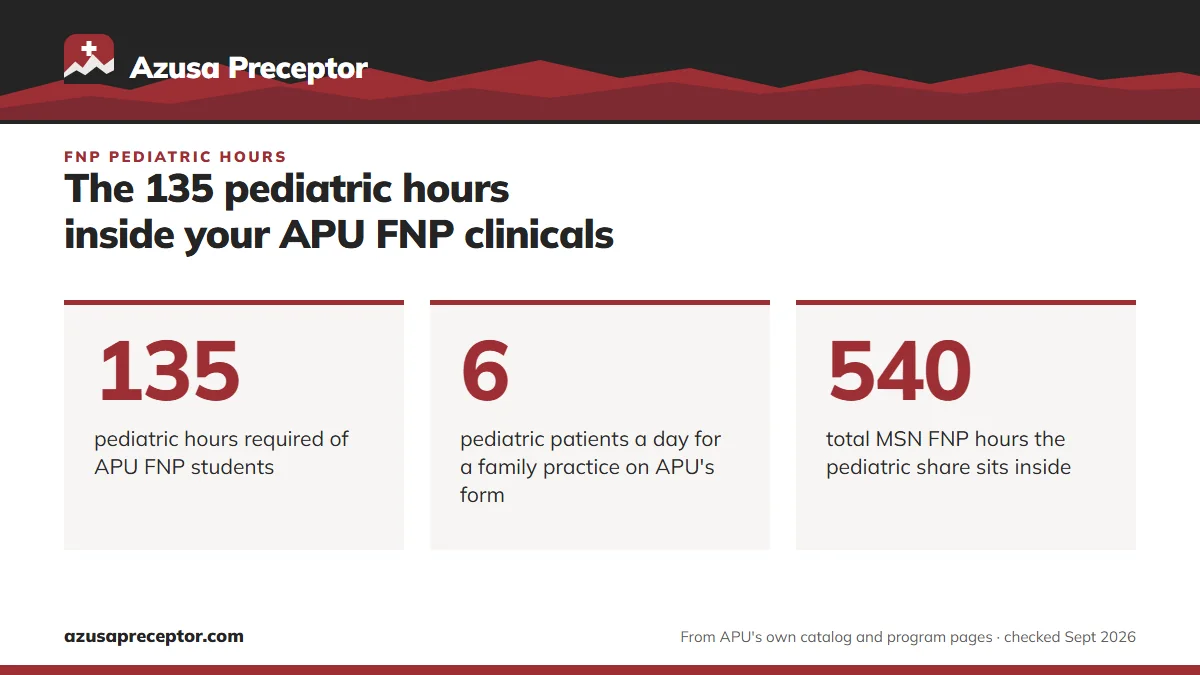
Azusa Pacific University (APU) requires Family Nurse Practitioner students to place 135 of their clinical hours in pediatrics, inside GNRS 600 rather than on top of it. For pediatric courses, APU's Azusa and Inland Empire request form counts a pediatric clinic, or a family practice with a caseload of six or more children daily, so a family practice's daily volume decides whether it fits.
Find a pediatric preceptor
Tell us your campus, city and the term you need the hours.
On this page
Where they sitSix patients a daySetting optionsScheduling the blockVetting checklistTracking the 135How we helpQuestionsWhere the 135 pediatric hours sit
The pediatric share is part of your total, not an extra layer. APU's catalog says MSN students need 540 hours in GNRS 600 and that FNP students must include 135 pediatric hours among them. BSN-to-DNP students on the FNP track carry the same 135 pediatric hours inside their 750 direct-care hours, while AGPCNP students on that path place 135 in geriatrics instead.
In unit terms, 135 hours works out to three clinical units at APU's 45 hours per unit, or a quarter of the MSN total. That makes it a sizable block: roughly one full term at a moderate load, or a steady slice spread over two or three terms. The GNRS 600 page explains how the units themselves are scheduled.
Students in the combined FNP and school nurse credential MSN still carry the 135 pediatric hours inside their 540. Their school-setting field experience is a separate course, GNRS 550A, with its own hours.
The six-pediatric-patients-a-day rule
APU's Azusa and Inland Empire request form spells out which settings qualify for pediatric courses: a clinic devoted to children, or a family practice whose daily schedule includes at least six young patients. Women's health follows the same logic, with an OB/GYN clinic or a family practice handling six or more women's health visits a day. Specialty clinics need faculty approval.
The effect is simple. A family practice with an excellent preceptor may still fall short for pediatric hours if its schedule is mostly adults. The threshold describes the practice's volume, so the number to check is how many children the clinic sees on an ordinary day, not how willing the preceptor is.
One gap is worth knowing. APU's catalog sets the 135 hours but does not say whether they must happen in a particular setting, and the San Diego NP request form was not yet posted when we checked. The form's rule is the clearest published guide; your clinical faculty and APU's Graduate Placement Team confirm what applies to you.
The six-a-day threshold describes the family practice. Confirm the clinic's typical daily pediatric volume with the office manager before you file the request, not after.
Pediatric clinic, family practice or specialty clinic
| Setting | What the form says | Confirm first |
|---|---|---|
| Pediatric clinic | Listed as a qualifying setting for pediatric courses | Preceptor credential, the clinic's legal name and its legal signer |
| Family practice | Qualifies with six or more pediatric visits a day | Typical daily pediatric volume and which provider sees the children |
| Pediatric specialty clinic | Needs faculty approval | Your clinical faculty's approval before you commit |
| Urgent care | Not named on the form | Ask clinical faculty whether it can count |
On the preceptor side, the form's categories cover physicians, NPs and physician assistants working under an on-site physician, and its credential dropdown names PNP as well, so a pediatric nurse practitioner or a pediatrician both fit. Somewhere in the program, one of your terms must also be with a nurse practitioner. The exclusions for relatives and your own work unit are on the preceptor requirements page.
A dedicated pediatric clinic is the most direct route, since every visit is pediatric. A qualifying family practice keeps you in one familiar primary care setting for longer. Which suits you depends on your campus, your commute and the terms left in your plan.
Fitting 135 hours into your GNRS 600 terms
You can shape the block two ways. A concentrated block places a full term of units at a pediatric clinic, and at 3 units that works out to exactly 135 hours. A spread approach keeps you at a qualifying family practice across several terms. How APU credits hours at a mixed practice toward the 135 is a question to settle with your clinical faculty before the term starts.
Either way, APU's recent guidelines (2023-24) bar front-loading and back-loading, so a pediatric block needs an even weekly pace like any other; rotation rules covers the details. The same guidelines warn that weekend and evening slots are rare in family practice, which matters if you plan pediatric hours around a full-time job.
Leave room at the end. A student who reaches the final term with the pediatric share unfinished has to find a qualifying site under the most time pressure. Place the block in an early or middle term and your last term stays flexible.
Questions to ask a family practice before you file
Before a family practice goes on your request form, find out:
- How many pediatric patients the practice sees on a typical day, and whether that holds year-round
- Which provider sees most of the children, and whether that person holds one of the credentials APU's form accepts
- Which days and hours bring the most pediatric visits, so your clinical schedule lines up with them
- Whether the preceptor is a relative or close friend, or the site is your own work unit, since APU excludes both
- The clinic's legal name, the legal signer with credentials and the office manager contact
- Whether the site already has an APU affiliation agreement, or would need a new one
The last two items feed straight into paperwork. The Graduate Preceptor Request form asks for the legal name, signer and office manager, one form per preceptor, and a site without a current agreement needs extra lead time, as the affiliation agreements page explains.
How we find pediatric hours for APU FNP students
Pediatric hours take extra care to place, and finding them is a core part of what we do for APU students. We search pediatric clinics and qualifying family practices near your home in Southern California, and we confirm the practice's daily pediatric volume with the office manager before anything goes to APU.
We then gather the details APU's form asks for, check whether the site already holds an APU affiliation agreement, and time the block so it lands in the term your plan needs. The written clearance comes from APU's placement team, and the request we prepare for it already shows how the site meets the six-a-day threshold. If a pediatric preceptor withdraws, we begin the search for a replacement immediately. Use the form below to tell us your campus, city and term.
Questions APU students ask
Are the 135 pediatric hours added on top of the 540?
No. APU's catalog places them inside the total: MSN FNP students need 540 hours in GNRS 600, and 135 of those must be pediatric. BSN-to-DNP FNP students likewise place 135 pediatric hours inside their 750 direct-care hours. Plan the pediatric block as part of your GNRS 600 units rather than as an extra course.
Can a pediatrician precept my APU pediatric hours?
Yes, as far as APU's current request form goes: MDs and DOs are accepted, and that includes pediatricians, alongside NPs and physician assistants working with an on-site physician. The form's credential list names PNP too. Just make sure another term in your plan covers the requirement to learn from a nurse practitioner for at least one semester.
Does urgent care count toward APU FNP pediatric hours?
APU's request form does not name urgent care. Its qualifying settings for pediatric courses are children's clinics and family practices seeing six or more young patients daily, and specialty clinics need faculty approval. Ask your clinical faculty before you commit an urgent care site to your pediatric block.
Do AGPCNP students need pediatric hours?
The 135-hour pediatric share belongs to the FNP. APU's catalog lists 540 hours for the MSN AGPCNP without naming a pediatric portion. On the BSN-to-DNP path, AGPCNP students place 135 of their 750 direct-care hours in geriatrics instead, which calls for a site with a strong older-adult population.
What if my family practice sees fewer than six children a day?
By the form's rule it falls short of the pediatric threshold, though it may still suit your adult primary care hours. One option is pairing it with a pediatric clinic for the pediatric share, which means a second request form, since APU asks for one per preceptor. Your clinical faculty decide how the hours are credited.
Related pages
Last checked 2026-09-25
We check these pages against APU's own catalog and program pages. Your syllabus, your clinical faculty and APU's student placement coordinators have the final word.
APU says the clinical site and preceptor are yours to find. We make that the easy part.
Tell us your APU program, where you live in Southern California and when your next clinical term starts. We find preceptors who fit the course and prepare what APU and the site need before anything is approved.
- Preceptors matched to the course: primary care for
GNRS 600, pediatrics for the PNP courses, psychiatric care for PMHNP - Credentials, license and site details ready for APU's review and the affiliation agreement
- Close to home, from the San Gabriel Valley and the Inland Empire to San Diego
Start your placement plan
Program, city and term is all we need to begin.