Clinical placement at Azusa Pacific, step by step
Azusa Pacific University (APU) runs graduate clinical placement as a chain of gates: a program plan, compliance, a preceptor you help find, a Graduate Preceptor Request form, review by the placement team, an affiliation agreement and written clearance. Only after the last gate do your hours start counting. This page walks the whole chain in order and points to the detail behind each link.
Get your placement plan
Tell us your APU program and where you live. A placement advisor replies with the preceptor and site options that fit your APU course.
On this page
The path at a glanceBefore your first clinicalFind a preceptorRequest to clearanceHours and MedatraxEvaluations and OSCEsIf the plan slipsWhy students choose usQuestionsThe whole path on one page
Graduate placement at APU moves through three phases. You get ready, you secure a site, and then you complete the clinical. Each phase ends in a gate, and a missed gate holds up everything after it.
| Phase | What has to happen | Where it lives at APU |
|---|---|---|
| Get ready | Program plan with your advisor; B- or better in advanced pathophysiology, pharmacology and health assessment; compliance finished | Advising, the catalog, CastleBranch or Complio |
| Secure a site | Preceptor found, one request form per preceptor, placement team review, affiliation agreement, written clearance | The NP onboarding page of the SON student hub |
| Complete the clinical | Supervised hours, weekly Medatrax entries, preceptor and faculty evaluations, OSCEs | Medatrax, Canvas and your clinical faculty |
Several steps below come from the publicly readable MSN Advanced Practice Program Guidelines, which is the 2023-24 edition. The current guidelines, the SON Student Handbook and your syllabus sit behind your APU account and have the final word.
Phase one: get ready before any clinical course
Planning comes first. Under APU's 2023-24 guidelines, a student with no program plan on file is left out of the placement count, and APRN students are held out of advanced health assessment until advising is finished. Advanced pathophysiology, pharmacology and health assessment each need a B- or better before any clinical course begins.
Experience is a gate as well. The MSN APRN tracks admit nurses with a year or more of nursing practice who reside in Southern California, FNP-track students in the BSN-to-DNP pathway must reach 8 months as an RN before year two, and both MSN and DNP students stay in clinical work throughout.
Compliance steps APU lists for advanced practice students
- Review the SON Student Handbook and upload the acknowledgement
- Complete the Student Data Questionnaire
- Complete or update CastleBranch, or Complio at the San Diego campus
- Finish the 2026-27 training modules in Canvas
- Review the COVID-19 standards that clinical facilities set
For Fall 2026 these were due August 1, 2026, and program deadlines can differ. The CastleBranch and Complio guide covers package codes and review times.
Phase two, part one: find and propose a preceptor
APU's BSN-to-DNP FAQ puts the search on the student, with APU's staff, faculty and student placement coordinators in support, and the MSN NP and CNS tracks work as a shared model along the same lines. Finding your own clinical site explains how that split plays out and how to search close to home.
Timing is where plans slip. The 2023-24 guidelines want the placement coordinator to hear about any new preceptor 6-8 weeks ahead of the term, the window APU uses for vetting and for a general liability contract. The same guidelines rank fit for your course level and patients above convenience, and they note that Saturday and evening clinicals are hard to come by, above all in family practice.
Screen the preceptor against APU's preceptor requirements before anyone signs anything. Accepted credentials differ between the NP, PMHNP and CNS courses, and relatives, close friends and colleagues from your own unit are ruled out.
Phase two, part two: from request form to written clearance
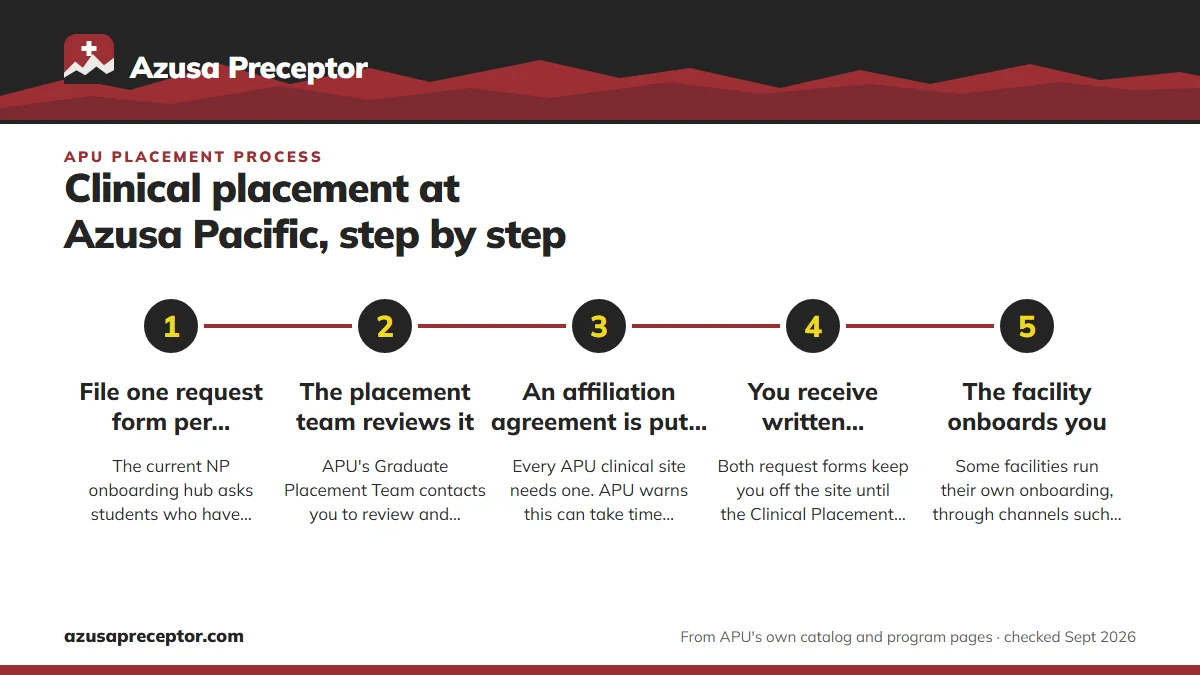
- File one request form per preceptorThe current NP onboarding hub asks students who have secured a preceptor to submit a Graduate Preceptor Request form. PMHNP, Nursing Education and Azusa or Inland Empire NP students each have their own version.
- The placement team reviews itAPU's Graduate Placement Team contacts you to review and confirm the placement, vets the preceptor and checks that your requirements are current. The placement team page covers offers and the one-week confirmation.
- An affiliation agreement is put in placeEvery APU clinical site needs one. APU warns this can take time, most of all when the organization holds no current agreement, so affiliation agreements deserve attention early.
- You receive written clearanceBoth request forms keep you off the site until the Clinical Placement Team signs off, and the 2023-24 guidelines ask for that sign-off as written notice from the placement coordinator.
- The facility onboards youSome facilities run their own onboarding, through channels such as MyClinicalExchange. When a facility charges for that per student, APU's hub says the School of Nursing receives the invoice, not the student.
Hours worked before written clearance, or anywhere APU never approved, come out of Medatrax. Wait for the notice.
Phase three: hours, rotation rules and Medatrax
APU counts 45 clinical hours for each clinical unit. MSN FNP and AGPCNP students carry GNRS 600 for 12 units in total, or 540 hours, and a term of 2-6 units with faculty approval works out to 90-270 hours. Clinical hours by program lists every track, including the places where APU's own figures disagree.
The rotation has its own rules in the 2023-24 guidelines: didactic and clinical courses run together, hours cannot be front-loaded or back-loaded, and no overnight shift right before a clinical day. The rotation rules page covers pauses and incompletes.
Log hours in Medatrax every week. A missed weekly entry can draw an academic warning, and the department chair strips out any hours recorded at an unapproved site. The Medatrax guide shows how to keep the log clean.
Phase three: how APU evaluates your clinical work
Two people grade the clinical: your preceptor and your clinical faculty. APU uses the clinical evaluation and the preceptor's evaluation as minimum-standard instruments, and a score under the standard in any single category sets off a remediation plan built with clinical faculty.
On top of that, OSCEs run in most clinical courses, plus progression OSCEs at the program level. The summative OSCE sits in GNRS 592B for FNP and AGNP students and in GNRS 542 for PNP students, while BSN-to-DNP APRN students take a clinical performance exam in GNRS 618. Assigned iHuman virtual patient cases each come with a fee, and a clinical portfolio opens once 540-765 hours are complete.
The preceptor email you enter on the request form is where APU's end-of-term evaluation lands, so use an inbox the preceptor actually opens. Evaluations and OSCEs goes deeper.
When a placement falls through
APU's 2023-24 guidelines are frank that a clinical placement is not promised. Students left without a site have to begin dropping the course before a third of the semester has passed, and some qualify for a late-drop fee waiver with priority placement the following term. The no-placement drop rule sets out who qualifies.
If a site collapses mid-course and nothing replaces it, APU may offer a clinical incomplete, while no hours survive a failed course. If a preceptor starts to pull back, tell clinical faculty at once, because leaving a site before faculty have tried to repair things costs you the waiver. Keep a second preceptor in view until your first one holds written clearance.
Why APU students choose us for this process
We are specialists in APU's clinical process and work it in APU's own order. We find a preceptor whose credential fits your course at a site close to home in Southern California, then gather what the placement team and the affiliation agreement need: license and credential, the practice's registered name, who signs for it, a contact in the front office and whatever onboarding the site runs.
Before anything is filed, we check whether APU and the site already have an affiliation agreement, so a new one gets the lead time it needs. Written clearance of every site stays with APU's placement staff, and what they receive from us is complete and inside APU's rules from the first submission. Should a preceptor leave mid-term, we remain on call and start lining up a replacement. Your program, home city and first clinical term are enough to begin, using the form below.
Questions APU students ask
How far ahead should I start APU's clinical placement process?
Start at least a full term before the clinical. APU's older guidelines want a new preceptor named 6-8 weeks out, APU wanted Fall 2026 compliance finished by August 1, 2026, and a clinic that has never signed an APU agreement adds time APU does not put a number on. Two terms ahead leaves room for a second option if the first site stalls.
Can I start clinical hours while APU reviews my site?
No. Neither APU request form lets you report before the Clinical Placement Team has cleared the site, and the guidelines want that clearance in writing from the placement coordinator. The department chair deletes Medatrax hours from sites APU has not approved, so early hours are lost hours.
Which APU documents govern my clinical placement?
Your syllabus, the current SON Student Handbook and the current MSN Advanced Practice Program Guidelines, all on the SON student hub behind your APU account. The guidelines file anyone can open is the 2023-24 edition, even where the hub labels it 2025-26, so check any rule taken from it against your syllabus and your clinical faculty.
Is the process the same for DNP, Nursing Education and leadership students?
The gates are similar and the paperwork differs. Post-master's DNP students work with the DNP Program Director, who also serves as the DNP Clinical Residency Coordinator. Nursing Education students file their own practicum site form. Healthcare Administration and Leadership students follow a published calendar built around Practicum Survey A and Practicum Survey B.
Do APU pre-licensure students follow this process?
No. In the traditional BSN, the upper-division transfer BSN and the ELM pre-licensure phase, program administrators assign clinical groups once partner facilities confirm. Students then self-enroll in a clinical onboarding Canvas course and have 5 business days to finish that facility's paperwork. The student-led search begins in the graduate NP and CNS phase.
Related pages
Last checked 2026-09-25
We check these pages against APU's own catalog and program pages. Your syllabus, your clinical faculty and APU's student placement coordinators have the final word.
APU says the clinical site and preceptor are yours to find. We make that the easy part.
Tell us your APU program, where you live in Southern California and when your next clinical term starts. We find preceptors who fit the course and prepare what APU and the site need before anything is approved.
- Preceptors matched to the course: primary care for
GNRS 600, pediatrics for the PNP courses, psychiatric care for PMHNP - Credentials, license and site details ready for APU's review and the affiliation agreement
- Close to home, from the San Gabriel Valley and the Inland Empire to San Diego
Start your placement plan
Program, city and term is all we need to begin.