APU's online DNP: planning the residency behind the degree
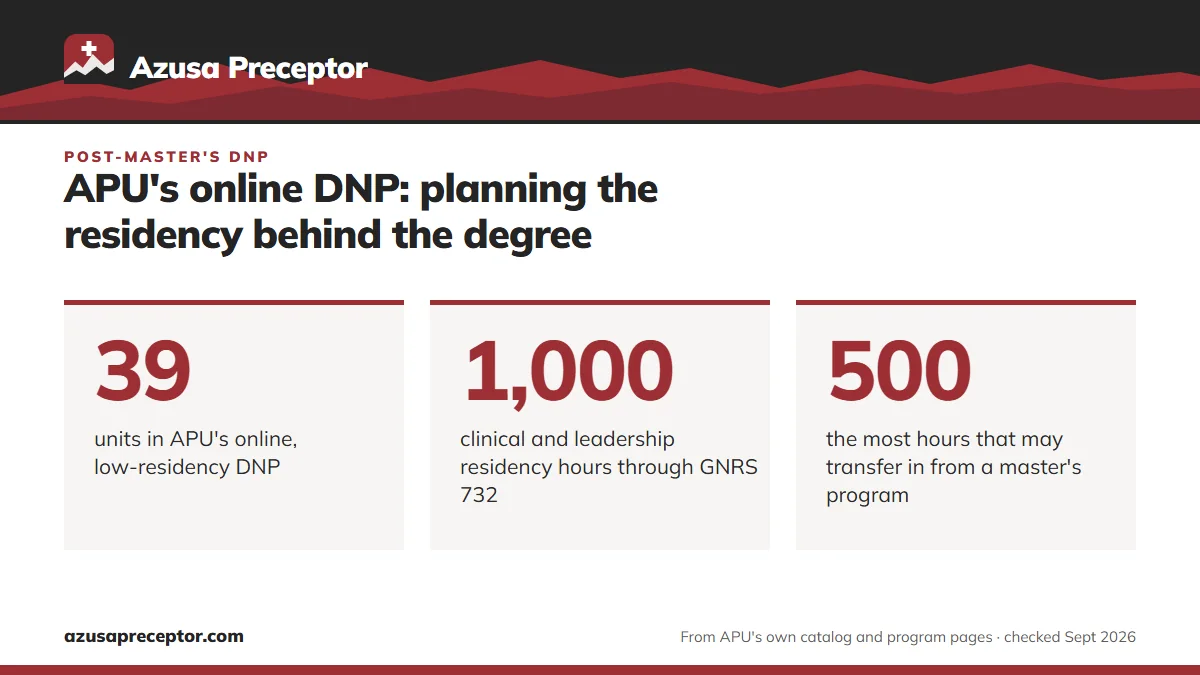
Azusa Pacific University (APU) offers a 39-unit, low-residency, online Doctor of Nursing Practice for nurses who already hold a master's. The coursework travels with you, but the residency does not: you need 1,000 hours of clinical and leadership residency through GNRS 732, up to 500 of which can transfer in, and the rest need sites that fit your scholarly project.
Plan your DNP residency sites
Tell us your role, your project idea and how many hours you expect to transfer.
On this page
Who it servesCourse sequenceCounting to 1,000Residency settingsWho arranges the siteLicensure and locationWhy students choose usQuestionsWho the DNP is for
APU's DNP prepares nurses for direct roles such as NP, CNS, CRNA and nurse-midwife, and for indirect roles in health systems leadership. It is the post-master's route into the doctorate; BSN-prepared nurses use the separate BSN to DNP pathway, which adds NP clinical courses.
Delivery is fully online with low residency. Even so, APU requires a current California RN license at entry, and DNP students must keep working clinically while enrolled. Graduation takes a 3.0 GPA, the full residency hours and a scholarly project you defend.
Fall applications are due July 21 and spring applications November 15. APU's DNP page still advertises a May 4 summer start, though the 2027 summer term opens May 3, so confirm dates with admissions before you plan around them.
The course sequence and where the residency sits
APU publishes the DNP core in order: GNRS 716 in the first semester, GNRS 712 and GNRS 718 in the second, and GNRS 780 in the third. Full-time students carry 6 to 7 core units a semester. Fall and spring run 16 weeks; DNP summer courses run 8 or 12 weeks.
GNRS 732, the DNP Clinical Residency, requires only admission to the program, so residency hours can start in your first term. It carries 0 units and repeats each term until your hours are complete. APU's DNP page sets a 3-unit DNP course at 135 hours a semester, which gives you a yardstick for how much a residency term can hold alongside coursework.
Older course numbers, GNRS 733A to GNRS 733C and GNRS 734A to GNRS 734C, still appear in the course list but are not part of current DNP requirements. If an older plan or a classmate mentions them, ask your advisor how they map to GNRS 732.
Counting to 1,000 hours
APU requires 1,000 hours of clinical and leadership residency, matching the AACN minimum. Graduates of an accredited APRN program (NP, CNS, CRNA or CNM) may transfer up to 500 clinical hours, and graduates of non-APRN master's programs may transfer up to 500 direct clinical hours. Applicants submit a letter from their APRN program stating the hours they completed.
| Your background | Hours that may transfer | Residency hours left |
|---|---|---|
| APRN master's with 500 or more documented clinical hours | Up to 500 | At least 500 |
| Non-APRN master's, such as education or leadership, with documented direct clinical hours | Up to 500 direct clinical hours | At least 500 |
| Master's with fewer documented hours | The documented amount | 1,000 minus what transfers |
| Co-enrolled in the Oncology NP Fellowship | Up to 500 fellowship hours may count | Ask APU how this combines with a transfer |
The hours letter is the document to chase first. Until APU has it, you cannot know how many residency hours you owe or how many terms of GNRS 732 to plan. Our residency hours guide covers logging and transfer in more depth.
What residency hours look like
APU's catalog splits the residency into two kinds of time. Clinical hours fall within an advanced practice specialty. Leadership hours build organizational leadership and carry the scholarly project, which runs through the residency from start to finish.
So your sites should serve the project. An NP improving diabetes follow-up might split hours between a primary care practice and that clinic's quality team; a nurse leader studying readmissions might work alongside a hospital's care-transitions staff. APU's faculty decide what fits; these examples only show how project and site connect.
Every setting needs APU approval and, under APU's rule for clinical sites, an affiliation agreement. APU's graduate guidelines remove hours logged at a site that was not approved, so approval has to land before the first residency hour, not after.
Who arranges the residency site
No public DNP document says who finds the residency site. APU's shared onboarding instructions send DNP students to the DNP Clinical Residency Coordinator, a role the DNP Program Director also holds, or to their program manager. The current DNP Program Guidelines sit behind the APU login.
In most of APU's other graduate programs, students propose a site and preceptor, and the program vets and approves them. Expect something similar, and confirm it with the coordinator in your first term, well before the residency clock matters.
Compliance applies to an online doctorate too. CastleBranch has a package code just for DNP students, and you keep the account current for as long as you are enrolled; our CastleBranch and Complio guide covers the setup and review times.
Licensure, location and accreditation
Because the DNP is online, applicants sometimes assume location does not matter. APU still requires a California RN license at entry, and its professional licensure disclosures do not list the DNP. APU is also not accepting distance applicants who live in 14 states and Washington, DC, and it notes that list changes often.
If you live outside California or might move, check the current list and our state authorization page before applying, and plan residency sites where your license and APU's approvals line up.
CCNE has accredited APU's DNP since November 2013, and the current term runs to December 31, 2028, with the next on-site review in spring 2028. Keep those dates handy in case a residency site asks about accreditation.
Why DNP students choose us
As a DNP student you likely bring a strong network and very little spare time. We turn your project idea into a short list of residency sites and preceptors who can support both the clinical and the leadership side, then prepare what APU needs to review them: credentials and licenses, the organization's official name and signing authority, and the right administrative contact.
We find out whether each site has an APU affiliation agreement on file and flag new-agreement lead time before you commit. Whether your hours letter leaves you 500 hours or the full 1,000, we pace the terms so the residency keeps step with GNRS 716 through GNRS 780 instead of piling up at the end.
If a site changes leadership or a preceptor leaves mid-project, we find a replacement that keeps the project intact. The program approves every site; we deliver a complete file that fits its rules. Tell us about your project through our contact page.
Questions APU students ask
Can I complete APU's online DNP if I live outside California?
APU requires a current California RN license at entry, does not list the DNP in its licensure disclosures, and currently takes no distance applicants from 14 states plus Washington, DC. Residency sites also need APU approval and an agreement. Check APU's current state authorization list and talk with admissions before applying from outside California.
How do I document the clinical hours I want to transfer?
APU asks for a letter from your APRN program stating the clinical hours you completed. Graduates of non-APRN master's programs may also transfer up to 500 direct clinical hours; ask admissions what documentation they accept. Request the letter early, because your remaining residency hours depend on the number it states.
Can residency hours happen at my own workplace?
APU's public DNP pages do not say. Its MSN guidelines accept clinical time at an employer only when the employer signs a written division of labor that keeps those hours apart from your paid job. Ask the DNP Clinical Residency Coordinator whether the same rule governs residency hours before you plan on it.
Is APU's DNP the same program as the BSN to DNP?
No. The post-master's DNP is 39 units, fully online and low-residency, for nurses who already hold a master's. The BSN to DNP runs 67 to 71 units, includes NP clinical courses on its APRN track and asks NP-track students to live near a Southern California regional center. Both use GNRS 732 for residency hours.
How many residency hours can I log in one term?
APU's public pages show no per-term cap for GNRS 732. The course repeats until you reach your total, and APU's DNP page puts a 3-unit DNP course at 135 hours a semester, which gives you a planning benchmark. Your residency coordinator and project timeline set the pace that works for you.
Related pages
Last checked 2026-09-25
We check these pages against APU's own catalog and program pages. Your syllabus, your clinical faculty and APU's student placement coordinators have the final word.
APU says the clinical site and preceptor are yours to find. We make that the easy part.
Tell us your APU program, where you live in Southern California and when your next clinical term starts. We find preceptors who fit the course and prepare what APU and the site need before anything is approved.
- Preceptors matched to the course: primary care for
GNRS 600, pediatrics for the PNP courses, psychiatric care for PMHNP - Credentials, license and site details ready for APU's review and the affiliation agreement
- Close to home, from the San Gabriel Valley and the Inland Empire to San Diego
Start your placement plan
Program, city and term is all we need to begin.