CastleBranch and Complio at Azusa Pacific: package codes, review times and deadlines
Azusa Pacific University (APU) tracks clinical compliance in CastleBranch on every campus but San Diego, where the tracker is Complio, an American DataBank product. Either way you pay for the subscription yourself, choose the package code for your program, and get every item accepted before the term deadline, which for Fall 2026 was August 1, 2026. Leave room for review: CastleBranch says checking a document can take 7-10 business days.
Get your placement plan
Tell us your APU program and where you live. A placement advisor replies with the preceptor and site options that fit your APU course.
On this page
Which tracker you usePackage codesThe term checklistTraining modulesDeadlinesCommon delaysWhere we fitQuestionsWhich tracker your campus uses
The split follows your campus, not your specialty. Students at Azusa, the Inland Empire and APU's other nursing locations work in CastleBranch. San Diego students work in Complio, the American DataBank platform, and APU's onboarding pages point San Diego students to their campus program managers for Complio questions. San Diego prelicensure cohorts are handled in Complio as well.
The account belongs to you. APU's SON Student Handbook says students purchase the subscription themselves and must keep it active and current for the entire time they are enrolled, not only in the term their first rotation begins. Letting it lapse leaves you out of compliance, and APU says incomplete requirements can delay a clinical placement.
The vendor sets the price, and nothing on this site prints amounts. Our placement costs page sorts out which compliance and clinical charges fall to you and which APU covers.
Package codes: pick the one for your program
CastleBranch sorts APU students by package code, so confirm which one is yours before you pay. The School of Nursing's CastleBranch overview lists a single Advanced Practice code shared by every CastleBranch campus, while the DNP, Nursing Education and HAL (Healthcare Administration and Leadership) programs each have a code of their own. Drug screens have separate codes and are ordered only when a clinical site asks for one.
APU keeps two versions of that overview in its nursing knowledge base: one for students who began in Spring 2024 or later, and one for students who began in Fall 2023 or earlier. Open the version that matches your start term and copy the code from it, rather than from a classmate's text or an old email.
| Student | Package named in the overview | Who to ask |
|---|---|---|
| MSN NP and CNS tracks, NP and CNS certificates | Advanced Practice, one code for all CastleBranch campuses | Graduate Placement Team |
| DNP students | DNP code; BSN-to-DNP NP-track students confirm whether Advanced Practice or DNP applies | DNP Clinical Residency Coordinator or program manager |
| MSN Nursing Education | Nursing Education code | Your placement coordinator |
| MSN Healthcare Administration and Leadership | HAL code | HAL practicum coordinator |
| Any student whose site requires a drug screen | Separate drug screen code | Order only after the site asks |
| San Diego campus | Complio account instead of CastleBranch | San Diego program managers |
The onboarding checklist APU posts each term
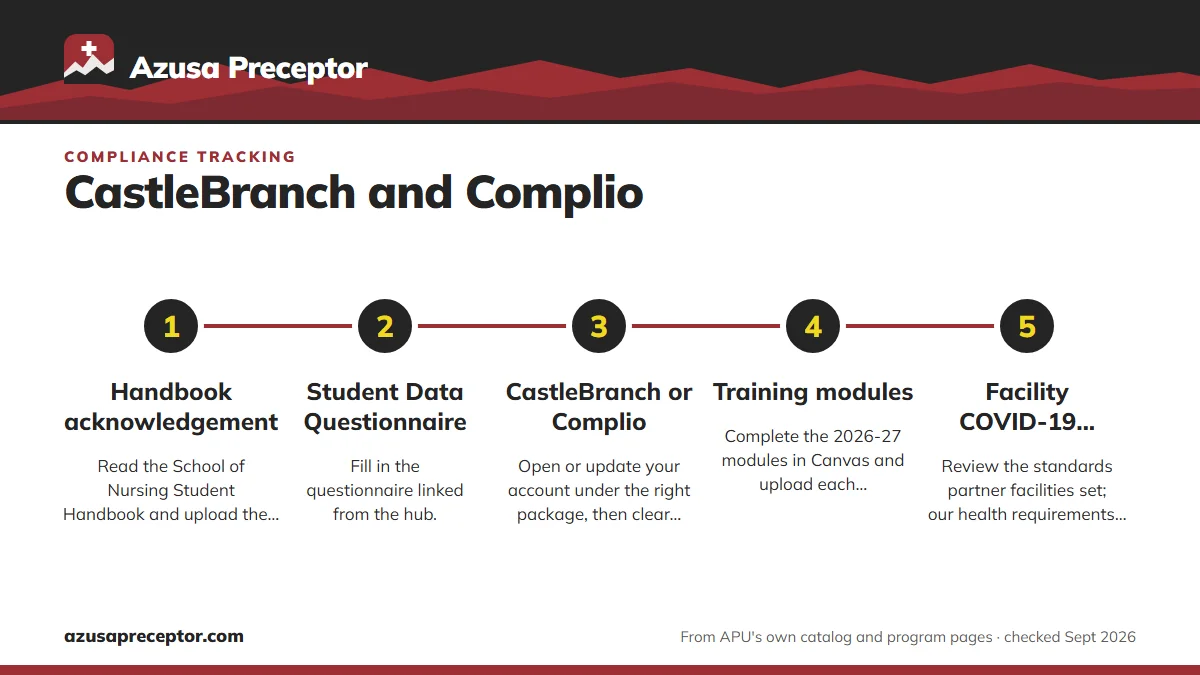
The tracker is one line on a longer list. APU's onboarding hub for NP students sets out five tasks to finish by the term deadline, and it notes that individual programs may set their own dates.
- Handbook acknowledgementRead the School of Nursing Student Handbook and upload the signed acknowledgement.
- Student Data QuestionnaireFill in the questionnaire linked from the hub.
- CastleBranch or ComplioOpen or update your account under the right package, then clear anything marked expired or rejected.
- Training modulesComplete the 2026-27 modules in Canvas and upload each certificate, except Implicit Bias.
- Facility COVID-19 standardsReview the standards partner facilities set; our health requirements page explains what they can mean for your placement.
The other items in your package each have a page of their own here: the background check and drug screen, your California RN license and malpractice coverage.
The 2026-27 training modules
APU's SON Training 2026/2027 sheet lists five modules, all taken inside Canvas. Three of them renew every year, so they belong on the same calendar as your TB screening and flu record. Each certificate is a separate upload, which is easy to forget in a busy August.
- Bloodborne Pathogens: renewed annually.
- HIPAA: renewed annually.
- Aerosol Transmissible Diseases: renewed annually; Cal/OSHA places COVID-19 under this standard.
- Workplace Violence Prevention.
- Implicit Bias: taken once, with no certificate to upload.
Every module certificate except Implicit Bias goes into CastleBranch or Complio. When you update the account each fall, check the dates on last year's certificates first: an annual module that expired over the summer counts as a missing item, the same as an expired card.
Deadlines: August 1 and the dates before it
APU posts one compliance date per term on its onboarding hub. For Fall 2026, clinical placement requirements had to be complete by August 1, 2026, and prelicensure students also had to be fully CastleBranch-compliant by that day, ahead of the August 24 start of classes.
| Term | Date posted | Where it appeared |
|---|---|---|
| Fall 2026 | August 1, 2026 | Current onboarding hub |
| Fall 2024 | August 1, with training modules due September 1 | Archived all-student updates (2024) |
| Summer 2024 (new students) | March 31, 2024 | Archived all-student updates (2024) |
| Spring 2024 | December 15, 2023 | Archived all-student updates (2024) |
Treat the older rows as a pattern rather than a schedule: fall work has come due around the start of August and spring work in mid-December, but only the hub and your program's messages set this year's date. Our academic calendar page lines those dates up with the term sessions.
Then count backward. If review can take up to 10 business days, a TB result uploaded in the last week of July may still read pending on August 1.
Where students lose time in the tracker
Watch dates as closely as documents. A TB result that runs out in September, a BLS card that expires mid-term, or a flu declination that one hospital refuses can turn a clean account into a problem after you were cleared. APU warns that declinations and waivers can block placement at some agencies.
Keep the tracker and the placement moving side by side. Compliance is only half of being ready: APU's placement team still has to clear your site in writing, and the Graduate Preceptor Request form and affiliation agreement follow their own timeline. A fully compliant student with no approved site still has nowhere to log hours, since APU removes hours recorded at an unapproved site from Medatrax.
An upload is not the same as compliance. An item counts only once the reviewer accepts it, so upload early and check back for rejections.
Why APU students choose us while the tracker is in review
The tracker proves you are ready; it does not find you a site. That second half is what we do, and we do it while your uploads sit in review. We search for a preceptor and clinic that fit your APU course near your Southern California home, confirm the preceptor's credential and license, and collect the details APU's Graduate Placement Team asks for on the request form.
We also ask each site what its own onboarding requires, such as a drug screen, CB Bridges or a more recent TB test, and tell you early, so you order each add-on once and on time. The result is a placement request that is complete on arrival and a compliance account that matches the site. Send us your campus and course below, or see how our process works.
Questions APU students ask
Do APU San Diego nursing students use CastleBranch?
No. APU's San Diego campus uses Complio, the American DataBank compliance platform, and its prelicensure cohorts are handled there too. APU's onboarding pages send San Diego students to their campus program managers with Complio questions. The training certificates and handbook items APU asks for still apply; they simply go into Complio instead of CastleBranch.
How long does CastleBranch take to review a document?
CastleBranch puts its review time at 7 to 10 business days per document. That clock starts after you upload, so a TB result or BLS card sent close to the deadline may still show as pending when APU checks. Upload each item as soon as you have it, then look again a few days later for rejections that need a correction.
Which CastleBranch package code does an APU NP student use?
APU's CastleBranch overview lists one Advanced Practice code for NP and CNS students at every CastleBranch campus, and gives the doctoral, educator and leadership programs their own codes. Use the overview written for your start term, Spring 2024 and later or Fall 2023 and earlier, and copy the code from it. BSN-to-DNP students on the NP track should confirm which code applies.
Do I need a new CastleBranch account every year at APU?
APU's handbook expects the account to stay live and up to date through your whole enrollment, so plan on one continuous account rather than a fresh start each fall. What renews is the content: the annual TB screening, flu record, physical and yearly training modules all need new uploads. Check your order for whether the subscription itself renews.
Is a hospital's onboarding portal the same thing as CastleBranch?
No. CastleBranch or Complio holds your APU compliance record, while some hospitals and clinics run their own student onboarding, and APU names MyClinicalExchange as one of those channels. APU's hub adds that when a facility levies its own per-student onboarding charge, the School of Nursing receives that invoice. Our guide to Southern California placement systems explains how those portals work.
Related pages
Last checked 2026-09-25
We check these pages against APU's own catalog and program pages. Your syllabus, your clinical faculty and APU's student placement coordinators have the final word.
APU says the clinical site and preceptor are yours to find. We make that the easy part.
Tell us your APU program, where you live in Southern California and when your next clinical term starts. We find preceptors who fit the course and prepare what APU and the site need before anything is approved.
- Preceptors matched to the course: primary care for
GNRS 600, pediatrics for the PNP courses, psychiatric care for PMHNP - Credentials, license and site details ready for APU's review and the affiliation agreement
- Close to home, from the San Gabriel Valley and the Inland Empire to San Diego
Start your placement plan
Program, city and term is all we need to begin.