GNRS 611 and your California furnishing number
Azusa Pacific University (APU) says its GNRS 611 Advanced Pharmacology course meets the California Board of Registered Nursing (BRN) requirement for a furnishing number, the authorization that lets an NP furnish drugs and devices under standardized procedures. You pass the course before your first clinical, and when you apply after graduation, the BRN asks your NP program director to verify it.
Find a preceptor who prescribes
Tell us your track and the course you need a site for.
On this page
What APU saysWhere GNRS 611 sitsWhat furnishing meansHow to applySchedule II rulesPharmacology in clinicalsWhy students choose usQuestionsWhat APU says about GNRS 611
APU's graduate nursing catalog states that GNRS 611 Advanced Pharmacology meets the BRN requirement for applying for a furnishing number. That makes it the one course in your plan that travels with you into licensing, and the BRN confirms it with the program rather than taking the transcript line on trust.
The BRN's furnishing instructions, revised in June 2025, list two items: the application and an Advanced Pharmacology Course Verification form completed by the NP program director. The course must equal at least 3 semester units, 5 quarter units or 45 hours of continuing education. The BRN's nurse practitioner page adds that furnishing Schedule II controlled substances requires pharmacology content that covers the risks of addiction.
Some apu.edu pages still call the course GNRS 594, its number before the current catalog, and name it as the pharmacology course that transfer credit applies to. Read any mention of GNRS 594 as the course the 2026-27 catalog lists as GNRS 611.
Where GNRS 611 sits in each APU track
Every NP and CNS path at APU includes GNRS 611, usually as part of the advanced practice core you finish before clinical work begins.
| Track | Where GNRS 611 falls | What follows it |
|---|---|---|
| MSN FNP and AGPCNP | Advanced practice core with GNRS 513, GNRS 610 and GNRS 612; GNRS 610 comes first | GNRS 612 with its lab, then GNRS 600 |
| MSN PNP-PC | Core courses finished before the pediatric sequence | GNRS 590A, the first pediatric clinical |
| MSN PMHNP | Core; GNRS 539 Psychopharmacology adds psychiatric drug content | GNRS 535, with GNRS 539 allowed in the same term |
| MSN CNS | Core, beside GNRS 613 Graduate Statistics | GNRS 520 or GNRS 530 |
| BSN to DNP, APRN track | No GNRS 610 needed beforehand | GNRS 612, then GNRS 600 |
| MSN with SNSC | Needed to swap GNRS 590A in for GNRS 590C, along with GNRS 513, GNRS 610 and GNRS 511 or GNRS 612 | A route toward a later NP certificate |
| Post-master's NP and CNS certificates | In every certificate's course list | The matching clinical courses |
APU's older guidelines set the three P's in order: pathophysiology, then pharmacology, then health assessment, each at B- or better before any clinical course. A grade under that line in GNRS 611 holds back every clinical course behind it; our grades and probation page covers repeats. Post-master's applicants who are already California NPs may challenge or waive courses, so ask the department how that applies to pharmacology.
What a furnishing number lets an NP do
NP certification alone does not let you order medications in California. The furnishing number, issued by the BRN, allows an NP to order, or furnish, drugs and devices under standardized procedures developed with a supervising physician. Business and Professions Code section 2725 defines standardized procedures, and the BRN points NPs to its guidelines in Title 16 of the California Code of Regulations, Division 14, Article 7, alongside Article 8 on nurse practitioners.
Supervision under furnishing law does not mean a physician in the room. The physician must work with the NP on the standardized procedure, approve it and be reachable by phone during the patient exam. Under section 2836.1, no physician may supervise more than four NPs at one time for furnishing.
AB 890 later created the 103 NP and the 104 NP, categories that practice without standardized procedures after transition-to-practice hours. Neither is required, and a new NP starts under standardized procedures. Our page on California NP practice rules explains how those categories shape who precepts you.
Applying: one BreEZe application, two approvals
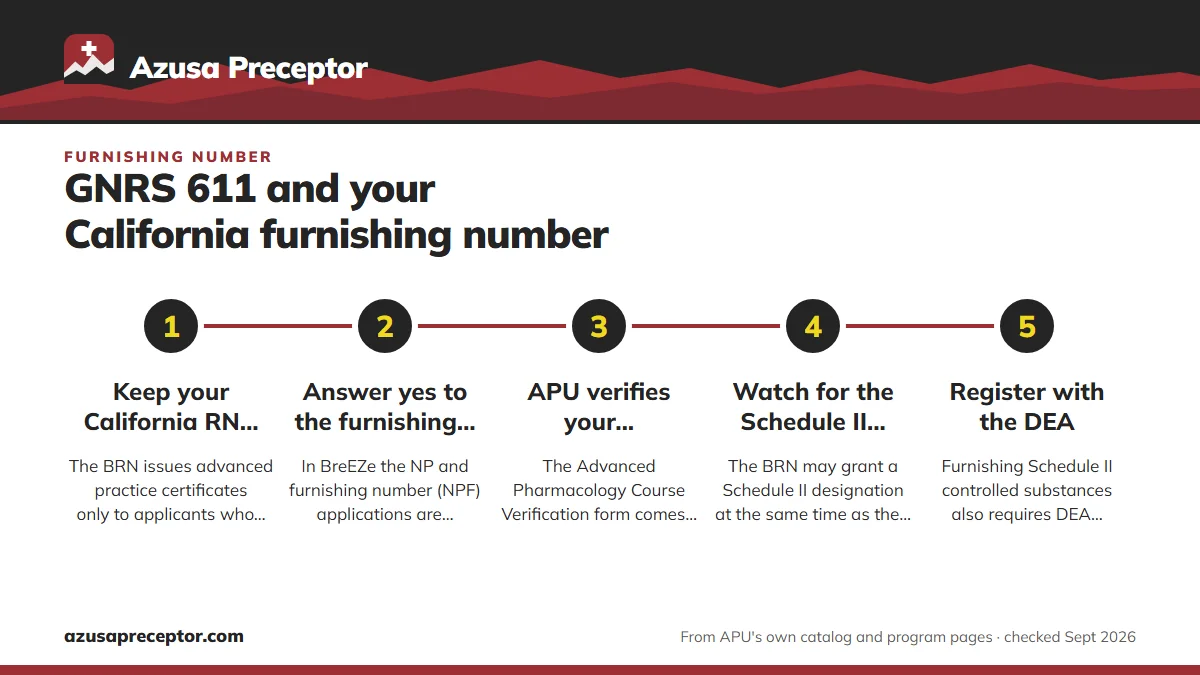
- Keep your California RN license activeThe BRN issues advanced practice certificates only to applicants who hold a California RN license, and every applicant is fingerprinted for state and FBI background checks.
- Answer yes to the furnishing questionIn BreEZe the NP and furnishing number (NPF) applications are combined. Saying yes to the furnishing question opens the furnishing application once your NP application is approved.
- APU verifies your pharmacology courseThe Advanced Pharmacology Course Verification form comes from the school, not from you, along with the verification of your NP program. Transcripts travel electronically through a vendor or directly from APU.
- Watch for the Schedule II designationThe BRN may grant a Schedule II designation at the same time as the furnishing number. Track progress in BreEZe or on the BRN's application status portal.
- Register with the DEAFurnishing Schedule II controlled substances also requires DEA registration, so plan that step once the BRN approves your furnishing number.
The certification side of the same application, including Method One for graduates of California programs, is covered on our BRN NP certification page.
Schedule II: getting it and keeping it
Schedule II authority has rules at both ends of your career. Under California law, continuing education courses cannot be used to obtain Schedule II authority the first time, so the pharmacology course the BRN verifies, GNRS 611 in your case, is what opens that door.
To keep it, you complete a Schedule II continuing education course of at least three hours by your renewal, so put that course on your calendar well before the renewal date arrives.
The BRN's current furnishing instructions do not mention a supervised-experience requirement, and our research found none. The BRN revises its instructions from time to time, so read the current version the week you apply. Demand is climbing: the March 2026 legislative background paper on the BRN reports that furnishing applications rose 39 percent over the last four fiscal years.
Putting GNRS 611 to work in your clinicals
GNRS 611 comes before your first clinical course, so its content is fresh just as you start seeing patients. FNP students begin GNRS 600 alongside GNRS 601 Primary Healthcare I, which puts drug knowledge to work in real prescribing decisions the same term.
Your preceptor's practice is where furnishing becomes concrete. APU accepts an MD, DO, NP, or a PA with an on-site supervising physician for NP courses, and every NP student precepts with an NP for at least one semester; the full rules are on our preceptor requirements page. An NP preceptor who furnishes under standardized procedures can walk you through how the clinic's protocols work in daily care. PMHNP students train with a psychiatrist or PMHNP, where GNRS 539 Psychopharmacology meets the medication decisions of each population course.
Oncology NP Fellowship applicants need the furnishing number before they start: APU lists a current California NP license and furnishing number among its admission requirements. The fellowship page has the details.
Why APU students choose us for prescribing-rich placements
APU students choose us because we look past the nearest open clinic to the placement that builds prescribing judgment. For NP courses we search close to home in Southern California for preceptors who manage medications across the population your course covers, and we plan your terms so the semester with an NP preceptor that APU asks for is in place.
Before anything reaches APU, we pull together what its Graduate Preceptor Request form asks about the preceptor and the practice: credential, license, the organization's legal name, the person authorized to sign and a front-office contact. We also check whether APU and the practice already share an affiliation agreement, because building a new one takes time. Written clearance comes from APU's placement team, and we make sure their review starts from a complete file. Should a preceptor withdraw mid-term, a replacement search starts right away. Start with the form below.
Questions APU students ask
Does APU's GNRS 611 qualify me for a California furnishing number?
APU's catalog says GNRS 611 Advanced Pharmacology meets the BRN requirement for applying for a furnishing number. The BRN still asks your NP program director to confirm the course on its Advanced Pharmacology Course Verification form, and the course must equal at least 3 semester units, 5 quarter units or 45 continuing education hours.
Do I apply for NP certification and the furnishing number separately?
No. In BreEZe the two applications are combined. You answer yes to the furnishing question, and the furnishing application opens once the BRN approves your NP application. A Schedule II designation may be granted at the same time, and furnishing Schedule II drugs also takes DEA registration.
Is GNRS 594 the same course as GNRS 611?
Yes. GNRS 611 was formerly numbered GNRS 594, and several apu.edu pages still name GNRS 594 as the pharmacology course that transfer credit applies to. The 2026-27 catalog uses GNRS 611. If a form or page shows the old number, treat it as the same course and confirm with your advisor.
Can a CE course give me Schedule II furnishing authority?
Not the first time. California law says continuing education courses cannot be used to obtain Schedule II authority initially, so the pharmacology has to come from your NP program. Once you hold it, keeping it requires a Schedule II continuing education course of at least three hours by your renewal.
How many NPs can one physician supervise for furnishing in California?
Four at one time, under Business and Professions Code section 2836.1. The physician need not be physically present but must collaborate on and approve the standardized procedure and be reachable by phone during the patient exam. The 103 and 104 NP categories created by AB 890 work without standardized procedures.
Related pages
Last checked 2026-09-25
We check these pages against APU's own catalog and program pages. Your syllabus, your clinical faculty and APU's student placement coordinators have the final word.
APU says the clinical site and preceptor are yours to find. We make that the easy part.
Tell us your APU program, where you live in Southern California and when your next clinical term starts. We find preceptors who fit the course and prepare what APU and the site need before anything is approved.
- Preceptors matched to the course: primary care for
GNRS 600, pediatrics for the PNP courses, psychiatric care for PMHNP - Credentials, license and site details ready for APU's review and the affiliation agreement
- Close to home, from the San Gabriel Valley and the Inland Empire to San Diego
Start your placement plan
Program, city and term is all we need to begin.