The Graduate Preceptor Request form, field by field
Azusa Pacific University (APU) asks graduate students who have lined up a preceptor to file a Graduate Preceptor Request form, one for each preceptor. It is a short form, yet it feeds the affiliation agreement, the preceptor's end-of-term evaluation and the placement team's review, so each field has a job. Below: which version applies to you, what goes in every field, and the gaps that send a request back.
Get your placement plan
Tell us your APU program and where you live. A placement advisor replies with the preceptor and site options that fit your APU course.
On this page
Which formField by fieldLegal name and signerOne per preceptorAfter you submitCommon gapsWhy students choose usQuestionsWhich version of the form you file
APU's current NP onboarding hub splits the request by program and campus rather than using one form for everyone. Choose the version that matches you, and look at the hub again each term, since versions change.
| Your program | Form to file | What stands out |
|---|---|---|
| NP students at Azusa or Inland Empire | The Azusa and Inland Empire form, titled Confirmed Clinical Placements | Lists NP, PNP and CNS course numbers, with hours per course |
| PMHNP students | PMHNP Preceptor Request | Carries its own preceptor rules for GNRS 535 to GNRS 538 |
| MSN Nursing Education | Nursing Education Practicum Site Information | Asks students outside Los Angeles for their city and state |
| NP students at San Diego | Not yet posted when the hub was last checked | Ask the San Diego program managers or the placement team |
| Healthcare Administration and Leadership | Practicum Survey A, then Practicum Survey B | Runs on a published calendar of fall and spring due dates |
The form, field by field
| Field | What to enter | Why it matters |
|---|---|---|
| Campus | Your APU campus | Ties the request to your program site |
| City of residence | Where you live now | APU weighs distance and expects a site near home |
| Course number and paired lecture course | For example GNRS 600 with GNRS 601 | Clinical and didactic courses run together, so both are checked |
| Preceptor name, credential and email | Credential from the dropdown, plus an inbox the preceptor reads | APU sends the end-of-term evaluation to that address |
| Clinic's legal name | The organization's name exactly as its contracts show it | The affiliation agreement is written in that name |
| Legal signer with credentials | The person with authority to sign contracts for the organization | That person signs the affiliation agreement |
| Office manager | Name and contact for whoever runs the office | A working contact at the site besides the preceptor |
| How you found the placement | Personal connection, cold calling or work connection | Asked on the Azusa and Inland Empire form |
On the Azusa and Inland Empire form, the credential dropdown offers MD, DO, NP and PA, plus CNS, CNM and PNP. Which of those a given course accepts is set out in APU's preceptor requirements.
Why the legal name and legal signer matter most
Two fields carry most of the weight. Each APU clinical site needs an affiliation agreement, and the form collects the clinic's legal name because that agreement is drafted in it. The legal signer is the person whose signature commits the organization to the agreement.
Both fields go wrong in familiar ways. Plenty of practices operate under the name on the front door while their contracts carry a different corporate name, and plenty of physicians who teach students are not the person who signs for the practice. A mismatch sends the agreement back for correction, on top of the time APU already warns a new agreement can take. Affiliation agreements explains that timeline.
The simple fix is one question to the office manager: what is the exact legal entity name, and who signs contracts, with what title? Enter the answers as given, credentials included.
One form for each preceptor
APU wants a separate request for each preceptor, even two at the same clinic. Every preceptor has a credential to check and an evaluation to receive, so two preceptors in one term means two forms and two reviews.
Program rules make this routine. NP students need at least a semester with a nurse practitioner, PMHNP students need a semester or more with a PMHNP, so plan on more than one preceptor type, and more than one form, across your terms. A preceptor added partway through a term needs a form too, and that new site waits for clearance like any other.
The Azusa and Inland Empire form also shows hours by course, older course numbers included, such as 180 hours apiece for the CNS courses GNRS 520 and GNRS 521. APU clinical hours collects those figures by program.
What happens after you press submit
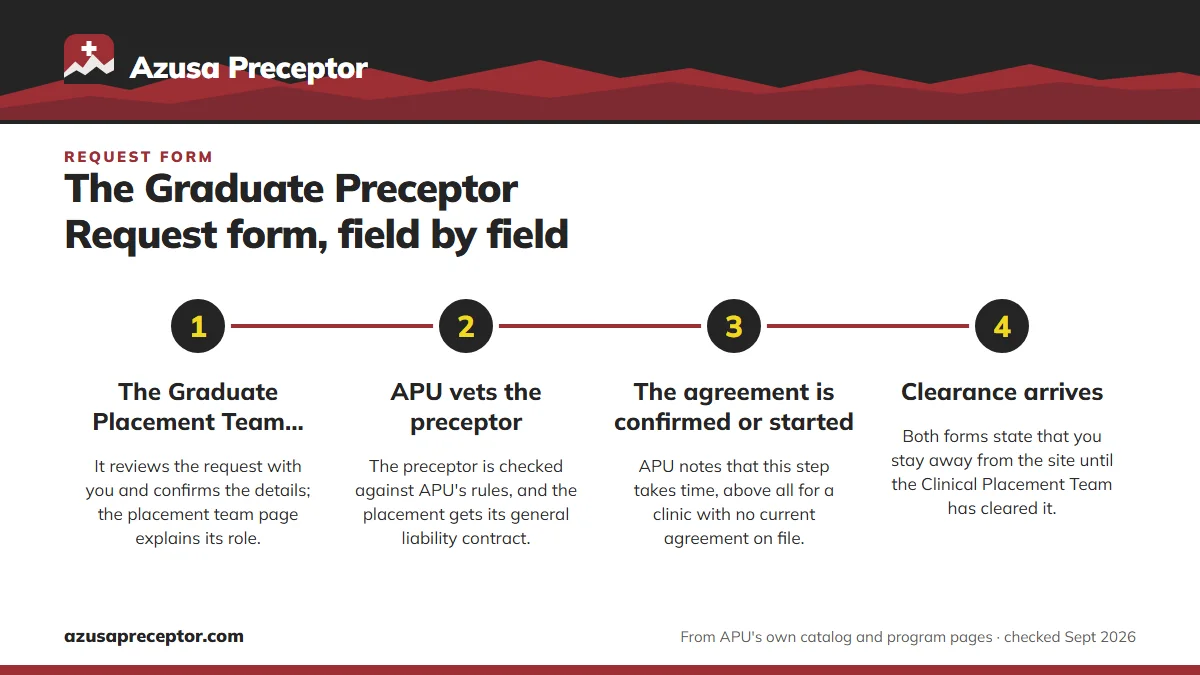
- The Graduate Placement Team contacts youIt reviews the request with you and confirms the details; the placement team page explains its role.
- APU vets the preceptorThe preceptor is checked against APU's rules, and the placement gets its general liability contract.
- The agreement is confirmed or startedAPU notes that this step takes time, above all for a clinic with no current agreement on file.
- Clearance arrivesBoth forms state that you stay away from the site until the Clinical Placement Team has cleared it.
The forms also caution that preceptors already working with APU may be unavailable, which is why the request is built around a preceptor you bring.
Filing the form is a request, not an approval. Hours logged before written clearance are removed from Medatrax.
Gaps that slow a request down
- The clinic's trade name entered where its legal name belongs
- The preceptor listed as legal signer when someone else signs contracts
- A course number from an old plan; the form still lists legacy numbers such as
GNRS 592B - The paired lecture course left blank
- A preceptor email nobody checks, which stalls the end-of-term evaluation
- A preceptor who is a relative or close friend, or who works in your own unit
- No office manager contact at all
Each gap costs a round of email with the placement team, and each round costs days. Clearing them before you submit is the quickest thing you can do for your start date. A short read-through with the office manager before you submit is the easiest way to catch the site-side ones.
How we prepare your request form
Our placement desk builds each request around what APU's form asks. After our desk secures a preceptor suited to your course at a site near home, we collect every field: the preceptor's credential and license, a working email for the evaluation, the clinic's exact legal entity name, the authorized signer with credentials, and an office manager contact.
We check the preceptor against APU's credential rules for your specific course and confirm up front whether APU and the clinic have signed an agreement before, so the placement team opens a request with nothing missing. APU's staff give the final clearance in writing, and the form they read from you is correct on its first submission. Share your program, city and start term through the form below.
Questions APU students ask
Where is APU's Graduate Preceptor Request form?
On the SON student hub, under the clinical placement onboarding requirements, on the page for advanced practice NP programs. That page links the PMHNP, Nursing Education and Azusa and Inland Empire versions. Check it at the start of each term, because APU updates the forms and posts new versions there.
Do I file a new form if my preceptor changes?
Yes. APU asks for one form per preceptor, so a replacement preceptor means a fresh form and a fresh review, even at the same clinic. Hold off on hours with the new preceptor until the Clinical Placement Team clears the change in writing, since hours from an unapproved placement can be taken off your log.
What is the paired lecture course on the form?
It is the didactic course you take alongside the clinical. For FNP students, GNRS 600 is the corequisite of both GNRS 601 and GNRS 602, while AGNP students pair GNRS 600 with GNRS 580. APU requires didactic and clinical courses at the same time, so the form confirms both are on your plan.
I study at the San Diego campus. Which form do I use?
When APU's NP hub was last checked for this guide, the San Diego NP request form had not been posted. San Diego also tracks compliance in Complio rather than CastleBranch. Ask your San Diego program managers or the Graduate Placement Team which form applies this term before you send anything.
Why does the form ask how I found my placement?
The Azusa and Inland Empire form asks whether the lead came from someone you know personally, from cold calling, or through work. It reflects APU's shared model, where students bring many of their own sites. A work connection also brings APU's employer rules into play: a signed division of duties and a unit other than your own.
Related pages
Last checked 2026-09-25
We check these pages against APU's own catalog and program pages. Your syllabus, your clinical faculty and APU's student placement coordinators have the final word.
APU says the clinical site and preceptor are yours to find. We make that the easy part.
Tell us your APU program, where you live in Southern California and when your next clinical term starts. We find preceptors who fit the course and prepare what APU and the site need before anything is approved.
- Preceptors matched to the course: primary care for
GNRS 600, pediatrics for the PNP courses, psychiatric care for PMHNP - Credentials, license and site details ready for APU's review and the affiliation agreement
- Close to home, from the San Gabriel Valley and the Inland Empire to San Diego
Start your placement plan
Program, city and term is all we need to begin.