How California NP rules shape who can precept you
California regulates nurse practitioners through the Board of Registered Nursing (BRN), and most NPs practice under standardized procedures written with a physician. AB 890 added two newer categories, the 103 NP and the 104 NP, and 16 CCR 1484 sets the state's rules for NP preceptors. For an Azusa Pacific University (APU) student, these rules decide which clinicians can host you and what a practice agrees to before you arrive.
Find a preceptor who fits
Tell us your program, city and term start.
On this page
Who regulates NPsStandardized procedures103 and 104 NPsWhat changes for you16 CCR 1484APU's added rulesOut-of-state programsQuestionsThe BRN and NP certification
Nurse practitioner certification in California comes from the BRN, a board within the Department of Consumer Affairs, and no one can apply without first holding a California RN license. A March 2026 legislative paper puts the board's reach at about 566,914 RNs, 45,838 of them NPs. APU's NP program is BRN-approved, and the board's approved-program list credits APU with three NP tracks: Family, Psych/Mental Health, and Pediatric and Adult Primary care.
For your search, that means every NP you ask to precept you holds BRN certification layered on an RN license, and APU keeps your own current California RN license on file too. Our BRN certification guide walks through what happens after graduation.
Standardized procedures and furnishing
Most California NPs work under standardized procedures, the protocols defined in Business and Professions Code section 2725 and developed with a supervising physician. The BRN's furnishing number lets an NP order drugs and devices under those procedures. APU's GNRS 611 Advanced Pharmacology meets the BRN's furnishing course requirement, as our furnishing number page explains.
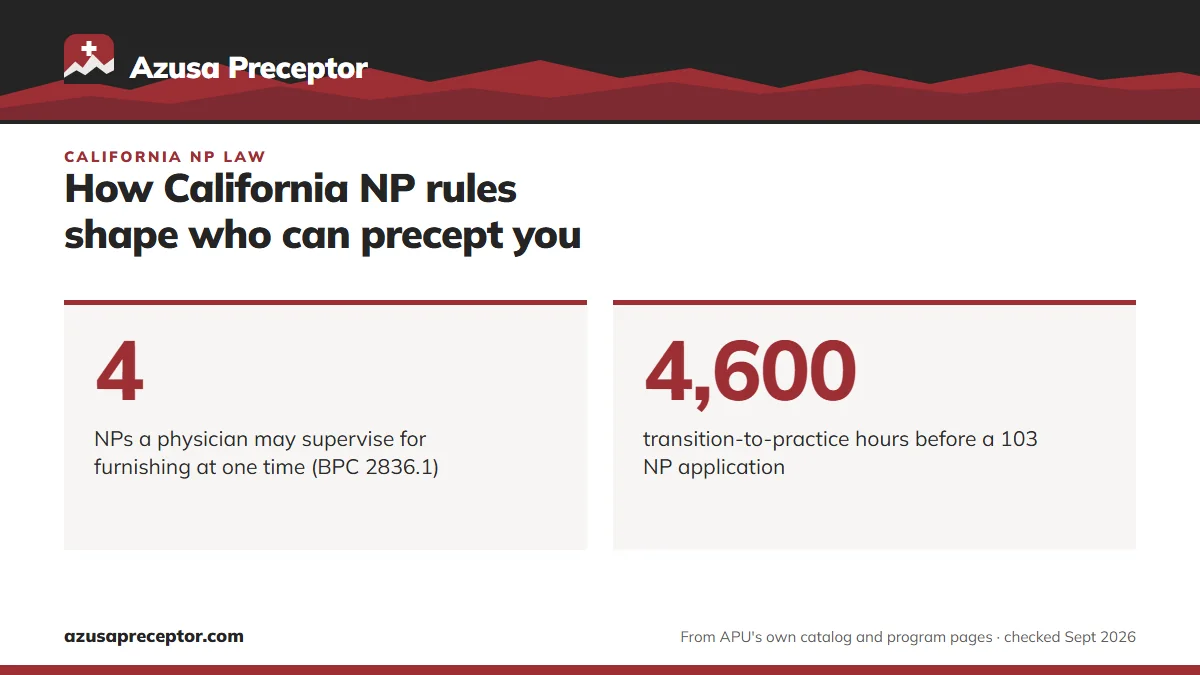
Supervision here does not mean a physician in the exam room. Under BPC 2836.1, the physician collaborates on and approves the procedures and must be reachable by phone during the exam, and a single physician can oversee at most four furnishing NPs at any one time. In such a practice, ask early who approves students; the legal signer on APU's request form may not be the NP.
AB 890's 103 and 104 NPs
AB 890 (Chapter 265, Statutes of 2020), later amended by SB 1451 (Chapter 481, Statutes of 2024), created two NP categories that practice without standardized procedures.
| 103 NP | 104 NP | |
|---|---|---|
| Statute | BPC 2837.103 | BPC 2837.104 |
| Where they practice | A listed group setting with at least one physician: clinics, most licensed health facilities, medical groups, home health agencies, hospices | On their own, outside any group setting, limited to the population focus of their national board certification |
| Path in | 4,600 hours or three full-time-equivalent years of transition to practice in California after NP certification, plus national certification | Three more full-time-equivalent years, or 4,600 hours, in good standing as a 103 NP |
| First recognized | 2023 | Starting in 2026 |
Neither category is required, and neither brings a new title or initials; a 103 or 104 NP is still an NP.
What the new categories mean for your search
The 104 category opens a newer kind of site: an NP-owned practice with no physician on staff. APU's request forms accept NP preceptors, so such a practice can host you if its population focus fits your course and it signs an affiliation agreement with APU. On the request form the credential is simply NP; 103 and 104 describe practice authority, not a separate credential.
Two timing facts help you plan past graduation. Transition-to-practice hours count only after BRN NP certification, so the hours you log as an APU student sit outside the 4,600. And under 16 CCR 1482.4, a doctorate-holding NP may apply direct patient care hours earned in the doctoral portion of the degree toward the 103-to-104 step, though not hours that already counted toward a master's, which is worth knowing for APU's DNP residency students.
16 CCR 1484: the state's preceptor rules
The BRN's NP education regulation, 16 CCR 1484, took its current form on October 1, 2025. Subsection (f) covers preceptors for California rotations: the clinician must be licensed in California, currently and in their own field, and must be clinically competent. The preceptor's job is to teach, supervise and evaluate, and the regulation wants that job spelled out in writing, agreed by the clinical agency, the preceptor and the school.
Subsection (h) sets minimums for the program as a whole: no fewer than 500 hours of supervised direct patient care across no fewer than 12 semester units of supervised clinical work, with advanced health assessment, pharmacology and pathophysiology finished before or alongside clinicals. APU's FNP and AGPCNP students log 540 hours in GNRS 600, and APU's recent guidelines put the three P courses, each passed at B- or higher, ahead of every clinical course.
APU's rules on top of state law
APU layers its own requirements over the state's. Its request forms accept physicians with MD or DO degrees, NPs, and PAs whose supervising physician works on site; psychiatric courses take a psychiatrist or PMHNP, as the PMHNP course page details; and an NP must precept you for one semester at minimum. The preceptor must be impartial, so family members and close friends are out, and a clinical at your workplace must sit outside your own unit.
No site may be attended without written approval, and APU's 2023-24 guidelines want a newly found preceptor named 6 to 8 weeks out from the term. APU's public documents set no minimum years in practice, no board certification rule and no cap on students per preceptor, so if a practice raises one, ask the placement team. Full detail is on our preceptor requirements page.
Out-of-state programs, and why APU students stand out
Under 16 CCR 1486, an NP program based outside California needs BRN approval before it places students here, must secure preceptors who meet board rules and must teach California NP law. As of November 20, 2025, the BRN oversaw 36 California NP programs, and 64 programs from other states had shown compliance with 1486. UC San Diego Health, for one, turns away affiliations with unapproved out-of-state NP programs.
APU is a BRN-approved California program, so that hurdle skips you, but it explains why Southern California preceptors hear from many schools; our Southern California preceptor guide covers where to look. We make your request stand out: each preceptor we bring you is checked for a California license and a credential that fits your course before you file, so what reaches APU meets state law and APU's rules the first time.
Questions APU students ask
Can a 104 NP be my preceptor at APU?
Yes, if the practice fits your course. APU's forms accept NP preceptors, and a 104 NP is simply an NP practicing on their own within the population named on their national certification. Check that the focus matches your course, such as family practice for GNRS 600, and that the practice will sign an affiliation agreement with APU.
Does my preceptor have to work under standardized procedures?
Neither California's preceptor rule nor APU's public request forms mention the preceptor's practice model. A standardized-procedure NP, a 103 NP in a group setting and a 104 NP in independent practice can all be considered. What the state checks is a current California license in the preceptor's own field and up-to-date clinical competence, and APU clears each preceptor in writing.
Do my APU clinical hours count toward the 103 NP transition to practice?
No. Transition-to-practice hours must come after BRN NP certification, in direct patient care in California, and within five years before the 103 application. Student hours come before certification, so they fall outside it. National certification is also required before a 103 application.
Can a PA precept me in California?
APU's NP request forms accept a physician assistant when a supervising physician is on site, and California's rule says anyone precepting a California rotation must be licensed in California in their own field. Plan the rest of your sequence so that at least one semester is precepted by an NP, as APU requires of every NP student.
What does the preceptor agreement under 16 CCR 1484 cover?
It puts the preceptor's role in writing: how the preceptor teaches, supervises and evaluates you, agreed by the clinical agency, the preceptor and the school. At APU, the placement coordinator sends the preceptor a handbook and collects a Preceptor Agreement Form, and the School of Nursing puts an affiliation agreement in place with the site itself.
Related pages
Last checked 2026-09-25
We check these pages against APU's own catalog and program pages. Your syllabus, your clinical faculty and APU's student placement coordinators have the final word.
APU says the clinical site and preceptor are yours to find. We make that the easy part.
Tell us your APU program, where you live in Southern California and when your next clinical term starts. We find preceptors who fit the course and prepare what APU and the site need before anything is approved.
- Preceptors matched to the course: primary care for
GNRS 600, pediatrics for the PNP courses, psychiatric care for PMHNP - Credentials, license and site details ready for APU's review and the affiliation agreement
- Close to home, from the San Gabriel Valley and the Inland Empire to San Diego
Start your placement plan
Program, city and term is all we need to begin.