California NP certification for APU graduates
Azusa Pacific University (APU) runs NP tracks approved by the California Board of Registered Nursing (BRN), so its graduates apply for California certification under the BRN's Method One, with the program itself confirming completion. National certification is a separate exam from a national body; it gates APU's post-master's certificates and the 103 NP path later. This page covers both, and how finishing your hours on time sets the calendar.
Finish your hours on schedule
Tell us your track, term and the hours still ahead.
On this page
BRN requirementsMethod OneApplying in BreEZeNational exams by trackTimingAfter certificationWhy students choose usQuestionsWhat the BRN asks of every NP applicant
The BRN, part of California's Department of Consumer Affairs, certifies nurse practitioners and the state's other advanced practice nurses. Its regulation, 16 CCR 1482, has three parts: an active California RN license; a master's or other graduate degree in nursing, or a master's in a related clinical field; and either completion of a BRN-approved NP program or national NP certification from a body accredited by NCCA or ABNS.
Every BRN applicant also submits fingerprints for state and FBI background checks. The license must be California's, which lines up with APU's own rules: NP applicants must live in Southern California and keep a current California RN license on file, as our RN license and residence page explains.
APU's catalog states that graduates of its APRN tracks are eligible for California certification and for the national exams in their population focus. The two credentials come from different bodies on different timelines, so plan them as two tasks.
Method One: the route for APU graduates
The BRN's NP application instructions sort applicants by where they trained. Graduates of a California-based NP program use Method One, which calls for a transcript and a program verification form along with the application. National certification appears only under the method for programs based outside California. Those instructions date from 2019, so check the BRN's advanced practice page for the current version before you file.
APU counts as a California program. The BRN's list of approved NP programs shows three APU tracks: Family Primary Care NP, Psych/Mental Health NP, and Pediatric and Adult Primary NP. Finishing one of them is your education basis for certification.
CNS graduates should know about a wording conflict. APU's catalog calls all its graduate nursing programs BRN-approved and says CNS graduates may apply for California CNS certification, while the BRN lists APU's CNS offerings but notes that CNS programs are not formally approved. Ask the program which route your CNS application should follow.
Applying in BreEZe
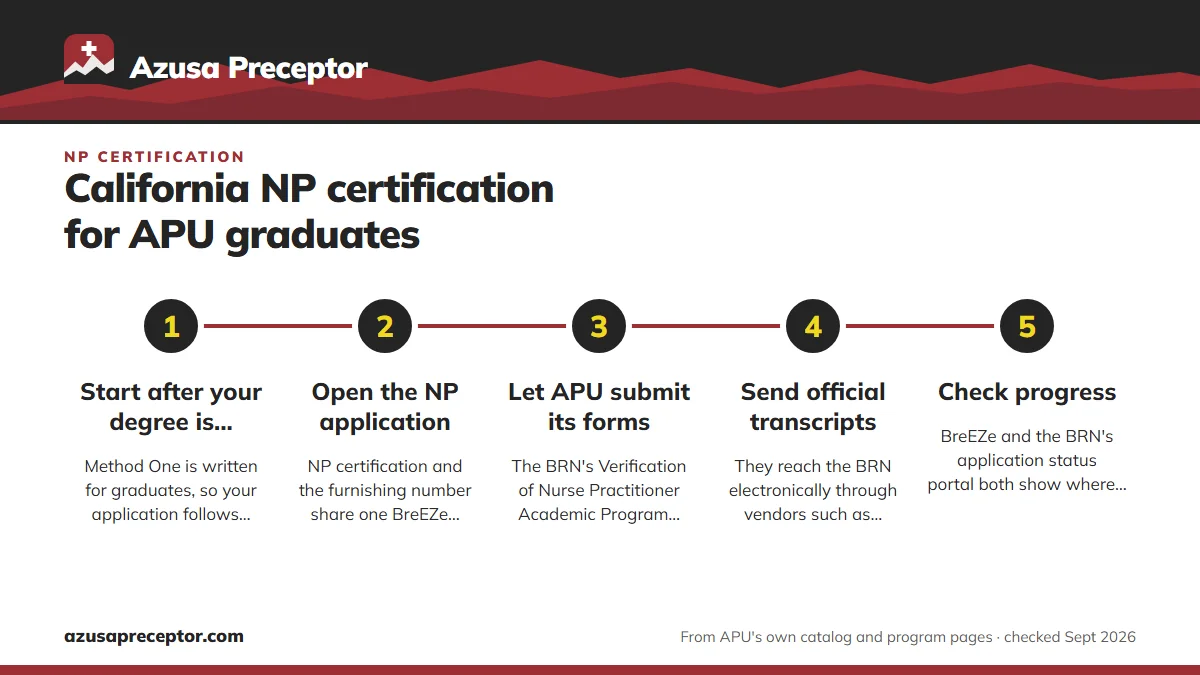
- Start after your degree is conferredMethod One is written for graduates, so your application follows your confer date. Ask the School of Nursing when it sends verification forms for your graduating term.
- Open the NP applicationNP certification and the furnishing number share one BreEZe application; the furnishing number page covers that half.
- Let APU submit its formsThe BRN's Verification of Nurse Practitioner Academic Program travels from the program to the board, not through you, together with the pharmacology course verification.
- Send official transcriptsThey reach the BRN electronically through vendors such as Parchment or National Student Clearinghouse, or straight from APU.
- Check progressBreEZe and the BRN's application status portal both show where your file stands.
Completeness matters more than speed. A March 2026 background paper prepared for the Legislature found the BRN processing complete NP applications within 7 days, and it counted a 31 percent rise in new NP applications over the last four fiscal years.
National certification by APU track
California certification and national certification are separate credentials. The BRN recognizes national certifying bodies accredited by NCCA or ABNS, and the 2026 legislative background paper counts five approved NP certifying bodies. These are the exams APU and the certifying bodies name for each track.
| APU track | National certification | Worth knowing |
|---|---|---|
| FNP | AANPCB (now branded NPCB) or ANCC | Both offer FNP exams |
| AGPCNP | AANPCB or ANCC | Named on APU's AGPCNP certificate page |
| PNP-PC | PNCB's CPNP-PC | Read PNCB's eligibility page for its hour rules |
| PMHNP | ANCC's PMHNP-BC; NPCB also lists a PMHNP exam | ANCC asks for at least 500 faculty-supervised clinical hours |
| CNS | ANCC | The BRN lists eligible foci: Acute Care CNS (adult-gerontology, neonatal, pediatric) and CNS-Gerontology |
| Oncology NP Fellowship | ONCC's AOCNP | The fellowship meets Pathway 1 eligibility; pediatric NPs cannot sit as adult oncology NPs |
National certification carries weight at APU even though Method One does not ask for it. APU issues its post-master's NP certificates only after national certification and the BRN's requirements are met, and the BRN requires national certification before any 103 NP application.
Timing: from last clinical hour to certified NP
Certification timing starts with your hours. A term that ends short of the total, or an Incomplete that runs up to 12 weeks past the term, moves your degree confer date and everything after it. On APU's 2026-27 calendar, fall degrees are conferred on December 12, 2026 and spring degrees on May 1, 2027; summer 2027 uses August 21 for the 16-week session and July 24 for the 12-week session.
State rules explain why the hour count is fixed. Since October 1, 2025, 16 CCR 1484 has set a floor for California NP programs: 500 or more hours of supervised direct patient care, plus 12 or more semester units of supervised clinical practice. APU's GNRS 600 is 12 units and 540 hours for the FNP and AGPCNP, and the other tracks' courses work out to the same 540; the clinical hours hub has every track.
Plan any move out of California with care. On whether its NP programs meet licensing education requirements, APU's professional licensure disclosures answer Yes for California and Not Determined everywhere else; the state authorization page has the detail. If a missing preceptor is what stands between you and your confer date, see delayed graduation.
After certification: standardized procedures, 103 and 104
A newly certified California NP practices under standardized procedures with a supervising physician. AB 890 and SB 1451 added two optional categories. A 103 NP works without standardized procedures in a listed group setting with at least one physician, after 4,600 hours, or three full-time-equivalent years, of California direct patient care practice and mentorship completed after BRN certification and within five years of applying, plus national certification.
A 104 NP may practice independently within the population focus of their national certification after three more full-time-equivalent years as a 103 NP. The BRN's 2026 sunset report says 104 NPs are recognized starting in 2026, and BreEZe now lists the application. Under 16 CCR 1482.4, direct patient care from the doctoral portion of a DNP can count toward that step, though hours already credited to a master's cannot; our DNP residency page covers doctoral hours.
Renewal has its own rule for NPs whose primary-care patients are more than 25 percent aged 65 or older: at least 6 of their 30 RN renewal continuing education hours must be in gerontology, dementia care or care of older patients.
Why APU students choose us: hours finished on schedule
Certification waits on a finished program, and a finished program waits on placements that hold. APU students choose us because we build the placements that carry them to their confer date: preceptors close to home in Southern California whose practices fit the course, lined up before the term so the full hour count fits inside it. For national exams that test a population, we look for the patient mix the course calls for, such as the pediatric share FNP students owe.
On the paperwork side, we package the preceptor's credential and license with the practice's legal details and signer so APU's request form goes in whole, and we learn at the start whether an affiliation agreement is already on file with APU. APU's team decides and clears each site in writing; we see to it that nothing in the file slows that decision. A preceptor who bows out mid-term gets replaced. See how it works or use the form below.
Questions APU students ask
Do APU graduates need national certification for California NP certification?
Not under Method One as the BRN's 2019 instructions describe it, since California program graduates qualify through program completion. National certification still matters: APU issues post-master's certificates only after it and the BRN's requirements are met, and the BRN requires it before a 103 NP application, so plan for both.
How long does the BRN take to approve an NP application?
A March 2026 background paper prepared for the Legislature found the BRN processing complete NP applications within 7 days. The key word is complete: the program verification form and transcripts need to arrive first, and APU sends the verification rather than you. Both BreEZe and the BRN's status portal show where your file stands.
Is 540 clinical hours enough for California NP certification?
California's regulation, 16 CCR 1484, sets the program minimum at 500 hours of supervised direct patient care and 12 semester units of supervised clinical practice. APU's FNP and AGPCNP clinical course is 12 units and 540 hours, and the BRN approves APU's NP tracks, so completing the program is your education basis for certification.
Can I get certified in another state with an APU NP degree?
APU's professional licensure disclosures answer Not Determined for every state other than California on whether its NP programs meet licensing education requirements, with a determination date of May 1, 2021. APU also says it cannot confirm other states' requirements and points students to NCSBN, so check the other state's board before you plan a move.
Can APU CNS graduates get California certification?
APU's catalog says CNS graduates may apply for California CNS certification and names ANCC for national certification. The BRN lists APU's pediatric and adult-gerontology CNS offerings but notes that CNS programs are not formally BRN-approved, so ask the program which application route fits before you graduate.
Related pages
Last checked 2026-09-25
We check these pages against APU's own catalog and program pages. Your syllabus, your clinical faculty and APU's student placement coordinators have the final word.
APU says the clinical site and preceptor are yours to find. We make that the easy part.
Tell us your APU program, where you live in Southern California and when your next clinical term starts. We find preceptors who fit the course and prepare what APU and the site need before anything is approved.
- Preceptors matched to the course: primary care for
GNRS 600, pediatrics for the PNP courses, psychiatric care for PMHNP - Credentials, license and site details ready for APU's review and the affiliation agreement
- Close to home, from the San Gabriel Valley and the Inland Empire to San Diego
Start your placement plan
Program, city and term is all we need to begin.