How Southern California hospitals take nursing students
Southern California hospitals take students through the school rather than through the student. An affiliation agreement comes first, the request arrives from a school coordinator, and compliance runs through a portal such as Complio or Clinician Nexus. Some schools and hospitals also share CCPS, a centralized system operated by the Foundation for California Community Colleges. This guide explains each route and where it meets the process at Azusa Pacific University (APU).
Plan around the hospital routes
Tell us your program, city and term start.
On this page
The common patternCCPSSchool-routed requestsPortalsScripps, Sharp and RUHSNo public processFitting APU's processQuestionsThe common pattern: agreement first, school-routed request
Every Southern California system that describes a student process starts from the same step: a current affiliation agreement with the school. Several then route the request through the school's coordinator rather than the student, and two expect lead times measured in months.
The BRN's 2026 sunset report calls California's placement consortia few, uneven, voluntary and missing from some regions, notes that each facility makes the final call on placements, and says the board lacks authority to require a statewide system. Its prelicensure survey found 81 programs denied clinical space in 2022-23. For an APU nurse practitioner student, that means hospital placements ride on APU's agreements and APU's requests.
CCPS, the Centralized Clinical Placement System
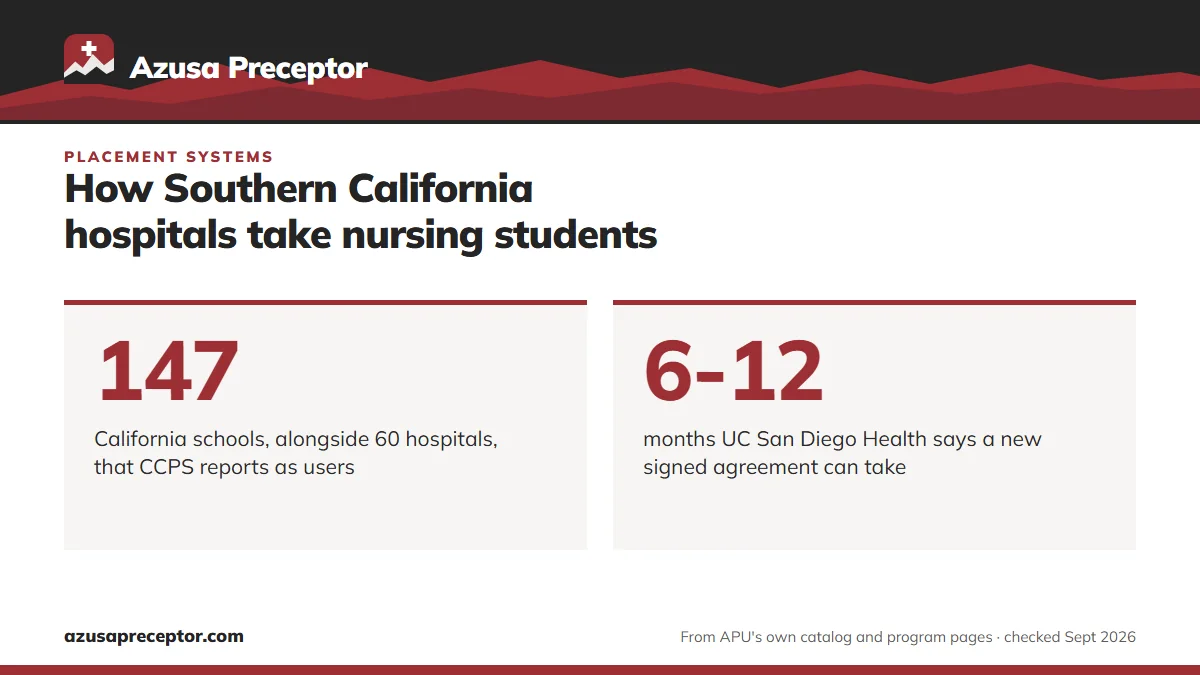
CCPS is an online placement and compliance tool that the Foundation for California Community Colleges developed and maintains in-house. It reports 147 California schools and 60 California hospitals as users. Schools send placement requests to several sites at once and track student compliance, while clinical agencies reply in a standard format and keep a single schedule across every school. HealthImpact's Nursing Resource Center lists Los Angeles among the regions that use it.
CCPS is sometimes described as a Hospital Association of Southern California system, but the association's homepage does not mention it, and the CCPS site names the Foundation as its operator. UCLA Health runs cohort requests through CCPS and reserves cohort placements for three named programs. CCPS's public schools page does not list APU, and no APU source mentions it, so for APU graduate students CCPS is background rather than a route.
Hospitals that hear only from the school
The largest systems want the request to come from APU, not from you, and their public pages say exactly how.
- UCLA Health. Its preceptorship process covers MSN-NP students, including FNP and PMHNP, plus CNS and DNP students. The school requests during set windows, and neither the student nor the school coordinator may contact the preceptor or visit before clearance.
- Kaiser Permanente Southern California. An Individual Preceptorship Student works one-to-one with a KP employee or provider. The school's clinical coordinator requests through KP's Nursing Pathways process, and KP's 2022 FAQ asks for at least three months' notice.
- UC San Diego Health. Students may not submit affiliation requests; the school's coordinator must. A decision comes within 30 days, but getting an agreement signed can take roughly 6 to 12 months, so UCSDH urges students to arrange a backup placement.
If one of these systems is your goal, raise it early with APU's Graduate Placement Team, since the request has to come from the school side.
Compliance and onboarding portals
Once a request is live, the facility's own portal usually takes over.
| Tool | What it handles | Where APU students meet it |
|---|---|---|
| Complio (American DataBank) | Student requests and compliance at Scripps; student requirements at Sharp | APU's San Diego students already keep their requirements there |
| Clinician Nexus | NP student applications at Riverside University Health System | Any RUHS preceptorship department you pursue |
| MyClinicalExchange | Facility onboarding, sometimes with a per-student fee | APU says facilities invoice the School of Nursing for such fees |
| CastleBranch and CB Bridges | APU's compliance tracker; some sites also require CB Bridges | Every APU campus except San Diego |
A portal tracks compliance; the affiliation agreement and APU's written approval still have to be in place. APU's side of the paperwork is on our CastleBranch and Complio page.
Scripps, Sharp and RUHS up close
Scripps Health requires a current affiliation agreement, which it says takes 6 to 8 weeks to set up, and handles requests through Complio. Undergraduates may not contact preceptors, while most graduate students are required to identify their own preceptor before the formal request, a good fit for an APU student who arrives with a named clinician. For request deadlines, Scripps sends schools to the regional San Diego consortium that links nursing service and education.
Sharp HealthCare has students complete requirements in Complio and work through their school; faculty who oversee preceptorships contact Sharp's learning programs team and complete a yearly orientation. Its page does not single out NP students. Riverside University Health System, the county system that runs community health centers, offers NP student preceptorships in five departments, from family and internal medicine to geriatrics, the NICU and the SICU, with psychiatry reserved for employees of one RUHS campus. Local detail is on our San Diego and Riverside County guides.
Systems with no public student process
Many well-known systems publish nothing about outside NP students. Cedars-Sinai, Hoag, Keck Medicine of USC, CHOC and LA County DHS have no public page on the subject that could be found, and the neighboring LA County Department of Public Health offers nurse preceptorships only through universities that hold affiliation agreements. Providence, Dignity Health and MemorialCare remain unverified, since their pages could not be read in full.
CHLA has an advanced practice student rotations page that could not be read directly, and Loma Linda University Health lists an academic relations function without a public request process. An unpublished process is still a process: it simply runs through an existing agreement, so ask APU's placement team whether one exists before anyone contacts the system.
Where this meets APU's process, and how we help
Whatever a facility uses, APU's own steps stay constant: an affiliation agreement, a Graduate Preceptor Request form filed by you, and clearance in writing before your first day. Hospital routes run through APU's placement team; outpatient practices are where a student-led search usually lands.
That is where we focus. We read each system's public route before you spend weeks on it, point hospital-bound interest toward APU's placement team, and search the clinics and medical groups near your home where a preceptor can say yes directly. Each yes arrives with the details APU asks for, so what reaches the placement team is complete and fits the rules the first time. Our Southern California NP preceptor guide shows where those practices are.
Questions APU students ask
Does APU use CCPS?
No APU source mentions CCPS, and the system's public schools page does not list APU. APU's graduate placements run through its Graduate Placement Team, the Graduate Preceptor Request form and its own affiliation agreements. If a hospital mentions CCPS, ask the placement team how that facility takes APU students.
Can I contact a hospital preceptor directly?
At the systems with published rules, generally not. UCLA Health bars contact with the preceptor before clearance and asks that its staff not be approached as preceptors, and Kaiser and UC San Diego Health take requests from the school's coordinator. Private practices and community clinics are different: a student or service can ask a clinician directly, and APU then reviews the site.
How long does a new hospital agreement take?
Published figures vary widely. Scripps says 6 to 8 weeks to set one up, UC San Diego Health warns of roughly 6 to 12 months before signature, and Kaiser asks for requests at least three months ahead. APU itself warns that a site with no current agreement takes time, so plan a term or more ahead for any hospital.
Is Complio the same system APU's San Diego campus uses?
The vendor is the same: Complio, from American DataBank. APU's San Diego students keep their clinical requirements there, and Scripps and Sharp use it for student requests or compliance. Each clinical partner's own requirements still apply on top of APU's package, as APU's onboarding page notes.
Why do hospitals insist on an affiliation agreement first?
California's NP education rule wants the preceptor's duties put in writing and signed off by the clinical agency, the school and the preceptor, and APU ties every clinical site to an affiliation agreement. Hospitals set up that legal footing with the school before any student arrives, which is why a system new to APU takes the longest.
Related pages
Last checked 2026-09-25
We check these pages against APU's own catalog and program pages. Your syllabus, your clinical faculty and APU's student placement coordinators have the final word.
APU says the clinical site and preceptor are yours to find. We make that the easy part.
Tell us your APU program, where you live in Southern California and when your next clinical term starts. We find preceptors who fit the course and prepare what APU and the site need before anything is approved.
- Preceptors matched to the course: primary care for
GNRS 600, pediatrics for the PNP courses, psychiatric care for PMHNP - Credentials, license and site details ready for APU's review and the affiliation agreement
- Close to home, from the San Gabriel Valley and the Inland Empire to San Diego
Start your placement plan
Program, city and term is all we need to begin.