Precepting an Azusa Pacific University nursing student
Azusa Pacific University (APU) trains nurse practitioners, clinical nurse specialists, nurse educators and nurse leaders across Southern California, and each of them learns at the side of a practicing clinician. If you are a physician, NP, PA, CNS or nurse leader, this page covers who APU accepts as a preceptor, what California's rules ask of you, how evaluations work, what a term asks of your schedule and how to meet an APU student through us.
Open to precepting?
Tell us your specialty, city and the days you can teach.
On this page
Who can preceptCalifornia's 16 CCR 1484The paperworkTime commitmentEvaluationsRecognitionWork with usQuestionsWho can precept an APU student
APU's 2026 request forms and program documents set the preceptor types course by course.
- Nurse practitioner students: physicians (MD or DO), nurse practitioners, and physician assistants who have a supervising physician on site. The form's credential menu also offers CNS, CNM and PNP, and APU wants each NP student to train under an NP for one semester or more.
- Psychiatric mental health NP students: psychiatrists and PMHNPs. Licensed marriage and family therapists and psychologists qualify only for
GNRS 535, and each student needs a PMHNP preceptor for at least one semester. - Clinical nurse specialist students: a CNS, or a nurse leader for
GNRS 521andGNRS 543, whose work centers on leadership, unit-based care or teaching nurses. - Nursing education students: a nurse educator for the
GNRS 663capstone practicum. - Healthcare administration students: an experienced nurse administrator with a leadership track record, for
GNRS 567.
Impartiality applies across the board: APU rules out relatives and close friends as preceptors and bars placements in the unit where the student works. APU's public materials set no minimum years of experience, student ratio or site-visit schedule, and its preceptor handbook covers general qualifications. Our preceptor requirements guide has the detail.
What California asks of a preceptor
California's Board of Registered Nursing sets the baseline for NP preceptors in 16 CCR 1484, most recently amended effective October 1, 2025. For a rotation in California, the preceptor must be actively licensed in California in their own discipline and clinically current. The preceptor teaches, supervises and evaluates the student, and those duties are written into an agreement among the clinical agency, the preceptor and the program.
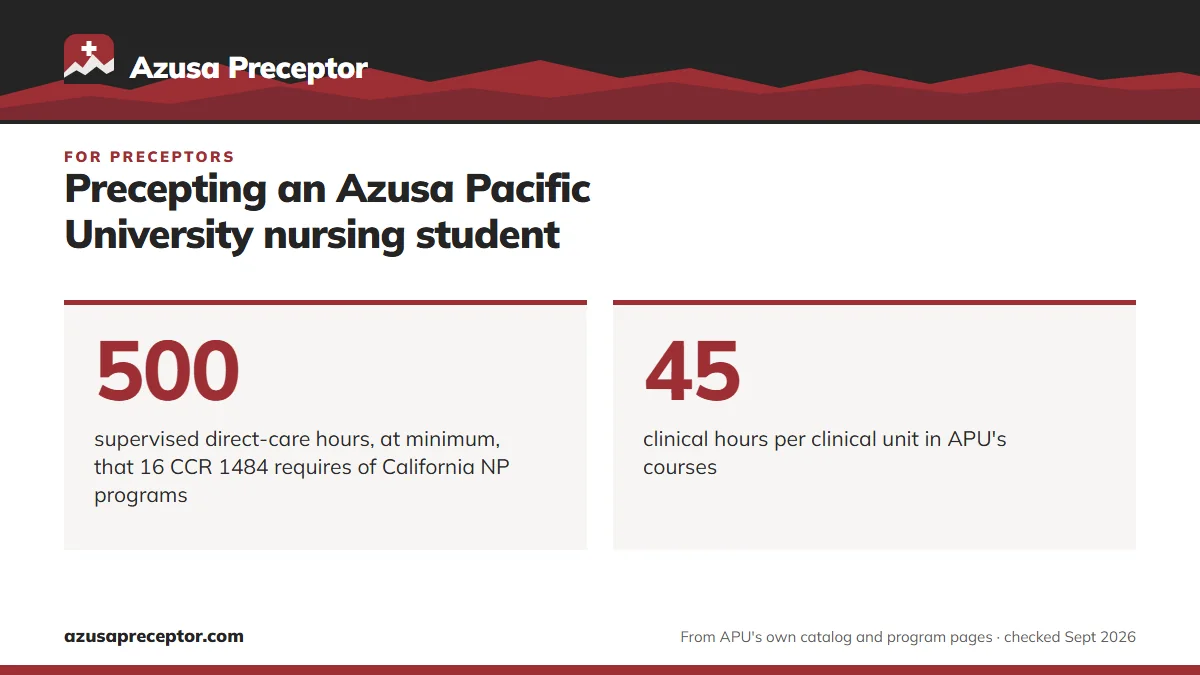
Under the same regulation, the program must orient each preceptor and review the preceptor's work no less than once every two years, and NP programs must deliver no fewer than 500 hours of supervised direct patient care. Under 16 CCR 1480, direct supervision means the preceptor or a faculty member is physically present at the site and keeps responsibility for patient care. Our California NP practice guide explains how standardized procedures and the 103 and 104 NP roles relate to precepting.
The paperwork behind a placement
Most of the paperwork sits with the student and APU. The student files a Graduate Preceptor Request form with your name, credential and email, your clinic's legal name, the person authorized to sign agreements and your office manager's contact. APU's Graduate Placement Team reviews the placement, and your organization needs an affiliation agreement with APU before the student starts.
APU describes its placement coordinator as the preceptor's first point of contact: sending a preceptor handbook, collecting a signed Preceptor Agreement Form and checking that the student's practicum requirements are current. The student comes to your clinic only after APU clears the site in writing, so every document is settled before the first clinic day. The affiliation agreements guide explains that step.
The time a term asks of you
APU's clinical courses work out to 45 hours per clinical unit, so the hours a student spends with you depend on the course. The figures below come from APU's catalog and request forms; the student's syllabus sets the exact number.
| Course | Hours |
|---|---|
GNRS 600 NP clinical, 2 to 6 units a term | Works out to 90 to 270 a term |
PMHNP population courses, GNRS 535 to GNRS 538 | 135 each |
CNS courses GNRS 520, GNRS 521 and GNRS 543 | 180 each on the request form |
PNP courses GNRS 590A, GNRS 532 and GNRS 542 | 135, 135 and 90 on the request form |
Nurse educator capstone, GNRS 663 | 135 |
APU asks students to spread hours evenly rather than front- or back-loading them, and bars a night shift before a clinical day, so expect a steady weekly rhythm. Students record their hours in Medatrax every week.
Evaluating your student
Your evaluation carries real weight. APU calls the preceptor evaluation, like the faculty evaluation, a minimum-standard tool, and a student who falls below the standard in any category moves to a remediation plan with clinical faculty. The request form collects your email so the end-of-semester evaluation reaches you directly.
If something concerns you during the term, contact the student's clinical faculty early. APU's guidelines count behavior such as keeping a change in a patient's status from the preceptor, charting errors or a breach of patient privacy as unsafe performance that can lead to dismissal. APU also runs OSCEs in most clinical courses, so your evaluation captures how the student works with real patients while APU tests skills separately; our evaluations and OSCEs guide covers both.
How APU thanks its preceptors
APU's public materials describe thanks rather than a formal benefits program. The School of Nursing posts a public thank-you letter from APU student nurses recognizing the clinical sites and preceptors who teach them, and preceptors receive the handbook and agreement form from the placement coordinator. APU's public pages describe no CE credit, adjunct title or tuition benefit, so ask the placement coordinator whether the current handbook adds anything.
Preceptors teach for reasons of their own: passing on what someone once taught them, shaping how new clinicians practice in their community and sharpening their own skills by explaining them. Demand for that teaching is growing, with California's NP applications up 31% over four fiscal years according to a 2026 legislative background paper.
Connect with an APU student through us
We connect clinicians with APU students whose course fits their practice, and we handle the preparation that keeps the process light for your office. Tell us your specialty, your clinic's city, the days you can teach and how many hours a term you could offer. We match you with an APU student in a suitable course, confirm the details the request form needs from your office and help find out early whether your organization already holds an APU affiliation agreement.
From there, the student files the request, APU's placement team reviews it and the placement coordinator contacts you with the handbook and agreement. Choose "I'm a preceptor (not a student)" on the form below, or open the chat, and we will take it from there.
Questions APU students ask
Do I need a California license to precept an APU student?
For a rotation in California, 16 CCR 1484 requires the preceptor to hold an active California license in their own profession and show current clinical competence. APU's public forms add no separate license rule, and because APU admits MSN APRN students who reside in Southern California, a current California license is the practical baseline for its NP rotations.
Can a physician assistant precept an APU nurse practitioner student?
Yes, for the NP tracks covered by the request form APU uses at Azusa and the Inland Empire, as long as a supervising physician is on site. Every NP student must also spend at least one semester with an NP preceptor, so a student's full plan will include an NP at some point. PMHNP courses follow their own rules, with psychiatrists and PMHNPs as preceptors.
How many APU students can I precept at one time?
APU publishes no student-to-preceptor ratio. The number depends on your setting and on what you agree with APU's placement coordinator and clinical faculty, and the preceptor handbook may address it. Starting with one student per term is a simple way to see how teaching fits into your clinic day before taking on more.
Will APU faculty visit my practice?
APU's public materials set no site-visit rule. Clinical faculty evaluate each student alongside you, and California's rules have programs orient their preceptors and reassess them on a two-year cycle, so some contact with APU is part of the arrangement. Ask the placement coordinator how your student's course handles check-ins.
Related pages
Last checked 2026-09-25
We check these pages against APU's own catalog and program pages. Your syllabus, your clinical faculty and APU's student placement coordinators have the final word.
APU says the clinical site and preceptor are yours to find. We make that the easy part.
Tell us your APU program, where you live in Southern California and when your next clinical term starts. We find preceptors who fit the course and prepare what APU and the site need before anything is approved.
- Preceptors matched to the course: primary care for
GNRS 600, pediatrics for the PNP courses, psychiatric care for PMHNP - Credentials, license and site details ready for APU's review and the affiliation agreement
- Close to home, from the San Gabriel Valley and the Inland Empire to San Diego
Start your placement plan
Program, city and term is all we need to begin.