When a missing preceptor pushes your APU graduation back
A term without a preceptor rarely costs just one course at Azusa Pacific University (APU). Clinical courses run alongside their lecture courses and some tracks move in a fixed order, so a lost term can move your degree confer date by a semester or more. APU's rules leave room to recover, from an eight-year limit to three terms a year; what matters is rebuilding the plan quickly.
Get back on schedule
Tell us your program, next clinical course and city.
On this page
The ripple effectThe eight-year limitRebuild your planRepeats and leavesConfer datesPetitionsHow we helpQuestionsHow one lost term ripples forward
APU requires didactic and clinical courses to be taken together, so a clinical course that cannot run usually pulls its paired lecture course with it. Where courses build on one another, the delay compounds. PMHNP students move through GNRS 535, GNRS 536, GNRS 537 and GNRS 538 in order, PNP-PC students take GNRS 590A before GNRS 532, and CNS students start with GNRS 520 or GNRS 530 and finish with GNRS 543.
FNP and AGPCNP students have more flexibility because GNRS 600 is taken 2 to 6 units at a time, but the 540 hours still have to fit into the terms that remain. Taking on more clinical units than planned requires sign-off from the director or chair under APU's guidelines, since preceptors and placement resources are shared, so doubling up later is something to request early rather than assume.
APU's eight-year limit
APU's graduate policy gives most programs eight years from first enrollment. Extensions come by petition, are rare and can carry added requirements. The older APRN guidelines describe the MSN advanced practice tracks as designed for 8 to 9 semesters while allowing up to eight years without an extension, and APU's program pages put the MSN at 6 to 9 semesters depending on specialty.
One delayed term usually leaves plenty of room inside that limit. The margin shrinks when setbacks stack: a lost term, a repeated course and a leave of absence can together use up more time than expected, particularly for part-time students. Track terms used against the eight years with your advisor.
Rebuilding your program plan
Act quickly, because APU's guidelines say a student with no program plan on file is left out of the clinical placement count.
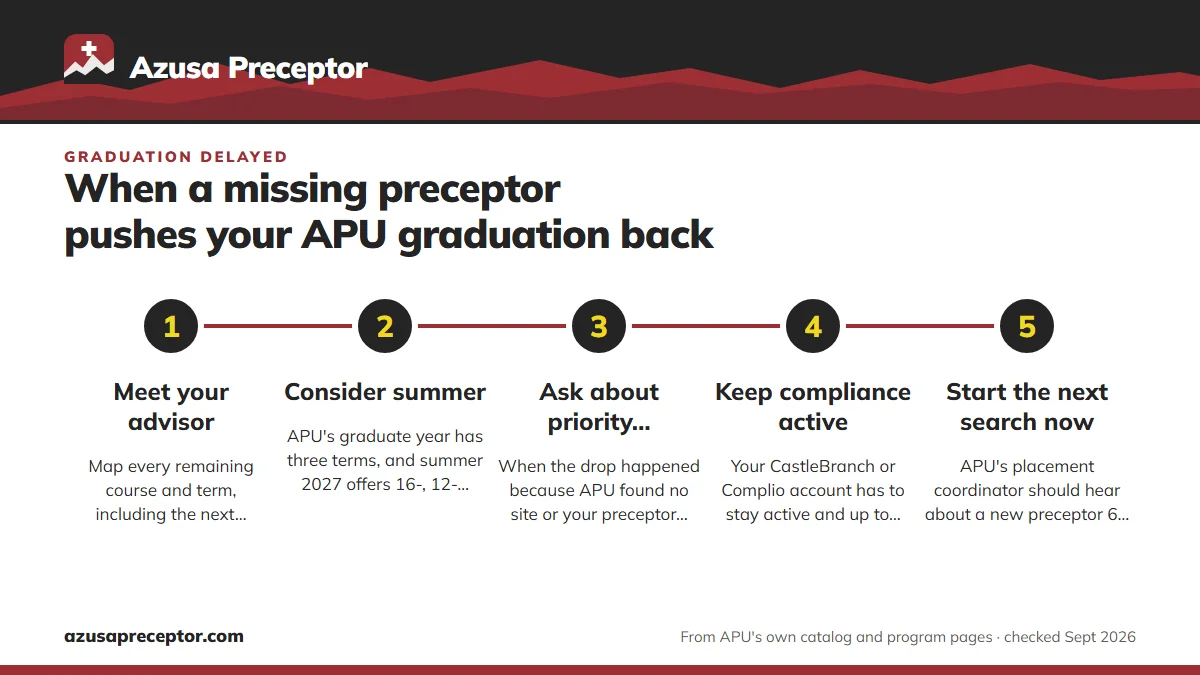
- Meet your advisorMap every remaining course and term, including the next clinical course and the lecture course that runs with it.
- Consider summerAPU's graduate year has three terms, and summer 2027 offers 16-, 12- and 8-week sessions starting May 3. Confirm your course runs in the session you want.
- Ask about priority placementWhen the drop happened because APU found no site or your preceptor left for reasons that had nothing to do with you, APU's guidelines allow next-term priority placement.
- Keep compliance activeYour CastleBranch or Complio account has to stay active and up to date throughout your enrollment, annual items included.
- Start the next search nowAPU's placement coordinator should hear about a new preceptor 6 to 8 weeks before the term, and a site without an agreement can need even more lead time.
The no-placement drop rule page explains when a drop brings fee waivers and priority placement.
Repeats, leaves and gaps in enrollment
Three catalog rules shape a longer delay. Read them before deciding to sit out a term.
| Rule | What APU's catalog says | Why it matters |
|---|---|---|
| Repeating a course | Up to three attempts; only the latest grade counts in the GPA; programs may allow fewer | APU's 2023-24 guidelines say clinical hours from a failed attempt do not carry into the repeat |
| Leave of absence | At least two consecutive terms, at most two years, filed before the absence; backdated forms are refused | An APU leave is not a Title IV approved leave for federal loans |
| Administrative withdrawal | Three consecutive terms without enrolling, such as fall, spring and summer | Returning means reapplying and re-acceptance under the current catalog |
Because a leave covers at least two terms, it fits a longer pause better than a single lost term. Speak with financial aid before filing one. Our grades and probation guide covers repeats and GPA rules.
Confer dates and what moves with them
APU's 2026-27 calendar lists degree confer dates of December 12, 2026 for fall and May 1, 2027 for spring, then July 24, 2027 for the 12-week summer session and August 21, 2027 for the 16-week one. A term's delay moves you to the next date on that list.
For NP graduates, several steps follow the confer date. The California Board of Registered Nursing certifies graduates of BRN-approved programs such as APU's, with the school sending the Verification of Nurse Practitioner Academic Program form, and the furnishing number draws on GNRS 611 Advanced Pharmacology. National certification exams come next. A later confer date pushes each step back, so tell prospective employers early. Our BRN NP certification guide lays out the sequence.
What counts as grounds for an exception
When a delay collides with a policy deadline, APU's Academic General Petition is the route to ask for an exception. The catalog grants exceptions only for documented circumstances beyond your control, and it names several things that do not qualify: work conflicts, a heavy work schedule, not doing well in a class and traveling a long distance to school.
A preceptor who withdrew or a site that closed its student program sits much closer to what the petition process describes than a busy shift pattern does. Keep the emails, dates and messages from your placement coordinator, since a petition rests on documentation. Your advisor can tell you whether a petition, a drop or an incomplete is the right tool.
Getting back on schedule with us
The fastest recovery starts a term ahead. Once your advisor confirms the next clinical course, we search for a preceptor matched to it close to home, prepare the credentials and site details APU's request form needs, and flag early whether the clinic has an APU affiliation agreement. If a summer session could keep you on track, we look for preceptors whose schedules fit those summer weeks and keep you updated as leads develop.
We also plan beyond the next term. For sequential tracks such as PMHNP, a clinic with more than one suitable provider can protect the rest of your plan. Tell us your program and target confer date using the form below; how it works explains each step.
Questions APU students ask
Can I take clinical units in the summer at APU?
APU's graduate year has three terms, and summer offers a 16-week session, a 12-week session and a pair of 8-week sessions. The calendar does not say which session a given NP clinical course uses, so ask your advisor which of your remaining courses run in summer before building the plan around one. The preceptor still needs the usual notice and clearance.
Is a leave of absence better than skipping one term?
APU's leave of absence covers at least two consecutive terms and at most two years, and it has to be filed before the absence begins. For a single lost term, staying enrolled in other courses may keep you closer to schedule. Not enrolling for three consecutive terms triggers administrative withdrawal and a new application under the current catalog.
Will a delayed graduation affect my federal student loans?
It may. APU's catalog notes that its leave of absence is not a Title IV approved leave for federal loan purposes, and dropping courses can change your enrollment status. Talk with APU's Student Services Center before you file a leave or a drop, so you understand any aid or repayment effects in advance.
Can I petition to extend APU's eight-year limit?
You can, but APU describes extensions as rare, and they can come with added requirements. Petitions for exceptions need documented circumstances beyond your control. A single delayed term usually fits well inside eight years, so the petition matters most when several setbacks pile up late in a program.
Which catalog applies if I come back after time away?
If APU administratively withdraws you after three consecutive terms without enrolling, returning means reapplying and being re-accepted under the current catalog. Requirements, course numbers and hour rules can change between catalogs, so a long gap can mean more than a later graduation date. Talk with your advisor about a formal leave before any long break.
Related pages
Last checked 2026-09-25
We check these pages against APU's own catalog and program pages. Your syllabus, your clinical faculty and APU's student placement coordinators have the final word.
APU says the clinical site and preceptor are yours to find. We make that the easy part.
Tell us your APU program, where you live in Southern California and when your next clinical term starts. We find preceptors who fit the course and prepare what APU and the site need before anything is approved.
- Preceptors matched to the course: primary care for
GNRS 600, pediatrics for the PNP courses, psychiatric care for PMHNP - Credentials, license and site details ready for APU's review and the affiliation agreement
- Close to home, from the San Gabriel Valley and the Inland Empire to San Diego
Start your placement plan
Program, city and term is all we need to begin.