How APU evaluates your clinicals: preceptors, faculty and OSCEs
Azusa Pacific University (APU) looks at clinical progress from several angles: your preceptor and your clinical faculty each evaluate you, most clinical courses add OSCEs, and a summative exam sits near the end of each NP track. Falling below the minimum standard in any evaluation category starts a remediation plan, so the preceptor you work with shapes more than your hour count.
Find a preceptor who fits your level
Tell us your track, course and campus.
On this page
Preceptor and facultyThe preceptor's roleOSCEsSummative OSCE by trackiHuman and portfolioRemediationHow we helpQuestionsTwo evaluators every clinical term
Every APU clinical course draws on two views of your work. Your preceptor sees you with patients week after week, and your clinical faculty member oversees the course and your progress through it. The catalog and APU's recent graduate guidelines (the 2023-24 edition) both say preceptors and clinical faculty give feedback.
The guidelines call the clinical evaluation and the preceptor evaluation minimum-standard tools. That wording matters: you do not need top marks in every area, but falling below the standard in any single category triggers a remediation plan with your clinical faculty. One weak area is enough, even when the rest of the form is strong.
The preceptor's evaluation reaches them by email. APU's Graduate Preceptor Request form collects the preceptor's email specifically for the end-of-semester evaluation, so check that address carefully when you file; the request form page walks through every field.
What your preceptor is asked to do
California sets the frame. The Board of Registered Nursing's NP program regulation, 16 CCR 1484, says a preceptor teaches, supervises and evaluates students, that those duties belong in a written agreement between the program, the clinical agency and the preceptor, and that the program orients its preceptors and evaluates them at least every two years.
At APU, the placement coordinator sends each preceptor a preceptor handbook and collects a signed Preceptor Agreement Form. Neither document is public, so the exact questions on APU's evaluation tool are not published. APU's public documents also give no faculty site-visit rule.
One published example shows the shape. In the Healthcare Administration and Leadership practicum, a faculty-approved learning contract binds student and preceptor, and the preceptor scores engagement, professionalism and the final project. NP evaluations run on their own tool, but the principle holds: the preceptor who agrees to take you is also agreeing to assess you in writing.
OSCEs from health assessment to the finish
OSCEs, the structured exams where you work through a simulated patient encounter, run through APU's graduate clinical sequence. APU's recent guidelines say most clinical courses require them, plus program-level progression OSCEs. The SON's Experiential Learning Team runs APU's labs and simulation, and APU lists Skills Centers on four campuses: Azusa, San Diego, the Inland Empire and High Desert.
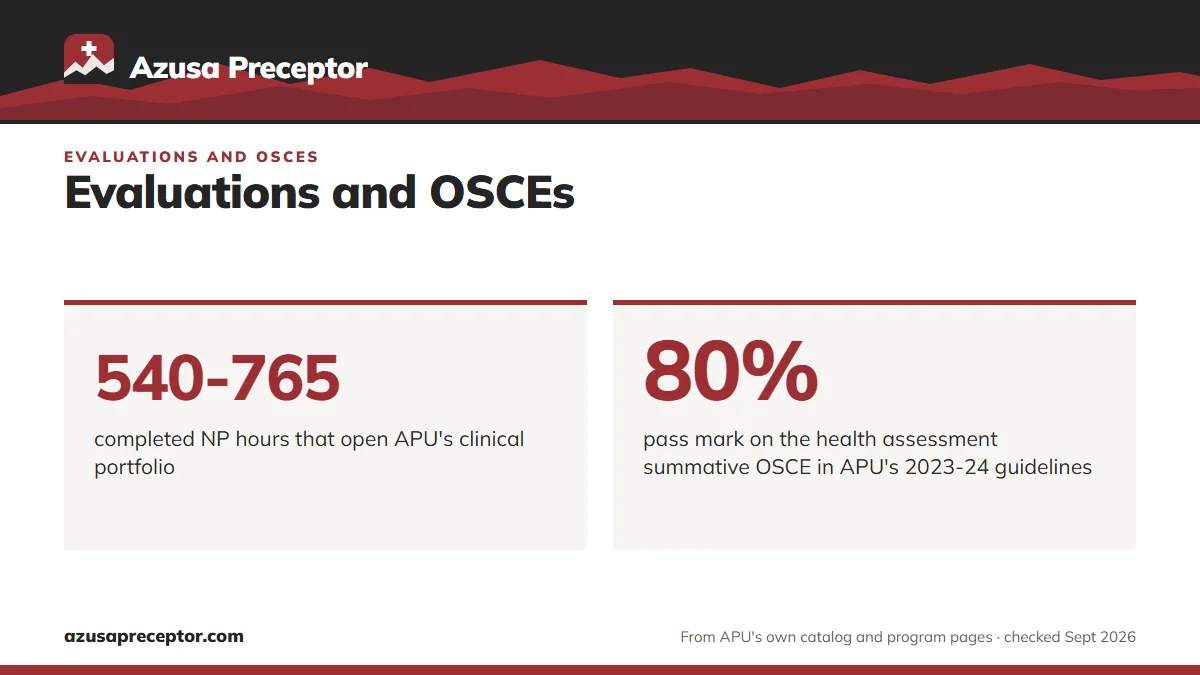
The first high-stakes one comes early. The 2023-24 guidelines set an 80% minimum on the health assessment summative OSCE, then numbered GNRS 512, with no remediation and no retest: a student who fails repeats the whole course. The 2026-27 catalog lists advanced health assessment as GNRS 612, so confirm on your syllabus whether the same rule applies; the GNRS 612 page covers that course.
The same guidelines add that some tracks have competency tests that must be passed on the first attempt, or the course is repeated. Ask your lead faculty in week one which exams in your course carry that rule.
Treat any exam your syllabus marks as single-attempt as exactly that. APU's recent guidelines allow no retest on the health assessment summative OSCE.
Where the summative OSCE sits for your track
| Track | Where the guidelines place it | What to check |
|---|---|---|
| All APRN tracks (health assessment) | Summative OSCE in GNRS 512, now listed as GNRS 612 | 80% minimum and no retest in the 2023-24 guidelines |
| FNP and AGPCNP | Summative OSCE in GNRS 592B | GNRS 592B stays in the 2026-27 course list but is missing from the current FNP requirement table |
| PNP-PC | Summative OSCE in GNRS 542 | GNRS 542 is the current pediatric capstone course |
| BSN to DNP, APRN track | Clinical performance exam in GNRS 618 | GNRS 618 is one of the APRN Intensives in the course list |
| PMHNP and CNS | Not specified in public documents | Ask lead faculty which exams your track uses |
The FNP row is a genuine mismatch in APU's own sources. The dated guidelines point to GNRS 592B, while the 2026-27 FNP requirements center on GNRS 600 through GNRS 603 and leave the APRN Intensives (GNRS 615 to GNRS 618) out of the requirement table. Your program plan and syllabus settle which course holds the exam for your catalog year. Pediatric students can see where GNRS 542 falls on the PNP course sequence page.
Virtual cases and the clinical portfolio
iHuman virtual patient cases are required in several clinical courses, according to APU's recent guidelines, and students pay for them per case. The amounts change, so they are not listed here; the placement costs page explains which clinical expenses fall to you. APU's public documents do not say the cases count toward your direct patient care hours, so plan them as coursework alongside your preceptor time.
The clinical portfolio comes later. It opens at a milestone: according to the same guidelines, NP students get portfolio access after completing somewhere between 540 and 765 hours. What goes into it is set in the current handbook and your course materials. Since the trigger is your completed hours, an accurate weekly record in Medatrax is what brings the portfolio within reach on time.
If an evaluation falls below standard
APU's recent guidelines describe the path. A student who does not meet expected competencies in didactic work, simulation or clinical practice receives an academic warning. You and your faculty then agree on a remediation plan with a schedule and the documentation needed to show the competencies are met.
Some problems go further. The guidelines say unsafe clinical performance can lead to dismissal, and they list examples such as failing to report a patient's condition to the preceptor, inaccurate documentation and privacy violations. A student dismissed from a site also loses access to the fee waiver and priority placement described on the no-placement drop rule page.
Grades carry the weight in the end. The dated guidelines treat B- as the passing grade in MSN clinical courses, and clinical time logged in a course you fail must be earned again when you retake it. The grades and probation page covers standing, repeats and appeals.
How the right placement shows up in your evaluations
Evaluations reward fit, and fit is what APU students choose us for. We match you with preceptors whose patients suit your course and level, family and adult primary care for GNRS 600, pediatric practices for the PNP sequence, psychiatric settings for PMHNP, so the competencies on your evaluation are ones you practice every week.
We confirm up front that each preceptor expects to teach, supervise and complete APU's end-of-semester evaluation, and we record the correct email for it. We also look for steady weekly schedules, which leave room to prepare for OSCEs. Every site still needs APU's written clearance, and each request we prepare reaches the placement team with nothing missing. If a preceptor withdraws mid-term, a replacement search starts at once. Send your track and course through the form below.
Questions APU students ask
Who evaluates me during APU clinical courses?
Two people. Your preceptor completes an end-of-semester evaluation, sent to the email on your Graduate Preceptor Request form, and your clinical faculty member completes the clinical evaluation. APU's recent guidelines treat both as minimum-standard tools, so falling below the standard in any category leads to a remediation plan with your clinical faculty.
Can I retake a summative OSCE at APU?
APU's 2023-24 guidelines say the health assessment summative OSCE requires at least 80% with no remediation or retest, and a student who fails repeats the whole course. They add that some tracks have competency tests that must be passed on the first attempt. Your current syllabus has the final word, so check it in the first week.
Do iHuman cases count toward my APU clinical hours?
APU's public documents describe iHuman as required virtual patient cases in several clinical courses, paid per case by the student. They do not say the cases count toward direct patient care hours. Your hour total comes from the time you log with an approved preceptor, so treat iHuman as coursework rather than a substitute for clinic time.
Does my preceptor get any orientation from APU?
California's NP program regulation requires programs to orient preceptors and evaluate them at least every two years. At APU, the placement coordinator sends each preceptor a preceptor handbook and collects a signed Preceptor Agreement Form. Neither document is public; APU's documents describe the placement coordinator sending them as part of setting up the placement.
When do I get access to APU's clinical portfolio?
APU's recent guidelines say students gain access to a clinical portfolio once their completed hours reach the 540-765 range for the NP tracks. The contents and deadlines sit in the current handbook and course materials, which require the APU login. Keeping Medatrax current each week is the surest way to reach that point on schedule.
Related pages
Last checked 2026-09-25
We check these pages against APU's own catalog and program pages. Your syllabus, your clinical faculty and APU's student placement coordinators have the final word.
APU says the clinical site and preceptor are yours to find. We make that the easy part.
Tell us your APU program, where you live in Southern California and when your next clinical term starts. We find preceptors who fit the course and prepare what APU and the site need before anything is approved.
- Preceptors matched to the course: primary care for
GNRS 600, pediatrics for the PNP courses, psychiatric care for PMHNP - Credentials, license and site details ready for APU's review and the affiliation agreement
- Close to home, from the San Gabriel Valley and the Inland Empire to San Diego
Start your placement plan
Program, city and term is all we need to begin.