What Azusa Pacific's Graduate Placement Team handles
Azusa Pacific University (APU) staffs graduate clinical placement with student placement coordinators, a Clinical Placement Coordinator and the Graduate Placement Team. Between them they vet preceptors, secure agreements with clinics, make placement offers and issue the written clearance a first clinical day depends on. Knowing who does what, and what they need back from you, is the fastest way to keep a placement moving.
Get your placement plan
Tell us your APU program and where you live. A placement advisor replies with the preceptor and site options that fit your APU course.
On this page
Who is whoAfter you proposeOffers and one weekWorking with the teamTheir part and yoursWhy students choose usQuestionsWho sits on APU's placement side
APU's documents use several names for placement staff, and the names drift from one document to the next. Read them as overlapping roles inside one placement function, not as separate offices you must visit in turn.
| Role | What it handles | Where APU names it |
|---|---|---|
| Graduate Placement Team | Reviews and confirms NP placements once a request form comes in | The advanced practice onboarding page of the SON student hub |
| Clinical Placement Team | Clears each site before a student reports; keeps separate mailboxes for pre-licensure and advanced-practice placements | The request forms and the hub |
| Clinical Placement Coordinator | Vets proposed preceptors, issues written approval, serves as the preceptor's first contact | 2023-24 MSN guidelines; 2025-26 leadership guidelines |
| Student placement coordinators | Assist students who are finding a site and preceptor | The BSN-to-DNP FAQ |
| Campus program managers | Campus questions, including Complio at San Diego | The SON student hub |
| DNP Program Director | Doubles as the DNP Clinical Residency Coordinator | The DNP program page |
Faculty and administrators work alongside them. Clinical faculty approve specialty clinics and step in when a rotation runs into trouble, and a department chair is the one who strips hours logged at an unapproved site.
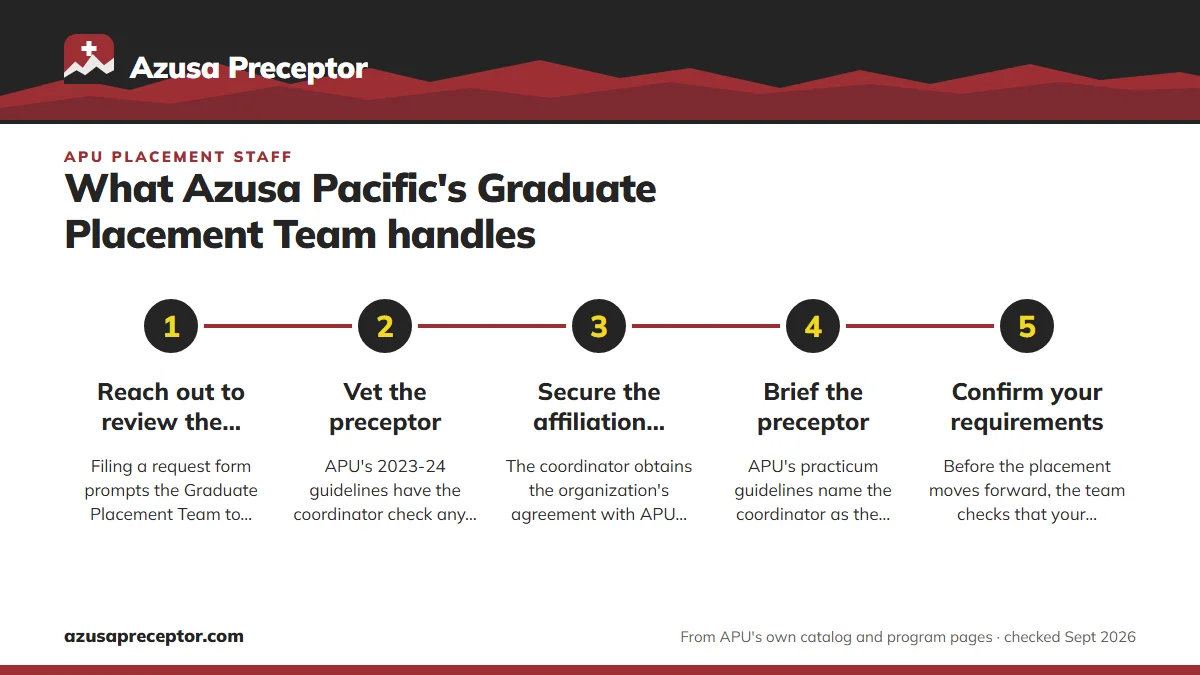
What the team does after you propose a preceptor
- Reach out to review the placementFiling a request form prompts the Graduate Placement Team to contact you, go over the details and confirm them.
- Vet the preceptorAPU's 2023-24 guidelines have the coordinator check any preceptor a student puts forward and arrange a general liability contract for the placement.
- Secure the affiliation agreementThe coordinator obtains the organization's agreement with APU. When the clinic has none, this tends to be the longest wait; see affiliation agreements.
- Brief the preceptorAPU's practicum guidelines name the coordinator as the person a preceptor hears from first: the one who sends out the Preceptor Handbook and gets the Preceptor Agreement Form signed.
- Confirm your requirementsBefore the placement moves forward, the team checks that your practicum requirements in CastleBranch or Complio are current.
- Clear the site in writingA written approval from the placement coordinator is what finally lets you walk in, and both request forms say so.
Placement offers and the one-week reply
When the team lines up a site for you, it comes as an offer, and APU's 2023-24 guidelines allow one week to confirm it. Use that week well: look at the site, the schedule and the commute, send any questions early, and give your answer in writing.
The week carries weight beyond the offer. If a term later goes unplaced, the guidelines list conduct that forfeits the late-drop fee waiver, and two items on that list sit right here: turning down an offered placement, and letting the week pass without confirming. The drop rule page covers the rest of the list.
Offers follow APU's own priorities. The guidelines weigh whether a site suits your course level and patient population before they weigh distance, and they describe commutes of an hour or two each way as ordinary. When an offer sits far from home, the real question is whether the experience fits the course, because saying no has consequences.
How to make the team's work faster
- Get a program plan on file. The 2023-24 guidelines leave students without one out of placement planning altogether.
- Name a new preceptor early. Six to eight weeks before the semester gives the coordinator room for vetting and the liability contract.
- Keep compliance current. The team checks CastleBranch or Complio before clearing a site, and Fall 2026 requirements closed on August 1, 2026.
- Send a complete request. One form per preceptor, carrying the entity's legal name, whoever signs its contracts and someone in the front office to contact; our field-by-field request form guide explains every entry.
- Ask before adding units. APRN students need director or chair approval to take on extra clinical units, because placement staff and preceptors are shared across the program.
- Reply within days. Offers, document requests and scheduling questions all move faster when your answer comes back quickly.
Where the team's work meets yours
For MSN NP and CNS students, APU splits the work. Placement staff advise, approve and paper the placement; you look for a site close to home and bring it forward, which finding your own clinical site covers in detail. The team decides whether a site and preceptor are approved, handles the agreement with the organization, and tells you when you may start.
A few items skip you entirely. Per APU's student hub, when a site charges an onboarding fee for each student, that invoice goes to the School of Nursing. Other items belong to you alone: weekly hour entries in Medatrax, compliance that stays current all year, and a prompt call to faculty the moment a site starts to wobble, since leaving a site before faculty can intervene costs you the fee waiver.
Why APU students choose us alongside the placement team
APU's placement team works fastest when a proposal arrives with nothing missing, and a proposal with nothing missing is what we produce. We find a preceptor whose credential suits your course, close to where you live, confirm the preceptor's availability for the hours your term requires, and gather the items the team reviews: license and credential, the organization's legal name, the authorized signer and the office manager.
We also find out early whether the clinic already has an agreement with APU, which tells you and the coordinator how much lead time to plan for. The coordinator's written clearance is the final word, and our role is to hand over a proposal that meets APU's rules on the first pass. When a preceptor withdraws partway through a term, our desk is still on call and starts the replacement search. The form below is where to start.
Questions APU students ask
How do I reach APU's Graduate Placement Team?
Begin at the clinical placement onboarding pages of the SON student hub, which list one mailbox for pre-licensure placements and another for advanced-practice placements. Submitting a Graduate Preceptor Request form also prompts the Graduate Placement Team to contact you. San Diego students can route campus questions through their program managers.
What happens if I turn down an APU placement offer?
You can decline, but it has a cost. APU's 2023-24 guidelines count refusing an offered placement among the reasons a student loses the late-drop fee waiver and next-term priority placement if the term ends without a site. Raise your concerns with the placement coordinator inside the one-week window before you decide.
Who approves my preceptor at APU?
The placement coordinator vets the preceptor, the Clinical Placement Team gives the site its clearance, and clinical faculty sign off on specialty clinics. The preceptor also signs APU's Preceptor Agreement Form. Until written clearance reaches you, your preceptor has said yes but APU has not.
Does the placement team handle the DNP residency?
The DNP runs on a different track. For residency questions, APU's onboarding pages send DNP students either to their program manager or to the residency coordinator, who is also the DNP Program Director. No public DNP document says who secures the residency site, so ask early; DNP residency hours explains how the hours count.
How long does APU take to clear a clinical site?
APU publishes no set turnaround. Its 2023-24 guidelines want new preceptors named six to eight weeks before the term, and APU cautions that an agreement with a clinic that has none takes time. CastleBranch notes that its own document review can run 7-10 business days, so finish compliance before you file.
Related pages
Last checked 2026-09-25
We check these pages against APU's own catalog and program pages. Your syllabus, your clinical faculty and APU's student placement coordinators have the final word.
APU says the clinical site and preceptor are yours to find. We make that the easy part.
Tell us your APU program, where you live in Southern California and when your next clinical term starts. We find preceptors who fit the course and prepare what APU and the site need before anything is approved.
- Preceptors matched to the course: primary care for
GNRS 600, pediatrics for the PNP courses, psychiatric care for PMHNP - Credentials, license and site details ready for APU's review and the affiliation agreement
- Close to home, from the San Gabriel Valley and the Inland Empire to San Diego
Start your placement plan
Program, city and term is all we need to begin.