APU clinical placement costs: who pays for what
Azusa Pacific University (APU) clinical placements carry a handful of costs, and APU's own pages split them between you, your course fees and the School of Nursing. You buy your CastleBranch or Complio subscription and, on most APU pages, your background check; a nursing clinical fee on several program pages includes malpractice insurance; and when a facility charges an onboarding fee, it bills the School of Nursing. This page sorts each item by who pays, without amounts, and shows where APU's sources disagree.
Ask what shapes your quote
Program, city and term start is enough.
On this page
Who paysCastleBranch or ComplioBackground and drug testsMalpractice and clinical feeCourse-linked costsFacility onboarding feesCosts outside fee tablesOur placement quoteQuestionsWho pays, item by item
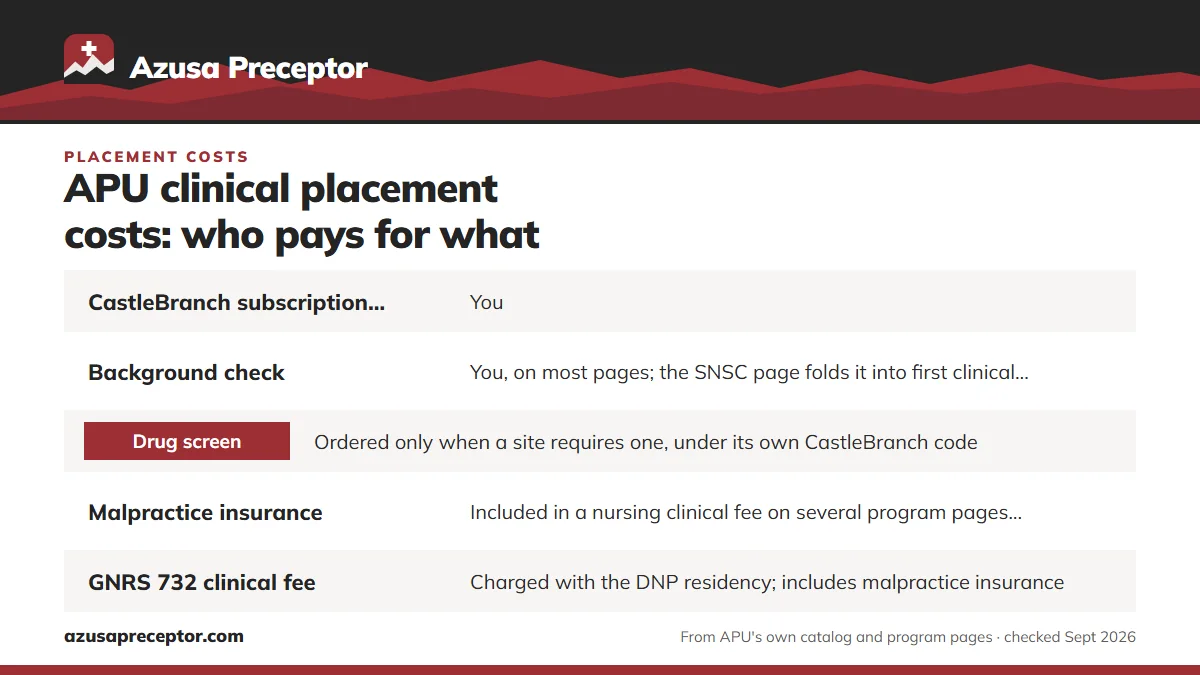
APU's fee tables, program pages, student hub and handbooks each mention part of the picture. The table pulls the placement-related items together; amounts live on APU's current fee tables and the vendors' sites, so check those for your program and term.
| Item | Who pays, per APU | Where APU says it |
|---|---|---|
| CastleBranch subscription (Complio at San Diego) | You | SON student hub; 2023-24 MSN Advanced Practice Guidelines |
| Background check | You, on most pages; the SNSC page folds it into first clinical course lab fees | Catalog, program pages, SNSC page |
| Drug screen | Ordered only when a site requires one, under its own CastleBranch code | SON knowledge base (CastleBranch overview) |
| Malpractice insurance | Included in a nursing clinical fee on several program pages; the FNP certificate page asks you to document coverage | Program fee tables; FNP certificate page |
| GNRS 732 clinical fee | Charged with the DNP residency; includes malpractice insurance | BSN-to-DNP program page; catalog |
| iHuman virtual cases | A per-case fee applies to required cases | 2023-24 MSN Advanced Practice Guidelines |
| Facility onboarding fees (MyClinicalExchange and similar) | Invoiced by the facility to the School of Nursing | SON prelicensure hub; archived all-student updates |
| N95 fit test and masks | Provided by the SON when a facility needs them | SON student hub |
Your compliance subscription
Clinical requirements live in a paid vendor account that you purchase yourself. San Diego students use Complio, run by American DataBank; everyone else uses CastleBranch. APU's handbook asks you to keep that account live and up to date through your final term, not only your first clinical course.
CastleBranch assigns packages by code: a single Advanced Practice code serves all campuses, while the DNP, Nursing Education and the leadership (HAL) program each get their own. Choose the code for your program when you order, since the package determines what the account tracks.
CastleBranch warns that checking uploads may need 7 to 10 business days, so get documents in well before your term's deadline; for Fall 2026 that deadline was August 1, 2026. Setup steps and package details are on our CastleBranch and Complio page.
Background checks and drug screens
APU requires a background check of every graduate student before clinical placement, citing the Joint Commission, contracted facilities and the School of Nursing. Who pays is one of the places APU contradicts itself. Most APU pages, the catalog among them, put the charge on you, with a higher rate for international students. The exception is the page for the school nurse credential, which rolls the check into the lab fees of your first clinical course. Ask which applies to your program before you order.
Sites can add their own requirements on top: some ask for Live Scan or more frequent checks, and some require CB Bridges. Drug screens happen only at a site's request and use a separate CastleBranch code. APU's public sources do not print who covers these site-driven extras, so confirm with the placement team when a site asks. The scope of the check itself is on our background check and drug screen page.
Malpractice insurance and the clinical fee
Malpractice coverage is the second conflict. A number of APU program fee tables show malpractice insurance built into the nursing clinical fee, and the residency fee for GNRS 732 carries it too, per the BSN-to-DNP page. The FNP certificate page, however, lists malpractice insurance documentation among the items due when clinical coursework begins. On the undergraduate side, liability coverage for SON practicums already rides on lab fees.
Read together, most APU pages tie coverage to a clinical fee, while at least one expects documentation from you. If your program's fee table shows the clinical fee, ask whether a separate certificate is still needed; if it does not, ask how your coverage is provided before your first clinical course.
Because the zero-unit residency course is taken again each term until the hours are done, ask how its clinical fee applies to every enrollment. More detail is on our malpractice insurance and clinical fee page.
Course costs and the cost of a lost term
A few course items carry their own charges. Required iHuman virtual cases carry a per-case fee, and they sit inside the evaluation system described on our evaluations and OSCEs page, alongside preceptor and faculty evaluations and OSCEs.
The largest cost is usually time. A drop for no placement, or a failed clinical course, adds a term to your plan. APU can excuse late-drop fees, and move you up for the next term, when the missing site or a departing preceptor was not your doing; the conditions are on our no-placement drop rule page.
A failed course is harder. Hours from it do not carry over, so a repeat means paying for the course again and working every hour a second time. That is the strongest financial case for securing a fitting preceptor early.
Facility onboarding fees and what the SON covers
Some facilities charge a per-student onboarding fee through their own systems. APU names Providence, MyClinicalExchange and Pronto Wellness as examples and says the student does not pay: the facility invoices the School of Nursing. That statement appears on the SON's prelicensure hub and in archived all-student updates from 2024, so if a graduate site sends you an invoice, check with the placement team before paying it. MyClinicalExchange is the one onboarding platform the hub names outright, while Providence and Pronto Wellness appear as facilities that bill per student.
The SON also covers respirator needs. Post-licensure students carry no general N95 fit-test requirement; if a facility wants one, the SON supplies both the test and the masks. Facility portals and onboarding steps across the region are explained on our Southern California clinical placement systems page.
Costs that never appear on a fee table
Some real costs sit outside APU's fee tables. The handbook counts a driver's license, vehicle registration and an auto policy that names you, directly or by endorsement, among clinical documents, and APU's guidelines treat long drives to a well-matched site as normal. Fuel and time on the road add up across a clinical sequence of 540 hours or more.
Health items are yours to keep current: comprehensive health insurance for the whole practicum, an annual physical with the technical standards form, TB screening, a flu shot or declination, immunization records or titers, and an American Heart Association BLS card. APU's sources describe these as documents you provide without saying who covers them, so check what your health plan includes.
Time away from work is the last one. Graduate nursing students at APU are expected to hold a clinical job while enrolled, and with no night shift allowed before a clinical day, some terms mean swapping shifts with coworkers.
What shapes our placement quote
Our service is separate from anything APU charges, and APU students choose us because the work is thorough from the first conversation. A quote reflects your program and course, where you live in Southern California, how soon your term starts and how specialized the preceptor needs to be: a psychiatric preceptor for GNRS 537 children and adolescents is a different search from a family practice for GNRS 600.
Every quote covers the same thorough work: a search for a preceptor and site suited to your APU course near home, a complete file for APU's review (credentials, license, the organization's registered name, its authorized signer and the person who runs the office), an early read on whether APU already has a contract there, and a replacement search if your preceptor leaves. The factors are laid out on our cost page, or use the form below to ask for your quote.
Questions APU students ask
Do APU students pay MyClinicalExchange or other facility onboarding fees?
APU says no: facilities that charge a per-student onboarding fee, including through MyClinicalExchange, invoice the School of Nursing. The statement appears on the SON's prelicensure hub and in archived all-student updates, so graduate students should confirm with the placement team before paying anything a site sends.
Is malpractice insurance included in APU's clinical fee?
Often, yes: several APU program fee tables fold malpractice coverage into the nursing clinical fee, and the DNP residency fee covers it as well. The FNP certificate page, however, asks you to document malpractice insurance when clinical coursework starts. Ask your program which applies before your first clinical term.
Who pays for the APU background check?
You do, according to the catalog and the majority of APU program pages, and international students are charged more. One page disagrees: the school nurse credential listing bundles the check into first-course lab fees. Because the sources disagree, confirm with your program before ordering through CastleBranch or Complio.
Do I need to keep my CastleBranch account active after my first clinical course?
Yes. APU's handbook asks you to maintain the CastleBranch or Complio account in good standing until you finish the program. Annual items such as TB screening, the flu shot or declination, the physical and the yearly training modules keep coming due, so the account stays in use across your whole program.
Does iHuman cost extra at APU?
Yes. APU's 2023-24 MSN Advanced Practice Guidelines say required iHuman virtual cases carry a per-case fee. The cases are part of how clinical performance is assessed, along with preceptor and faculty evaluations and OSCEs. Your syllabus lists which cases your course requires, so check it at the start of the term.
Related pages
Last checked 2026-09-25
We check these pages against APU's own catalog and program pages. Your syllabus, your clinical faculty and APU's student placement coordinators have the final word.
APU says the clinical site and preceptor are yours to find. We make that the easy part.
Tell us your APU program, where you live in Southern California and when your next clinical term starts. We find preceptors who fit the course and prepare what APU and the site need before anything is approved.
- Preceptors matched to the course: primary care for
GNRS 600, pediatrics for the PNP courses, psychiatric care for PMHNP - Credentials, license and site details ready for APU's review and the affiliation agreement
- Close to home, from the San Gabriel Valley and the Inland Empire to San Diego
Start your placement plan
Program, city and term is all we need to begin.