Immunizations, TB, BLS and health status for Azusa Pacific clinicals
Before any graduate clinical course at Azusa Pacific University (APU), the health assessment lab included, you document CPR, TB screening and immunizations suited to your clinical setting, and your health must allow safe practice. Some records are one-time, others renew every year, and a clinical site can set stricter rules than APU does.
Get your placement plan
Tell us your APU program and where you live. A placement advisor replies with the preceptor and site options that fit your APU course.
On this page
The catalog ruleImmunizationsAnnual itemsBLS cardCOVID-19 standardsInsurance and injuriesWhere we fitQuestionsWhat the catalog requires before clinicals
APU's catalog sets the baseline for the advanced practice programs. At the start of graduate clinical coursework, which includes the health assessment lab (GNRS 612, or GNRS 511 on some pediatric tracks), students document RN licensure, CPR, TB screening and immunizations appropriate to the clinical setting. Their health status must also permit safe clinical practice.
The detail behind that sentence lives in the School of Nursing Student Handbook. The version summarized here is the 2024-25 edition, the most recent one posted publicly; the current handbook sits behind your APU login and has the final word, along with your syllabus and the placement team.
Two of the catalog's items have their own pages on this site: your license is covered under RN license and Southern California residence, and the screening that runs beside these records is on the background check and drug screen page.
One-time immunization records
The 2024-25 handbook prefers titers, lab proof of immunity, over vaccination dates wherever a titer is an option. Gather these records once and keep clean copies; a site that runs its own onboarding may ask for them again.
| Record | What the handbook accepts | Watch for |
|---|---|---|
| MMR | Two vaccinations or positive titers | Titers are the preferred proof |
| Varicella | Two vaccinations or a positive titer | Titers are the preferred proof |
| Hepatitis B | The series, a titer or a declination | Facilities may reject a declination |
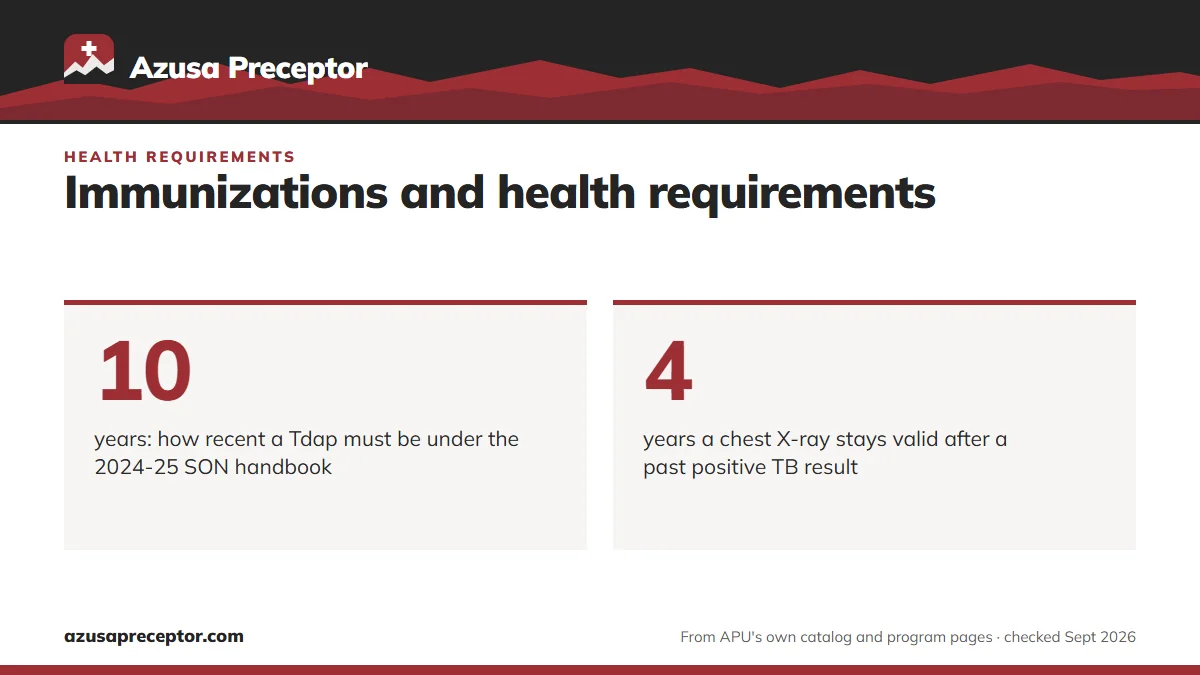
| Tdap | A dose within the last 10 years | Check the date before every fall update |
APU's 2023-24 graduate guidelines asked for a hepatitis B titer specifically, rather than a series or a declination. The later handbook is broader, but a site that refuses declinations brings you back to proof of the series or a titer, so a titer is the most useful hepatitis B record to have on file.
Annual items: TB, flu and the physical
- TB screening: a one-step test each year after an initial negative, or a QuantiFERON or a questionnaire if you have tested positive before.
- Chest X-ray for a past positive: valid for four years under the handbook.
- Site-specific TB timing: some sites want a test from the last six months, which can mean retesting even when APU's yearly cycle is current.
- Flu: the vaccine, or a declination on the school's form. Kaiser and some other facilities reject declinations.
- Physical: an annual exam, with the technical standards form signed by a health care provider.
Here APU's documents differ. The 2023-24 graduate guidelines call for annual two-step TB testing, while the 2024-25 handbook allows a one-step test after an initial negative. Ask your placement coordinator which rule applies to your cohort before you book the test.
Line up the renewal dates so they land before the term deadline rather than in the middle of a rotation. A yearly TB result dated in June runs through the next fall and spring terms; one dated in February comes due again in the middle of the following spring. Upload each result to CastleBranch or Complio as soon as you have it.
BLS: only the American Heart Association card
The catalog's word is CPR; the handbook is more specific. APU accepts only the American Heart Association BLS course, and the card has to be renewed before it expires, not after. A card from another provider does not meet the rule, even if your employer accepts it for your RN job.
Check the expiration against your whole term, not just the compliance deadline. A card that lapses in October leaves you out of compliance in the middle of a fall rotation, and because APU's rotation rules bar back-loading hours at the end of a term, lost clinic days are hard to recover. The rotation rules page explains how pacing works.
If your card is due during the term, renew it before the term starts. That takes one more date off the list you have to watch while you are juggling clinic days, shifts and coursework.
COVID-19: facility rules, not an APU mandate
For 2026-27, APU's onboarding hub says the university does not require COVID-19 vaccination, but students must meet the standards of the partner facilities where they train. A student who does not meet a facility's standard is not assured a placement there, and hours missed as a result may not be recoverable that semester, leading to an Incomplete or a withdrawal request.
The rule has moved over three years. The 2023-24 graduate guidelines required a bivalent mRNA vaccine for first-time compliance, the 2024-25 handbook followed Los Angeles County public-health orders, and the current hub leaves it to each facility. If a classmate from an older cohort describes a different rule, that history is why.
In practice, the question to ask is the site's, not APU's. Reviewing facility-driven standards is one of the tasks on APU's term checklist, and the answer can differ between two hospitals in the same city.
Health insurance, masks and injuries at a site
Signing the Clinical Participation Form is a promise to stay covered by comprehensive health insurance until the practicum ends, and some sites want proof. Keep a current image of your card with the rest of your compliance records.
Post-licensure students do not need N95 fit testing as a standing requirement. When a facility does need one, the School of Nursing provides the fit test and the masks, so a site's respirator rule is something to raise with APU rather than to arrange on your own.
If you are hurt or exposed at a clinical site, the 2024-25 handbook routes it through APU's workers' compensation. Your instructor reports it to Human Resources, and you are sent to a Concentra urgent care for treatment. Tell your clinical faculty right away so that process can start.
Why APU students choose us for sites with strict health rules
Health rules vary most from site to site. One hospital refuses flu declinations, another wants a TB result from the last six months, a third sets its own COVID-19 standard. When we vet a site for you, we record its onboarding needs and compare them with the records you already hold, so you know before you commit whether you need a titer, a retest or nothing new. If your flu record rules out one hospital, we look for a nearby clinic whose rules your record already meets.
From there we prepare what APU's Graduate Placement Team needs to review the placement and stay on call through the term. Tell us your course and the part of Southern California you live in through the form below, or read how we approach finding a site near home.
Questions APU students ask
Does APU require a two-step TB test for nursing students?
It depends on which APU document you follow. The 2023-24 graduate guidelines call for annual two-step testing, while the 2024-25 SON handbook accepts a one-step test each year after an initial negative, or a QuantiFERON or questionnaire after a past positive. Some sites also want a result from the last six months, so confirm the current rule with your placement coordinator.
Can I decline the flu shot as an APU nursing student?
APU's handbook allows a declination on the school's form, but it also warns that Kaiser and some other facilities reject declinations. At those sites the declination does not clear you, whatever APU's form says. Make the decision with your likely site in mind, since the facility's rule decides whether you can start there.
Is COVID-19 vaccination required for APU clinicals?
Not by APU itself for 2026-27. The onboarding hub says students must meet each partner facility's standard instead, and that a student who does not may not be placed there. Earlier APU documents set different rules, including a bivalent vaccine requirement in the 2023-24 guidelines, so rely on the current hub rather than older advice.
Does APU accept a BLS card from any provider?
No. APU's handbook accepts only the American Heart Association BLS course, so a card from another provider does not meet the rule even if your employer accepts it. Take the AHA course, renew the card before it expires, and choose a renewal date that keeps the card valid through your entire clinical term.
What happens after a needlestick at an APU clinical site?
APU treats a clinical injury or exposure as a workers' compensation matter under its 2024-25 handbook: the instructor contacts Human Resources and directs you to a Concentra urgent care clinic. Tell your clinical faculty right away so the process starts promptly, and check the current handbook behind the APU login for any changes to those steps.
Related pages
Last checked 2026-09-25
We check these pages against APU's own catalog and program pages. Your syllabus, your clinical faculty and APU's student placement coordinators have the final word.
APU says the clinical site and preceptor are yours to find. We make that the easy part.
Tell us your APU program, where you live in Southern California and when your next clinical term starts. We find preceptors who fit the course and prepare what APU and the site need before anything is approved.
- Preceptors matched to the course: primary care for
GNRS 600, pediatrics for the PNP courses, psychiatric care for PMHNP - Credentials, license and site details ready for APU's review and the affiliation agreement
- Close to home, from the San Gabriel Valley and the Inland Empire to San Diego
Start your placement plan
Program, city and term is all we need to begin.