California RN license, Southern California residence and the experience gate at Azusa Pacific
Azusa Pacific University (APU) sets three gates in front of its nurse practitioner and clinical nurse specialist clinicals: a current California RN license on file, a home in Southern California, and at least a year of nursing experience. The online MSNs in Nursing Education and Healthcare Administration and Leadership swap the residence rule for a license rule, and the BSN to DNP sets its own experience bar.
Get your placement plan
Tell us your APU program and where you live. A placement advisor replies with the preceptor and site options that fit your APU course.
On this page
California RN licenseBy programSoCal residenceOnline MSN exceptionExperience gateOngoing clinical workWhere we fitQuestionsA California RN license on file
Every post-licensure APU nursing program lists a current California RN license among the documents students keep on file, and the catalog repeats the point for advanced practice students: RN licensure is one of the records due when graduate clinical coursework begins. The MSN NP application goes one step further and asks for a copy of your license status from California's BreEZe system.
Current means current for the whole time you are in clinicals, not just on the day you applied. Put your renewal date beside your BLS card and TB result in the calendar you use for CastleBranch or Complio, so a renewal never falls in the middle of a rotation.
The doctoral programs say the same. The post-master's DNP is taught online, yet a current California RN license is a condition of entry, and the BSN to DNP asks for one at admission as well.
License rules by program
The license APU asks for changes with the program. This table gathers what each APU page states.
| Program | License rule APU states |
|---|---|
| MSN NP and CNS tracks, NP and CNS certificates | Current California RN license on file; the MSN NP application asks for a BreEZe license status copy |
| BSN to DNP | Current California RN license at admission |
| DNP (post-master's, online) | California RN license mandatory at entry |
| Oncology NP Fellowship | Current California NP license and furnishing number; out-of-state applicants obtain California NP certification before clinicals |
| MSN Nursing Education, MSN Healthcare Administration and Leadership | Active, unencumbered nursing license in the state where the practicum takes place |
| RN to BSN | RN license in good standing before clinical courses; Bridge students hold it before upper-division clinicals |
| ELM-MSN | Pass the NCLEX before any advanced practice clinical course |
MSN NP students work toward the furnishing number that Oncology NP applicants already hold; our guide to the furnishing number and GNRS 611 covers how APU's pharmacology course supports that application.
The Southern California residence rule
APU's catalog states that applicants to the MSN advanced practice programs "must reside in Southern California." The BSN to DNP page words it differently for its NP-track students, who are expected to live close to one of APU's Southern California regional centers so they can attend in-person classes and rotations.
The rule fits how the programs run. The MSN NP specialties are offered at Azusa, the Inland Empire campus in San Bernardino and the San Diego campus in Mission Valley, and clinicals happen near where you live. APU's 2023-24 guidelines also ask students to stay put: no relocating mid-program, and a switch to another campus is generally not permitted. See APU's regional campuses for which tracks run where.
Leaving the region raises more than a commute question. APU's professional licensure disclosures list California as Yes for its NP programs and every other state as Not Determined, and no APU document says NP clinicals may take place outside California. The state authorization page has the detail.
Where the residence rule does not apply
The MSN in Nursing Education and the MSN in Healthcare Administration and Leadership are asynchronous online programs open to applicants anywhere. In place of a residence rule they carry a license rule: your nursing license must be active and unencumbered in whichever state hosts your practicum.
Both programs plan for distance in their own paperwork. The Nursing Education site form asks students outside the Los Angeles area for their city and state, and the Healthcare Administration and Leadership guidelines ask out-of-state students to reach the practicum coordinator six months ahead, against one to two months for everyone else.
If you are in one of these programs and live outside California, check your own state's rules as well. APU's catalog says it cannot confirm whether a program meets another state's licensure or certification requirements, and it points students to the Provost website and to NCSBN.
The experience gate: one year, or eight months
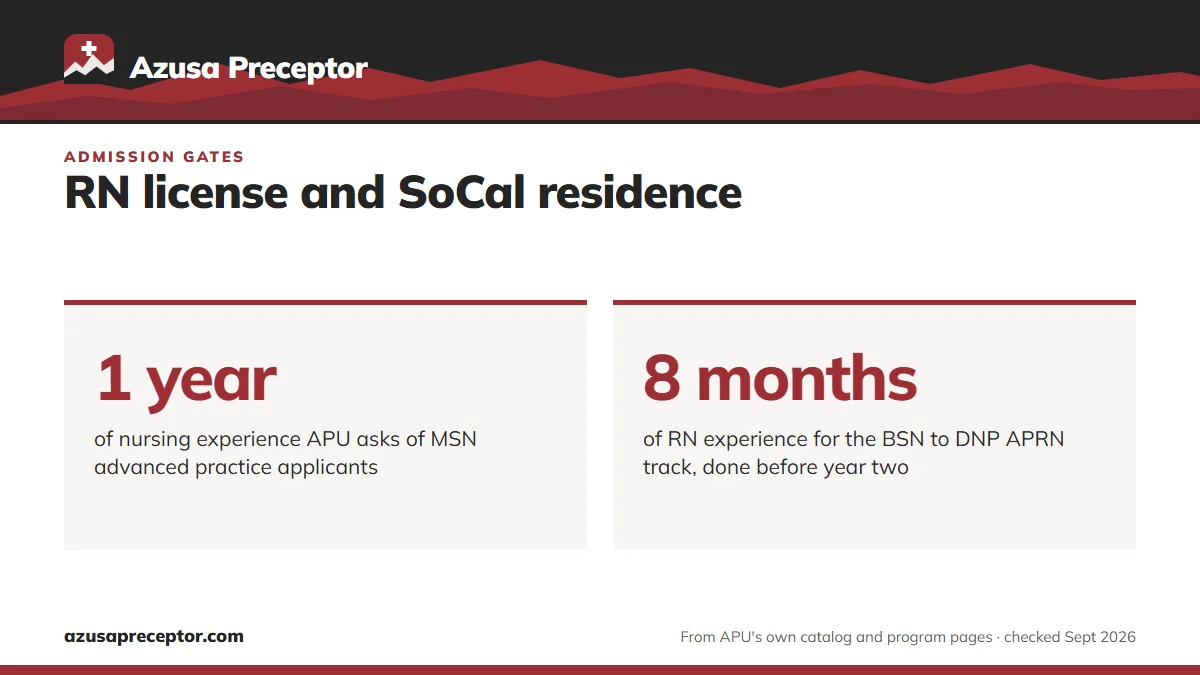
APU's catalog sets a minimum of one year of nursing experience for MSN advanced practice applicants. The 2023-24 graduate guidelines apply the same expectation before any clinical course and name ELM graduates specifically, so an ELM student moving from the prelicensure phase into an NP or CNS specialty works as an RN before those clinicals begin.
The BSN to DNP sets a different bar, and APU presents the two figures on different pages. Its APRN track sets the minimum at eight months of RN work, and someone newly licensed can build those months while enrolled, provided they are complete when year two starts.
Inside the ELM, the education and leadership tracks carry their own version of the rule: a year's worth of RN clinical experience, or its equivalent, must come before GNRS 663 in Nursing Education and before GNRS 567 in Healthcare Administration and Leadership. Check your catalog year, since this requirement attaches to those courses, not to the admission decision.
Keep working clinically while you study
Staying in practice is part of the plan: APU's catalog asks both MSN and DNP students to continue in clinical work throughout enrollment, and ELM students in the postlicensure phase are expected to have outside clinical work experience. That makes scheduling central to any search: a preceptor's clinic days have to fit around your own shifts, and APU's recent guidelines rule out a night shift on the eve of a clinical day.
Your workplace can host a rotation, within limits. APU's 2026 request forms say clinicals at your employer have to happen outside the unit you work on, and the guidelines require your employer to put in writing, and sign, how your student duties differ from your paid ones; the preceptor requirements page sets out these rules in full.
APU's guidelines also warn that clinic slots on Saturdays and in the evening are hard to find, family practice most of all. If your job fills your weekdays, raise that early, because it narrows the preceptors who can take you.
Why APU students choose us: searches built around home
APU ties its NP and CNS students to Southern California, so the search that matters is a local one. We look for preceptors and sites that fit your APU course close to where you live and around the shifts you already work, anywhere between the San Gabriel Valley and San Diego County, and we keep your own unit out of the search from the start.
Every match comes with the preceptor and clinic details APU's Graduate Placement Team asks for, prepared so the request is complete on arrival, plus an early word on whether the clinic is already under an APU affiliation agreement. Should a preceptor leave mid-term, we line up a replacement near home. Send your campus, course and ZIP code through the form below.
Questions APU students ask
Can I apply to APU's NP program if I live outside Southern California?
Not for the MSN advanced practice tracks. APU's catalog says applicants must reside in Southern California, and NP-track students in the BSN to DNP are expected to live close to a regional center in the same area. The online MSNs in Nursing Education and Healthcare Administration and Leadership accept applicants anywhere, provided they are licensed in the practicum's state.
Does APU's online DNP still require a California RN license?
Yes. Although the post-master's DNP runs online with minimal residency, APU requires a current California RN license from the day you enter. The BSN to DNP also asks for a current California license at admission. How transferred hours and residency hours add up is covered on our DNP residency hours page.
Can I begin APU's NP clinicals as a newly licensed RN?
On the MSN, the catalog wants a full year of nursing experience first, and the 2023-24 guidelines place that year before any clinical course, ELM graduates included. The BSN to DNP APRN track is more flexible: it asks for eight months as an RN, and a new graduate can complete them during the program before year two begins.
Can I move during APU's NP program?
APU's 2023-24 graduate guidelines advise against relocating while enrolled and say switching campuses is generally not allowed. Clinicals are arranged near home, and APU's licensure disclosures cover California only, so a move out of the region can complicate your placements. Talk with your program director before you sign a lease somewhere new.
How do I show my RN license to APU?
The MSN NP application asks for a copy of your license status from California's BreEZe system, and APU's handbook lists a current California RN license among the documents every post-licensure student keeps on file. Keep that record current through each renewal, since the catalog asks for licensure documentation at the start of clinical coursework.
Related pages
Last checked 2026-09-25
We check these pages against APU's own catalog and program pages. Your syllabus, your clinical faculty and APU's student placement coordinators have the final word.
APU says the clinical site and preceptor are yours to find. We make that the easy part.
Tell us your APU program, where you live in Southern California and when your next clinical term starts. We find preceptors who fit the course and prepare what APU and the site need before anything is approved.
- Preceptors matched to the course: primary care for
GNRS 600, pediatrics for the PNP courses, psychiatric care for PMHNP - Credentials, license and site details ready for APU's review and the affiliation agreement
- Close to home, from the San Gabriel Valley and the Inland Empire to San Diego
Start your placement plan
Program, city and term is all we need to begin.