Malpractice insurance and the nursing clinical fee at Azusa Pacific
Azusa Pacific University (APU) lists malpractice insurance among the items graduate nursing students need when clinical coursework begins, and the fee tables on several APU program pages list a nursing clinical fee that covers it. APU's pages are not consistent about whether that fee settles the matter or whether you bring proof of your own, so read your program's page and confirm with APU before buying a policy.
Get your placement plan
Tell us your APU program and where you live. A placement advisor replies with the preceptor and site options that fit your APU course.
On this page
The requirementThe clinical feeThe conflictYour own policyAuto and health coverWhere we fitQuestionsWhat APU asks for when clinicals start
APU's graduate program pages put malpractice insurance on the list of documents due at the start of clinical coursework, next to the license, CPR card, TB result and immunization records the catalog lists. It applies from your first clinical course onward, whether that is GNRS 600, a PMHNP population course such as GNRS 535, or a CNS rotation in GNRS 520.
Coverage is also part of how APU clears a site. APU's 2023-24 graduate guidelines describe the placement coordinator vetting each preceptor a student proposes and putting a general liability contract in place, and they ask for 6-8 weeks' notice of a new preceptor so that work can be done before the term. Those guidelines are dated, so check the timing against the current handbook and with the placement team.
In short, two things run side by side: your own coverage, which the program pages and fee tables speak to, and the contract APU sets up for the site, which the placement staff handle.
The nursing clinical fee that includes coverage
On several APU program pages, the fee table lists a nursing clinical fee and notes that malpractice insurance is part of it; the FNP certificate and LVN to BSN pages are two examples. The BSN to DNP page says the same about the clinical fee attached to GNRS 732, the DNP Clinical Residency.
GNRS 732 carries 0 units and doctoral students repeat it until they reach their residency hours, so its fee is tied to the course rather than to a unit load. How the fee applies across repeated enrollments is a question for your program office; the DNP residency hours page explains how those hours build up.
Undergraduates follow a parallel rule. APU's School of Nursing additional requirements page says lab fees include liability insurance for SON practicums. Amounts change by year and by program, and this site prints none of them, so read the current fee table on your own program page rather than a figure a classmate paid in an earlier year.
Where APU's sources disagree
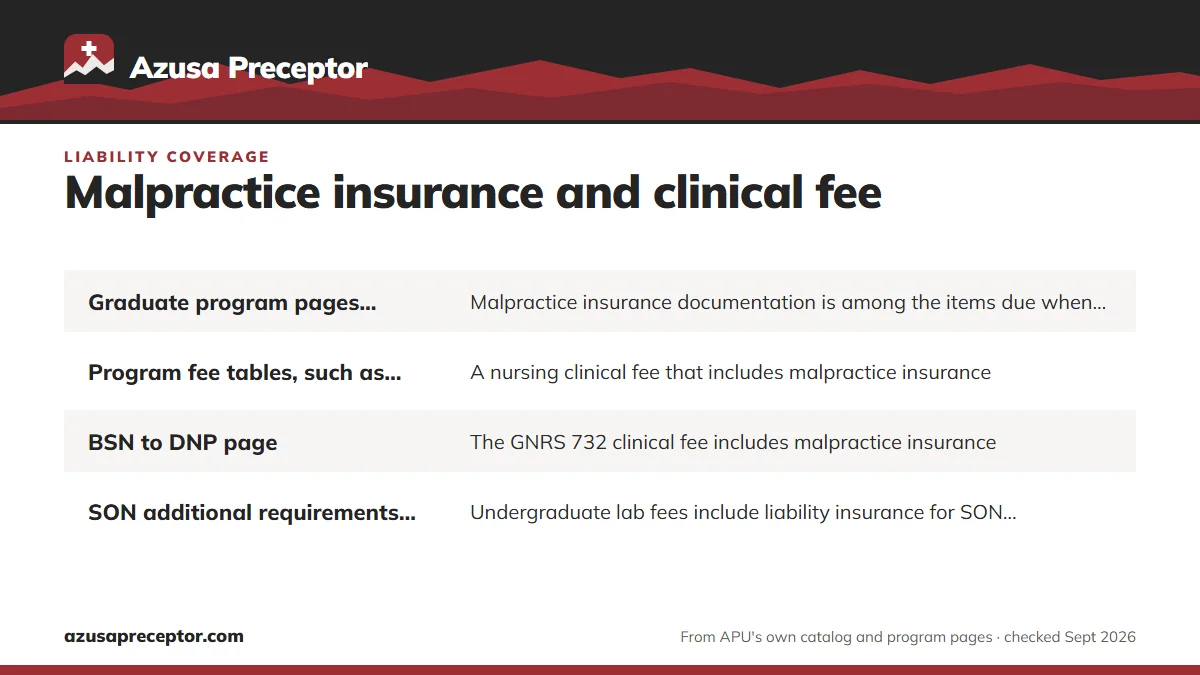
APU publishes four statements about coverage for clinical work, on four different pages. Here they are side by side, so you can see which ones apply to your program.
| APU source | What it says |
|---|---|
| Graduate program pages, such as the FNP certificate | Malpractice insurance documentation is among the items due when clinical coursework starts |
| Program fee tables, such as the FNP certificate and LVN to BSN | A nursing clinical fee that includes malpractice insurance |
| BSN to DNP page | The GNRS 732 clinical fee includes malpractice insurance |
| SON additional requirements page | Undergraduate lab fees include liability insurance for SON practicums |
Read together, these leave one open question: does the coverage inside the clinical fee count as the documentation APU wants, or do you also upload a policy of your own? APU's public pages do not settle it, and the current graduate handbook sits behind the APU login.
Ask your placement coordinator or program director, in writing, and keep the reply with your compliance records. If a clinical site asks you for proof of coverage, pass the request to APU's placement staff so the answer matches what APU has on file for that site.
Buying your own policy: questions to settle first
A personal policy may still make sense for you, but settle these questions before you pay for one. The first three go to APU; the last goes to the insurer.
- Does my program's nursing clinical fee include malpractice coverage for the clinical course I am taking this term?
- Does APU want a personal policy uploaded with my compliance records, or is the fee enough?
- Does my clinical site need anything beyond what APU provides?
- If I already hold a policy through my RN job, does it extend to supervised practice as a student NP or CNS?
That last question matters because the student role is different from the job your license covers today. Only the insurer can answer it, and the answer belongs in writing too.
None of this changes the order of events. Written clearance of the site from APU's placement team comes before your first day, and coverage questions are easiest to settle while the site is still being reviewed.
Other insurance on APU's list
Malpractice is not the only coverage APU checks. The handbook's document list includes your driver's license, auto insurance that names you on the policy or through an endorsement, and your vehicle registration. APU's recent guidelines rank fit for your level and population above closeness and describe commutes of one to two hours each way as common, so your car is part of your clinical plan.
The Clinical Participation Form also commits you to keeping comprehensive health insurance for the whole practicum; the health requirements page covers that promise and what happens after an injury at a site.
Facility onboarding fees are a separate matter again. APU's hub names MyClinicalExchange among the channels some facilities use to charge a per-student onboarding fee, and it says those charges are billed by the facility to the School of Nursing, not to you. Our placement costs page lays out who pays for each of these items.
Why APU students choose us: sites ready for APU's paperwork
APU's affiliation agreement depends on details from your preceptor request: the form asks for the clinic's legal name, which the agreement needs, and for the legal signer with credentials. Those details have to be exact, and they are the ones we collect for every preceptor we bring you.
Alongside them we confirm the preceptor's credential, license and email and the office manager contact, and we tell you early if the clinic is already covered by an APU affiliation agreement. What reaches APU's Graduate Placement Team is complete the first time, which leaves the contract work the full lead time APU asks for. Should your preceptor leave during the term, we bring a replacement and prepare the same details again, so the new site's paperwork starts complete as well. Read how the affiliation agreement works, or send your course and area through the form below.
Questions APU students ask
Do APU nursing students need their own malpractice insurance?
APU's pages point both ways. Graduate program pages list malpractice insurance among the documents due when clinicals begin, while fee tables, and the BSN to DNP page for its residency, describe a clinical fee with malpractice coverage built in. Ask your placement coordinator whether the fee satisfies the requirement for your program before you buy a separate policy, and keep the answer.
What does the APU nursing clinical fee cover?
Several APU program fee tables describe the nursing clinical fee as including malpractice insurance; the BSN to DNP page makes the same statement about the GNRS 732 residency fee. APU's pages list nothing else inside it. The amount depends on your program and year, so check the current fee table on your program's apu.edu page.
Does my employer's malpractice policy cover me as an APU NP student?
That depends on the policy, and only the insurer can say. Supervised student NP practice is a different role from your RN job, so ask whether the policy extends to it. On APU's side, the program pages describe coverage through the clinical fee, and APU's recent guidelines describe a liability contract set up for each preceptor's site.
Why does APU want weeks of notice for a new preceptor?
APU's 2023-24 guidelines ask for 6-8 weeks' notice before the semester so the placement coordinator can vet the preceptor and put a liability contract in place, and every clinical site also needs an affiliation agreement. A site with no existing APU agreement takes the longest. The current handbook and placement team set this term's timing.
Are hospital onboarding fees part of APU's clinical fee?
No. APU's onboarding hub says some facilities, including those that onboard through MyClinicalExchange, charge a per-student fee, and that the facility sends that bill to the School of Nursing instead of the student. The nursing clinical fee on your program's fee table is a separate APU charge that, according to those tables, includes malpractice insurance.
Related pages
Last checked 2026-09-25
We check these pages against APU's own catalog and program pages. Your syllabus, your clinical faculty and APU's student placement coordinators have the final word.
APU says the clinical site and preceptor are yours to find. We make that the easy part.
Tell us your APU program, where you live in Southern California and when your next clinical term starts. We find preceptors who fit the course and prepare what APU and the site need before anything is approved.
- Preceptors matched to the course: primary care for
GNRS 600, pediatrics for the PNP courses, psychiatric care for PMHNP - Credentials, license and site details ready for APU's review and the affiliation agreement
- Close to home, from the San Gabriel Valley and the Inland Empire to San Diego
Start your placement plan
Program, city and term is all we need to begin.