APU's school nurse programs: four paths to the credential
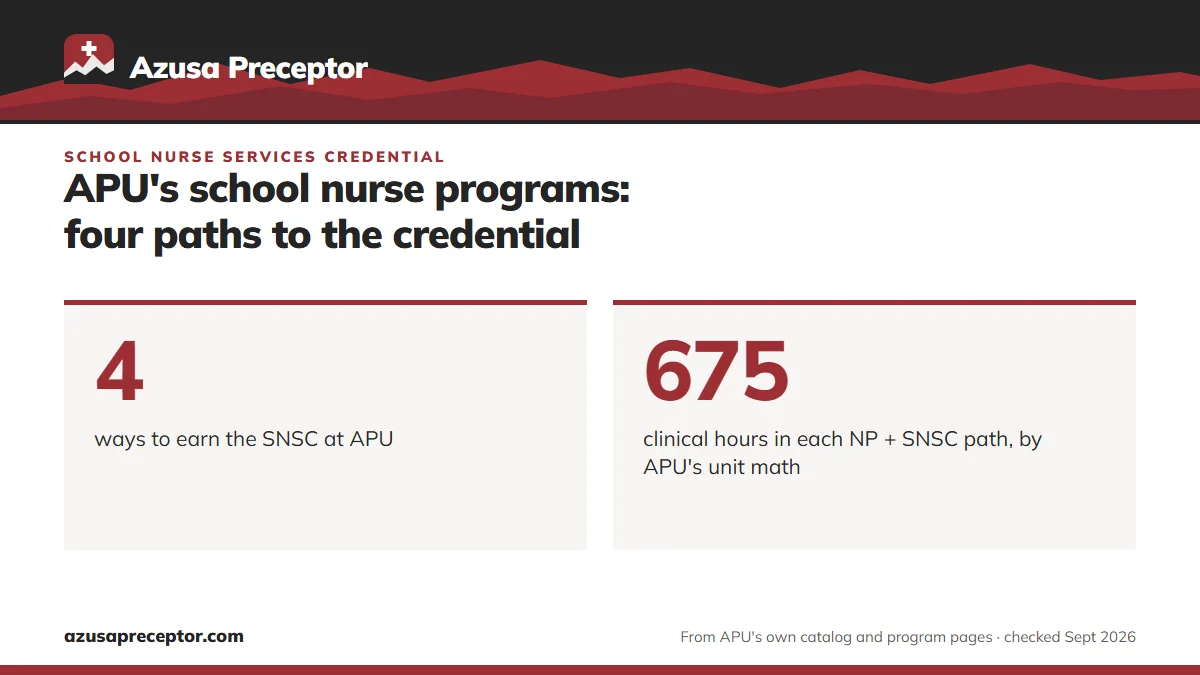
Azusa Pacific University (APU) offers California's School Nurse Services Credential (SNSC) four ways: inside an MSN, paired with the Family NP or Pediatric NP MSN, or on its own as a 24-unit credential. All four are listed at the Azusa campus and all four share the school-setting course GNRS 550A. What changes from path to path is the clinical load you carry, from 270 hours to 675.
Plan your SNSC clinicals
Tell us your path and the term your first clinical course starts.
On this page
Four paths comparedChoosing a pathFirst clinical coursePreceptors and sitesAdmission rulesCredential and certificationWhy students choose usQuestionsThe four SNSC paths side by side
The California Commission on Teacher Credentialing (CTC) approves APU's credential program, and APU lists every SNSC option at the Azusa campus. Coursework mixes on-campus meetings, synchronous and asynchronous online classes and supervised direct clinical practice.
| Path | Units | Clinical courses | Clinical hours |
|---|---|---|---|
| MSN with SNSC | 37-39 | GNRS 550A, GNRS 590C | 270 (works out to), plus audiometry |
| MSN, FNP + SNSC | 56 | GNRS 600, GNRS 550A | 675 (540 stated plus 135 that works out from units), plus audiometry |
| MSN, PNP-PC + SNSC | 53-55 | GNRS 590A, GNRS 532, GNRS 590B, GNRS 542, GNRS 550A | 675 (works out to), plus audiometry |
| SNSC only (nondegree) | 24 | GNRS 550A, GNRS 590C | 270 (works out to), plus audiometry |
Every path also requires a California-approved audiometry course. APU's course list includes GNRS 559 Audiometry for School Nurses, which carries eight hours of on-site practicum; those hours sit outside the totals in the table. The credential courses page covers GNRS 550A, GNRS 590C and audiometry in depth.
Which SNSC path fits your plans
The MSN with SNSC fits a nurse who wants the credential and a master's degree without becoming an NP. Beside the two clinical courses it adds GNRS 589 Adolescent Health Care, a 2-unit course with no clinical hours, and a health assessment course with lab, GNRS 511 or GNRS 612.
If an NP certificate might follow, the catalog leaves a door open. Once GNRS 513 and GNRS 610 are done, along with GNRS 611 and a health assessment lab (GNRS 511 or GNRS 612), you may take GNRS 590A in place of GNRS 590C, trading the credential's version of the young-family course for the one that opens the PNP-PC sequence.
The SNSC only path is a 24-unit nondegree credential for RNs who already hold a bachelor's degree: GNRS 504, GNRS 511 or GNRS 612, EDUC 537 Curriculum Design, GNRS 550A, GNRS 589 and GNRS 590C. APU says its admission rules match the MSN's.
The two NP combinations stack a full NP clinical load on top of the credential. FNP + SNSC reaches 56 units, including EDUC 537 and the 6-unit GNRS 550A; PNP-PC + SNSC runs 53 to 55. The FNP page and the PNP-PC page cover the NP side of each.
Where your first clinical hours fall
On the MSN with SNSC and the SNSC only path, your first clinical course is GNRS 550A Theory and Practice in School Nursing or GNRS 590C Primary Health Care of the Young Family for the School Nurse Services Credential. Both require the health assessment course first. Each is 6 units, 3 class and 3 clinical, which works out to 135 hours apiece.
GNRS 550A is the school-setting course: its hours are field experience in schools. GNRS 590C takes its name from young-family primary care, and your syllabus names the settings where its hours count.
On the NP combinations, your first precepted hours follow the NP track instead: GNRS 600 for FNP + SNSC, and GNRS 590A for PNP-PC + SNSC. GNRS 550A then adds its school hours in the term your program plan sets. APU publishes no sample plan for these paths, so that plan is the document to build around.
APU's 2023-24 guidelines note that the SNSC schedule is built around a working school nurse's day, which matters if you already work for a district and need clinical time that fits the school calendar.
Preceptors and school sites
No public APU source says who arranges the school site for GNRS 550A, and APU's current preceptor request forms do not list the SNSC courses by number. Ask your clinical faculty early how the school placement works for your cohort, and whether your own district can serve as a site.
If you work for a district, APU's employer rules for NP clinicals are a useful guide to the questions to ask. Under those rules, your employer signs off on a written split between your job and your clinical role, clinical hours are never paid work hours, and your own unit is off limits. Ask faculty how each of those applies to a school campus you already serve.
For the NP courses inside the combined paths, APU's NP rules apply in full: physicians, NPs, and PAs working with an on-site physician may precept; one semester or more has to be with an NP; and a family practice counts toward pediatric hours only when it sees at least six children a day. The preceptor requirements page lists every rule.
Admission rules, transfer units and deadlines
For the two NP combinations, APU's APRN admission rules apply directly: applicants live in Southern California and have at least a year of nursing work behind them. The SNSC only credential is open to RNs with a bachelor's degree under admission rules APU says match the MSN; confirm with admissions how the residence and experience rules apply to the paths that stop short of NP.
Two details on APU's SNSC page differ from its other graduate materials. The SNSC page allows 12 transfer units plus 6 more by petition, while the catalog allows 9 for the MSN. And the SNSC page says the background check cost is included in lab fees for the first clinical course, while the catalog and most program pages say the student pays. Ask admissions which applies to your path.
Deadlines differ too. The SNSC only credential lists a fall priority date of April 1 (final June 15) and a spring priority date of July 15 (final September 30); the FNP + SNSC path uses the NP calendar, with a spring priority date of October 20. The license and residence page covers the residence rule.
Credential, NP certification and what comes next
Every path ends with California's School Nurse Services Credential. The NP combinations add BRN NP certification and a national exam, FNP for FNP + SNSC and PNP for PNP-PC + SNSC. Both run through GNRS 611 Advanced Pharmacology, the course APU says meets the BRN furnishing-number requirement. The BRN certification page explains the NP side.
Graduates of the MSN with SNSC who later want to practice as NPs can look at APU's post-master's certificates, which use the same clinical courses as the MSN tracks; taking GNRS 590A in place of GNRS 590C is the swap the catalog offers for exactly that plan.
APU's professional licensure disclosures rate the FNP + SNSC and PNP + SNSC programs as meeting California's requirements, while every other state is listed as Not Determined. If a move out of California is possible, read the disclosure for your path before you enroll.
Why school nurse students choose us
If you already work as a school nurse, your clinical terms have to fit around the school year. We plan placements with that calendar in mind.
- For the NP combinations, we find primary care or pediatric preceptors near home for
GNRS 600or the pediatric sequence, with the pediatric volume APU's form asks for. - For
GNRS 590CorGNRS 590A, we match you with young-family primary care preceptors whose clinic hours can work beside a school job. - We prepare the preceptor and site details APU's placement team needs, one request per preceptor, so review starts complete.
- If a preceptor drops, we move straight to a replacement near you.
APU's faculty and placement staff decide on every site. What we deliver is a request that is complete and matched to your SNSC path. Share your path and the term you start, and we begin there.
Questions APU students ask
What clinical hours does the SNSC carry at APU?
The SNSC only credential and the MSN with SNSC each carry two clinical courses, GNRS 550A and GNRS 590C, at 3 clinical units apiece. At APU's 45 hours per unit that works out to 270 hours, plus the on-site audiometry practicum. The FNP and PNP-PC combinations reach 675 because they add the full NP clinical load.
Who approves APU's school nurse credential program?
The California Commission on Teacher Credentialing (CTC) approves APU's SNSC program, and CCNE accredits APU's master's programs. The NP portions of the combined paths fall under the California BRN's approval of APU's NP program. Those are separate approvals covering separate parts of your plan.
Can I add an NP later after the MSN with SNSC?
Yes, through a post-master's NP certificate. The catalog lets MSN with SNSC students take GNRS 590A instead of GNRS 590C after completing four prerequisites, GNRS 610, GNRS 611, GNRS 513 and a health assessment course with lab, which lines up with the pediatric NP sequence. Talk to your advisor before you register for GNRS 590C.
Do I need a preceptor for GNRS 550A?
GNRS 550A includes field experience in school settings, but no public APU source says who arranges the school site or what credential the supervising nurse must hold. Ask your clinical faculty a term ahead, so you know whether to propose a district and a supervising school nurse yourself or wait for an assignment.
Is the School Nurse Services Credential offered outside Azusa?
APU lists all four SNSC options at the Azusa campus only. Coursework mixes on-campus meetings with synchronous and asynchronous online classes, so some sessions bring you to Azusa. Confirm the on-campus schedule for your cohort with admissions before you plan clinical terms around it.
Related pages
Last checked 2026-09-25
We check these pages against APU's own catalog and program pages. Your syllabus, your clinical faculty and APU's student placement coordinators have the final word.
- APU Academic Catalog 2026-27: MSN with School Nurse Services Credential
- APU Academic Catalog 2026-27: MSN, FNP and School Nurse Services Credential
- APU Academic Catalog 2026-27: MSN, PNP-PC and School Nurse Services Credential
- APU Academic Catalog 2026-27: School Nurse Services Credential
- APU: School Nurse Services Credential
APU says the clinical site and preceptor are yours to find. We make that the easy part.
Tell us your APU program, where you live in Southern California and when your next clinical term starts. We find preceptors who fit the course and prepare what APU and the site need before anything is approved.
- Preceptors matched to the course: primary care for
GNRS 600, pediatrics for the PNP courses, psychiatric care for PMHNP - Credentials, license and site details ready for APU's review and the affiliation agreement
- Close to home, from the San Gabriel Valley and the Inland Empire to San Diego
Start your placement plan
Program, city and term is all we need to begin.