What the best APU preceptor placement service does
The right placement service for an Azusa Pacific University (APU) nursing student is built around APU's own process. It finds a preceptor who fits your course, prepares everything APU's Graduate Placement Team and the clinic need, and stays with you until the hours are logged. Use the standards below to judge any service, ours included.
Get your placement plan
Tell us your APU program and where you live. A placement advisor replies with the preceptor and site options that fit your APU course.
On this page
Built around APUCourse-matched preceptorsComplete paperworkClose to homeImpartial preceptorsAfter the matchWhy choose usQuestionsBuilt around APU's process
APU's rules decide whether a placement becomes real, so a good service starts there. APU's approach for MSN NP and CNS students is a shared one: placement staff assist, while students are also expected to line up a nearby site and report it on the Graduate Preceptor Request form. The Graduate Placement Team then reviews the placement, every site needs an affiliation agreement, and you report only after written clearance.
A service that knows those steps shapes the whole search around them. It asks for your course number and the paired lecture course, checks that each preceptor's credential fits your track and learns early whether APU already has an agreement with the clinic. Our placement process guide walks through the full path.
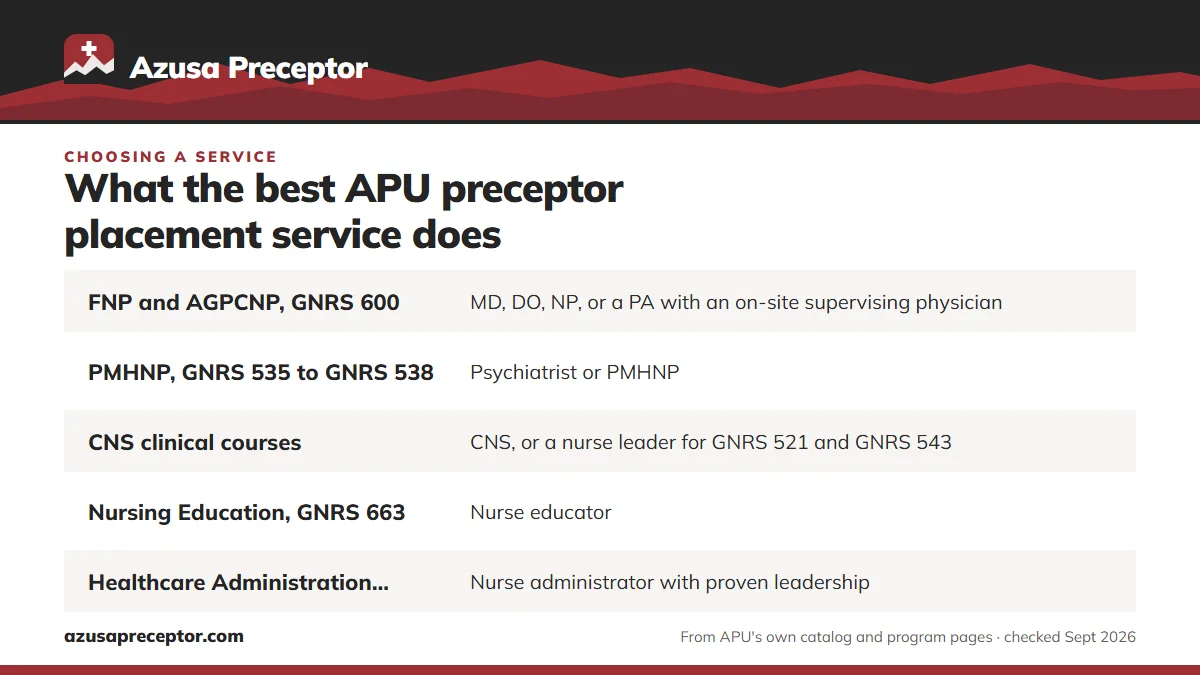
Preceptors matched to your course
APU sets preceptor rules course by course, so a match that suits one track can be wrong for another. A strong service checks every candidate against APU's request forms before you ever hear a name.
| Track | Preceptors APU accepts | Detail worth checking |
|---|---|---|
FNP and AGPCNP, GNRS 600 | MD, DO, NP, or a PA with an on-site supervising physician | At least one semester with an NP; FNP students need 135 pediatric hours |
PMHNP, GNRS 535 to GNRS 538 | Psychiatrist or PMHNP | LMFT or psychologist only in GNRS 535; one semester or more with a PMHNP |
| CNS clinical courses | CNS, or a nurse leader for GNRS 521 and GNRS 543 | Leadership, unit care or nursing education setting |
Nursing Education, GNRS 663 | Nurse educator | License in the state where the practicum takes place |
Healthcare Administration, GNRS 567 | Nurse administrator with proven leadership | Practicum Survey A and B dates |
Family practices can supply FNP pediatric hours when they see at least six pediatric patients a day, and specialty clinics need faculty approval. The preceptor requirements guide has every rule.
Paperwork that reaches APU complete
The Graduate Preceptor Request form asks for details many students end up chasing after the preceptor says yes: the preceptor's credential and email, the clinic's legal name for the affiliation agreement, the credentialed person who signs for the clinic and a contact for the office manager. The best service gathers all of it during the match, so the form is complete the first time.
It also asks the questions that save weeks later. Does the site run its own onboarding, such as MyClinicalExchange? Does it want a drug screen, Live Scan or CB Bridges on top of your CastleBranch or Complio file? Is there already an affiliation agreement, or will APU need to start one? Answers up front let you and APU's placement team plan an honest timeline.
Close to home across Southern California
Every MSN APRN applicant at APU must reside in Southern California, and APU's guidelines encourage sites near home while noting that fit for level and patient population comes first and that 1 to 2 hour commutes each way are common. A service that searches widely across your region can surface closer options than a student working from a short list of personal contacts.
Local knowledge matters too, because health systems take students in different ways. Some want requests from the school months ahead, some route everything through a centralized system, and many practices and community clinics simply need a willing preceptor and an agreement in place. Our Southern California regions hub shows what each area looks like.
Respecting APU's impartiality rules
APU requires an impartial preceptor: no family members or close friends, no placement at the same site as a family member who is also an SON student and no clinical time in the unit where you work. Training at your own employer needs a written division of labor signed by the employer, and clinical time may not be paid. APU treats a hidden close relationship as an ethics violation, with penalties up to course failure.
A careful service screens for these conflicts before proposing anyone and helps you describe an employer-based placement accurately on the request form. The goal is a placement that holds up under review, because a match that breaks APU's rules costs more time than it saves.
Support after the match
The match is the midpoint, not the finish. The best service stays involved until the term's hours are safely logged and the next term is already taking shape.
- A reminder to confirm any APU placement offer within one week, as APU's guidelines require
- Help keeping hours steady across the term, since APU bars front- and back-loading
- A nudge to log hours in Medatrax every week, since missed entries can bring an academic warning
- A replacement search the moment a preceptor withdraws
- Planning for next term's course before the 6 to 8 week notice window opens
- A clear quote that explains what shapes the price before any work begins
Our cost page explains each factor that shapes a quote.
Why APU students choose us
We built our service around APU and nothing else. We match preceptors to APU's course-level rules, gather the legal name, signer, office manager and credential details the request form asks for, and flag agreement status before you invest in a site. We search across Southern California, from the San Gabriel Valley to the Inland Empire and San Diego, and stay on call through every term of your program.
APU's placement team and faculty make the final call on every site, in writing. Our job is to make sure what reaches them is complete, fits APU's rules and gives you the strongest possible chance of an on-time start. Read how it works, then start with the form below.
Questions APU students ask
Can a placement service get my site approved by APU?
Approval belongs to APU. The Graduate Placement Team reviews each placement, the affiliation agreement has to be in place and you report only after written clearance. What a strong service controls is the quality of what APU receives: a preceptor whose credential fits the course, a site with complete legal details and a timeline that respects APU's notice window.
What should a placement service ask me before it starts searching?
Your APU program and campus, the clinical course number and units, the paired lecture course, the city you live in, your session start date, any hours already logged and where your CastleBranch or Complio file stands. Those answers let the service match your course the first time instead of learning your needs after a mismatch.
Who submits the Graduate Preceptor Request form when I use a service?
You do. The form is part of your record with APU and goes to the Graduate Placement Team, which then reaches out to walk through and confirm the placement. A good service supplies each answer the form needs, such as the preceptor's license type and the name of the clinic's authorized signer, so filing it is quick and complete.
Should I keep working with APU's placement staff if I use a service?
Yes. APU's placement staff are part of the shared model for MSN and certificate students, and they review every placement. Keep them informed of your plans, answer any placement offer within the week APU allows and use every route open to you. A service adds search power and preparation alongside APU's own process.
How is a placement service priced?
Pricing differs from service to service. Ours is a quote shaped by your program and course, the specialty you need, where you live and how soon your term starts. Our cost page walks through each factor, and we explain the quote before any search begins so you know exactly what you are getting.
Related pages
Last checked 2026-09-25
We check these pages against APU's own catalog and program pages. Your syllabus, your clinical faculty and APU's student placement coordinators have the final word.
APU says the clinical site and preceptor are yours to find. We make that the easy part.
Tell us your APU program, where you live in Southern California and when your next clinical term starts. We find preceptors who fit the course and prepare what APU and the site need before anything is approved.
- Preceptors matched to the course: primary care for
GNRS 600, pediatrics for the PNP courses, psychiatric care for PMHNP - Credentials, license and site details ready for APU's review and the affiliation agreement
- Close to home, from the San Gabriel Valley and the Inland Empire to San Diego
Start your placement plan
Program, city and term is all we need to begin.