APU BSN clinicals: APU assigns them, you prepare for them
In the pre-licensure BSN programs at Azusa Pacific University (APU), APU assigns your clinical placements, grouping students by facility after its partner sites confirm. BSN students do not search for a preceptor or a site. What you control is readiness, meaning compliance, the five-day onboarding window, transportation and progression, and that is what this guide covers.
Questions about BSN clinicals?
Tell us your program and campus, or where you are headed after the BSN.
On this page
Who places youTraditional BSN sequenceTransfer and LVN routesBefore your first clinicalProgression rulesPlanning your semestersHow we helpQuestionsAPU assigns BSN clinicals
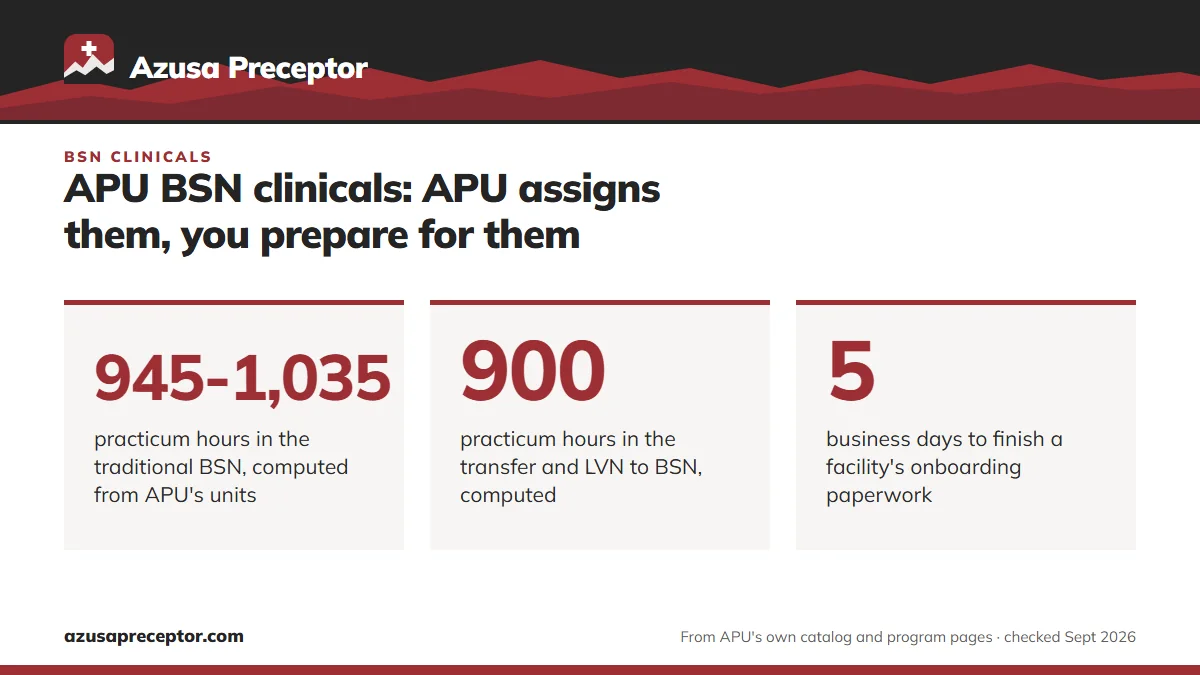
Across the traditional, upper-division transfer and LVN to BSN programs, clinical placement is APU's job. Once partner facilities confirm, program administrators sort students into clinical groups. Next you enroll yourself in a Canvas onboarding course for that facility and get five business days to complete its paperwork.
A few facilities bill a per-student onboarding charge, for example through MyClinicalExchange, and APU's student hub says those invoices go to the School of Nursing rather than to you. Clinicals can fall anywhere in APU's Southern California network, and some undergraduate clinicals require a driver's license, a car and liability insurance.
So the useful question for a BSN student is not where to find a site. It is how to be ready the moment APU assigns one, semester after semester.
The traditional BSN clinical sequence
The traditional BSN is an in-person cohort program at Azusa. Nursing courses run in fall and spring over four to four and a half years, depending on whether you join a spring or a fall cohort. Hours below come from APU's catalog; entries marked computed work out from 45 hours per clinical unit.
| Course | Clinical units | Hours | Setting |
|---|---|---|---|
UNRS 107P Foundations of Professional Nursing | 1 | 45, computed | First clinical course |
UNRS 212P Nursing Care of Adults and the Aging | 3 | 135 | Acute hospital, skilled nursing or transitional care |
UNRS 220 Health Assessment | 1 (lab) | 45 lab hours | Skills lab, not a placement |
UNRS 310P Mental Health Nursing | 2 | 90 | Mental health |
UNRS 314P Nursing Management and Restorative Care of Adults | 3 | 135, computed | Medical-surgical and rehabilitation |
UNRS 382P Community Health Nursing | 2 | 90 | Community |
UNRS 383P International or UNRS 384P Urban/Rural Health Nursing | 2-4 | 90-180, computed | UNRS 383 needs committee selection |
UNRS 402P Maternal, Newborn, and Women's Health | 2 | 90 | Maternity and women's health |
UNRS 404P Nursing Care of Children and Young Adults | 2 | 90 | Acute and community |
UNRS 414P Advanced Nursing Care of Adults | 4 | 180, computed | Critical care, transition to practice |
That totals 945 to 1,035 practicum hours plus the 45-hour lab. Electives add more: UNRS 444 offers an intensive precepted experience in mental health, community, obstetrics or pediatrics, and UNRS 282P Transcultural Health Care carries 1 to 3 clinical units.
Transfer and LVN to BSN routes
The upper-division transfer BSN admits students with at least 48 transferable prerequisite units into a cohort of six consecutive semesters over two years, summers included. It runs at High Desert, the Inland Empire and Monrovia, with starts in fall, spring or summer. Its 72 nursing units carry about 900 practicum hours by APU's unit math, plus the lab. APU's compare page gives 49 prerequisite units and 72 to 74 program units instead. Students on F-1 or J-1 visas are not eligible.
The clinical list mirrors the traditional program with one swap: UNRS 386P Population and Community Health Nursing, about 135 hours, replaces the community and international or urban courses, in community, public health and global health organizations.
The LVN to BSN uses the same coursework and sites. Current LVNs may earn credit through challenge exams or competency testing under CAEL and ACE guidelines, though APU does not publish how many clinical hours can be credited, and seats are space-available. A nondegree LVN to RN 30-unit option also exists; its course list and hours are not in the catalog, so see an advisor.
What to have ready before your first clinical
Accepted traditional BSN students submit the following before UNRS 107, and transfer students submit a similar list after acceptance:
- A physical exam from the past 12 months and proof that you meet APU's technical standards
- A two-step TB test and records for hepatitis B, MMR, varicella and Tdap (transfer students submit MMR and varicella titers)
- A background check
- American Heart Association BLS, with AED for traditional students
- For the traditional BSN, anatomy and chemistry with lab averaging at least B-, with no grade below C
Compliance lives in CastleBranch for the Azusa, Monrovia, Inland Empire and High Desert cohorts, while San Diego prelicensure students use Complio. The Fall 2026 cutoff for full prelicensure compliance was August 1, three weeks before classes began on August 24. See our CastleBranch and Complio guide and the immunization requirements.
Progression rules that protect your clinical seat
In the traditional BSN, all of one semester's coursework is prerequisite to the next, so a single failed course can move you out of your cohort's clinical rotation. The catalog asks for a 3.0 cumulative GPA with no course below C (73%), a 2.7 in the sciences, and a 2.7 in core nursing courses to stay off probation.
APU's sources conflict on the GPA numbers. For admission, the catalog asks for 3.0 and the program page for 3.5. To stay in, the catalog says 3.0 cumulative, while the School of Nursing Additional Requirements page says 2.0 in major classes. Your current handbook and advisor have the final word.
Across the undergraduate nursing courses, one repeat is allowed for a failed course, failing two or more can lead to dismissal, and a clinical course is graded as a unit: fail its theory side and the practicum fails with it, and the reverse.
Planning your semesters around clinicals
Assigned does not mean predictable. Days, shifts and facilities can change each semester, and a new facility can mean a new onboarding packet on a five-business-day clock. Keep immunization records, your BLS card and background check documents together, so each packet takes an evening rather than a week.
Build your work schedule and commute around the possibility of any site in the region. A reliable car and current auto insurance matter more than a perfect schedule, because the placement follows the facility, not your address.
Treat the RNs who precept you in electives such as UNRS 444 as future professional contacts. APU's student site quotes the BRN's definition of a prelicensure preceptor, an RN employed by the facility who meets the state's qualifications and supervises students in a faculty-designed experience, and those nurses become the references and colleagues you will want later.
How we help BSN students and new RNs
Our preceptor search is built for licensed RNs in APU's graduate programs, where APU asks students to find a site and preceptor with its help. For BSN students we focus on the planning side: understanding the clinical sequence, getting compliance documents organized before each deadline, and mapping the road into graduate study before you need it.
Once you hold a license, the picture changes. The RN to BSN serves RNs finishing a bachelor's; the BSN to DNP goes straight to a doctorate with eight months of RN experience expected before year two; the MSN FNP asks for a year of nursing experience and Southern California residence. In each of those, you find the preceptor with APU's help, and that is where we do our best work.
If you hold a bachelor's in another field, APU's ELM-MSN also assigns its prelicensure clinicals before the graduate phase. Ask us anything through the contact page.
Questions APU students ask
Do APU BSN students find their own clinical placements?
No. In the traditional, transfer and LVN to BSN programs, APU assigns clinical placements. After partner facilities confirm, administrators set the clinical groups, and each student completes the facility's onboarding in Canvas within five business days. Your part is keeping compliance current so you are ready the day an assignment arrives.
Can I choose my BSN clinical site at APU?
APU's public pages describe assignment by program administrators and do not describe a student choice process. The clinical electives, such as UNRS 444, offer a choice of focus, and the international option UNRS 383P requires selection by the Global and Community Health Committee. Ask your program office how preferences are collected.
Do APU BSN students pay facility onboarding fees?
APU's student hub says no. When a facility levies a per-student onboarding fee, through MyClinicalExchange or a similar system, APU says the bill goes to the School of Nursing. You still pay for your own compliance tracking subscription and your background check.
How many clinical hours are in APU's BSN?
The traditional BSN works out to 945 to 1,035 practicum hours plus a 45-hour assessment lab, depending on the community elective you take. The transfer and LVN to BSN work out to about 900 hours plus the lab. APU prints some of these hours, and the rest follow from its 45-hours-per-unit rule.
I'm an LVN. Which APU nursing program fits me?
The LVN to BSN uses the transfer BSN's 72-unit coursework at High Desert, the Inland Empire and Monrovia, with credit possible through challenge exams. A nondegree LVN to RN 30-unit option lets you sit for the California RN exam as a nongraduate. Both are space-available, and clinicals in both are school-assigned.
Related pages
Last checked 2026-09-25
We check these pages against APU's own catalog and program pages. Your syllabus, your clinical faculty and APU's student placement coordinators have the final word.
APU says the clinical site and preceptor are yours to find. We make that the easy part.
Tell us your APU program, where you live in Southern California and when your next clinical term starts. We find preceptors who fit the course and prepare what APU and the site need before anything is approved.
- Preceptors matched to the course: primary care for
GNRS 600, pediatrics for the PNP courses, psychiatric care for PMHNP - Credentials, license and site details ready for APU's review and the affiliation agreement
- Close to home, from the San Gabriel Valley and the Inland Empire to San Diego
Start your placement plan
Program, city and term is all we need to begin.